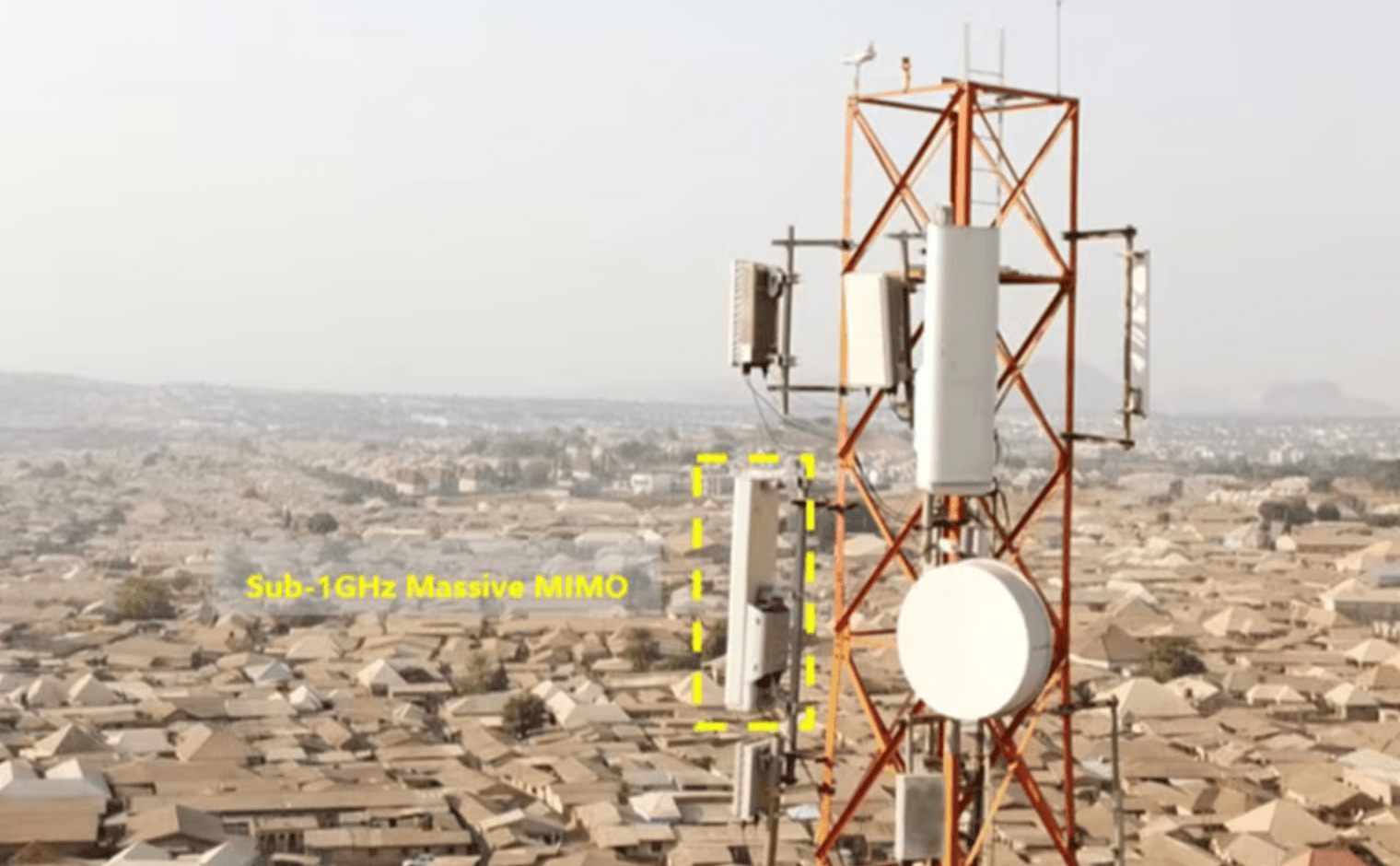
MTN Nigeria and Huawei deployed what they describe as the world’s first commercial sub-1 GHz Massive MIMO site, targeting low-band LTE congestion as more Nigerian users migrate from 2G and 3G to 4G services.
The deployment increased low-band LTE traffic by 104%, improved downlink user-perceived rates by 28%, and reduced physical resource block usage by 8% compared with previous 4T4R equipment. MTN and Huawei said the site builds on earlier C-band and tri-mid-band Massive MIMO deployments, creating what they call the first all-band Massive MIMO site.
Huawei said the sub-1 GHz Massive MIMO system combines large antenna arrays with wideband technology for low-band spectrum, while supporting GSM, UMTS, LTE, NR, and NB-IoT coexistence. The companies said the system doubles downlink LTE capacity versus 4T4R and could support a 3.2x capacity expansion with future NR evolution.
• Deployment: commercial sub-1 GHz Massive MIMO site in Nigeria
• Operators/vendors: MTN Nigeria and Huawei
• Claimed milestone: first commercial sub-1 GHz Massive MIMO site
• LTE traffic gain: +104%
• Downlink user-perceived rate gain: +28%
• PRB usage reduction: -8%
• Capacity claim: 2x downlink LTE capacity versus 4T4R
• Future evolution: up to 3.2x capacity expansion with NR
• Supported technologies: GSM, UMTS, LTE, NR, and NB-IoT
“Our successful collaboration with Huawei on the commercial debut of sub-1 GHz Massive MIMO has significantly boosted network performance. We now deliver faster, more stable connectivity to every user. Moving forward, we will deepen our partnership with Huawei to drive technological innovations, tackle key challenges in network development, and fuel the digital economy in Nigeria,” said Yahaya Ibrahim, CTO of MTN Nigeria.
🌐 Analysis: Low-band spectrum remains central to mobile coverage economics, especially in markets with large rural populations and heavy 4G migration. Applying Massive MIMO below 1 GHz addresses a difficult engineering problem: improving spectral efficiency in bands prized for coverage but constrained by antenna size, fragmented spectrum, and legacy technology coexistence.
For Huawei, the deployment extends Massive MIMO from mid-band and C-band into lower-frequency layers, supporting its broader “all bands to 5G” architecture. For MTN Nigeria, the result could help stretch scarce low-band spectrum as traffic from video, payments, and mobile broadband continues to rise.