Researchers from the University of Illinois Urbana-Champaign have demonstrated high-speed cryogenic optical interconnects based on vertical-cavity surface-emitting lasers (VCSELs), showing that the technology can support data rates of up to 138 Gbps per lane while reducing thermal leakage and power consumption in infrared focal plane arrays (FPAs). The results, published in the IEEE Photonics Technology Letters, address one of the key challenges in next-generation cryogenic imaging systems, where conventional copper interconnects introduce unwanted heat into sensitive detectors.
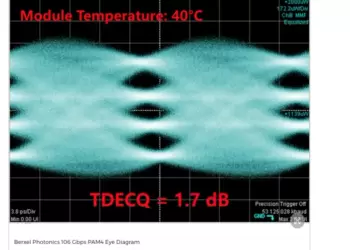
Modern cryogenic FPAs continue to increase in resolution, sensitivity, and imaging speed, driving aggregate data rates beyond 100 Gbps. Traditional electrical interconnects require numerous copper connections that conduct heat into the cryogenic sensor assembly, increasing detector noise and cooling requirements. The research team evaluated VCSEL-based optical links operating at temperatures between 77 Kelvin (-196°C / -321°F) and 120 Kelvin (-153°C / -243°F), demonstrating more than 50 GHz of modulation bandwidth at bias currents below 4 mA. The devices successfully transmitted 112 Gbps PAM-4 signals while extending operation to 138 Gbps per lane, with TDECQ measurements of 3.42 dB at 77 K and 4.15 dB at 120 K, remaining within applicable IEEE short-reach multimode optical communication specifications.
The researchers also estimated energy efficiency of approximately 68 femtojoules per bit at 77 K and 60 femtojoules per bit at 120 K, indicating that cryogenic VCSEL links can simultaneously reduce thermal load and power consumption while supporting the bandwidth demands of advanced infrared imaging systems. The work suggests that optical interconnects could become a practical alternative to copper links for future cryogenic sensors used in defense, scientific instrumentation, astronomy, and other high-performance imaging applications.
• Researchers demonstrated VCSEL optical links operating between 77 K and 120 K.
• Modulation bandwidth exceeded 50 GHz at bias currents below 4 mA.
• Demonstrated 112 Gbps per lane PAM-4 operation.
• Extended transmission reached 138 Gbps per lane.
• Estimated energy efficiency measured approximately 60–68 fJ/bit.
• Optical interconnects reduce thermal leakage compared with conventional copper wiring.
• Technology targets next-generation cryogenic infrared focal plane arrays.
“These results demonstrate that cryo-VCSEL optical links can be a promising and cost-effective solution to meet the high-speed data communication demands of FPAs,” said Liu.
🌐 Analysis: Although the work targets cryogenic infrared focal plane arrays rather than AI networking, it highlights an emerging operating regime for VCSEL technology. VCSELs already dominate short-reach multimode optical links inside data centers, and demonstrating reliable operation at cryogenic temperatures expands their potential into scientific instrumentation, quantum systems, space applications, and advanced defense imaging. The reported energy efficiency—roughly 60–68 fJ/bit—is notable because power dissipation and thermal management remain fundamental constraints in cryogenic electronics.
The research also illustrates the continuing evolution of VCSEL technology beyond conventional room-temperature Ethernet applications. As the industry explores specialized computing platforms—including quantum computing, superconducting electronics, and cryogenic sensing—high-speed optical interconnects capable of operating efficiently at extremely low temperatures could become an important enabling technology.