A panel discussion at last week’s IOWN Acceleration event, hosted by NTT in Japan, focused on how Thin-fiim Lithium Niobate (TFLN) photonics aims to combine the scalability of silicon with the performance of lithium niobate.
IOWN stands for the “Innovative Optical and Wireless Network” and is an initiative led by NTT to pursue a forward-looking vision for a new kind of information infrastructure. One of the central technologies in IOWN is advanced photonics.
Speaking on the panel were:
- Bob Byer, Professor Emeritus of Applied Physics at Stanford University and Distinguished Scientist, Physics & Informatics Laboratories, NTT Research
- Timothy McKenna, Principal Scientist, Physics & Informatics Laboratories at NTT Research
Key topics of discussion included
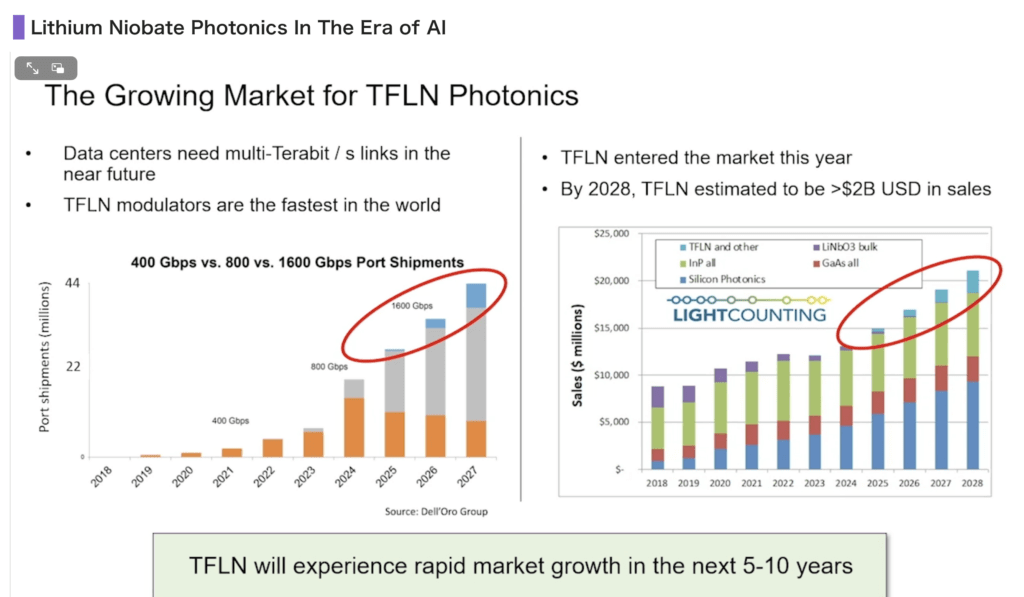
- The growing market for TFNP
- Recent breakthroughs allow the manufacturing of lithium niobate with nanometer precision, previously impossible
- TFLN allows for the creation of new types of photonic integrated circuits (PiCs) Current technologies based on silicon photonics will struggle at link speeds above 1 Tbps
- How AI cluster networks will flatten with optical transceivers embedded in accelerators, forming a mesh network with fewer optical switches
- In 5-10 years, TFLN photonics may dramatically change the compute landscape in another way — All optical compute accelerators that go beyond CMOS
Registration required for watching the presentations: https://forum.rd.ntt/event/7783/?