Lumentum reports record revenue, strength in telecom and lasers
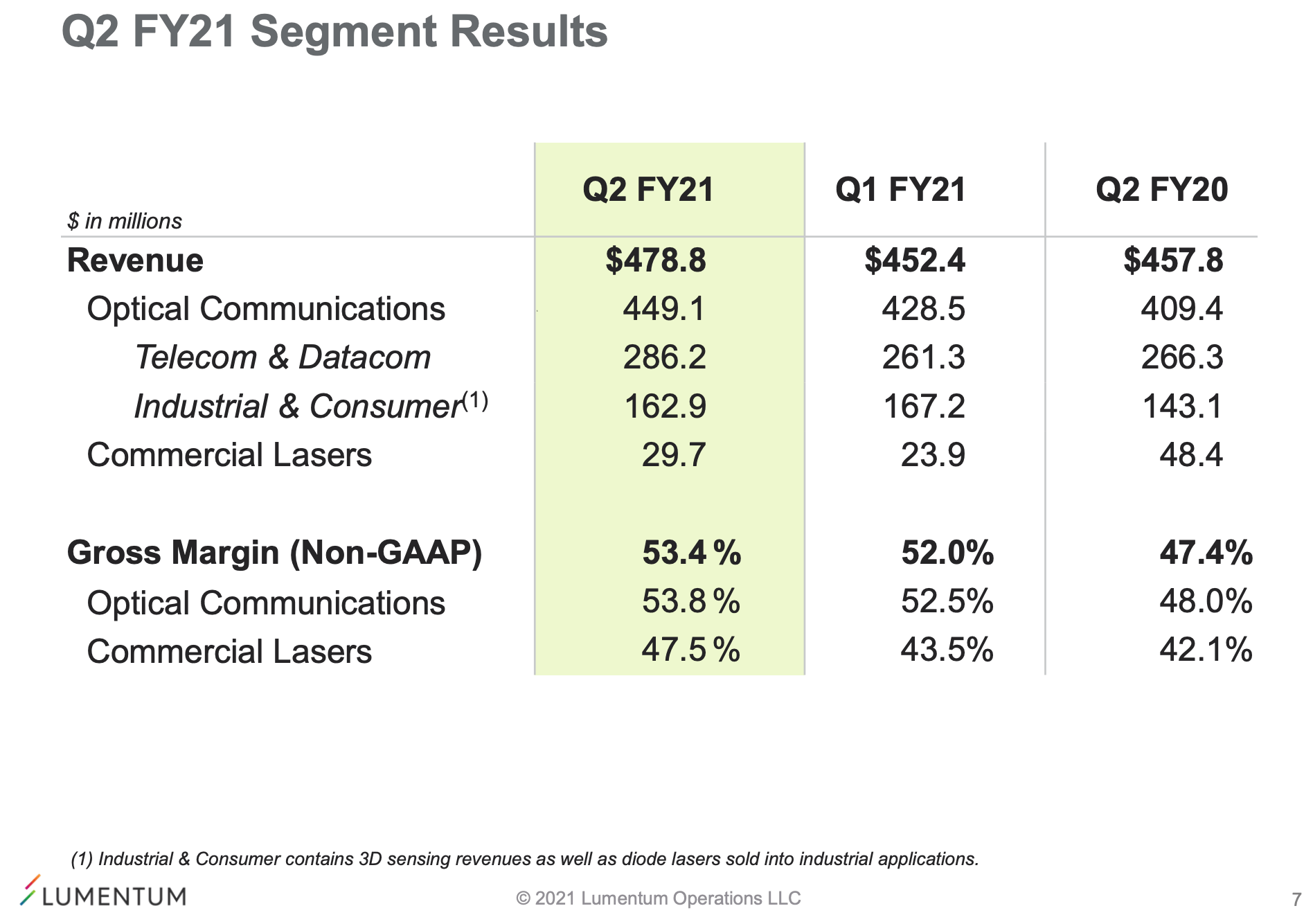
Lumentum Holdings reported net revenue for its fiscal second quarter of 2021 of $478.8 million, with GAAP net income of $83.2 million, or $1.06 per diluted share. Net revenue for the fiscal first quarter of 2021 was $452.4 million, with GAAP net income of $67.1 million, or $0.86 per diluted share. Net revenue for the fiscal second quarter of 2020 was $457.8 million, with GAAP net income of $49.1 million, or $0.63 per diluted share.
“Combining the positive momentum from the prior quarter, with strengthened demand in Telecom and Lasers, we achieved new record revenue and non-GAAP gross margin, operating margin, and earnings per share in the second quarter,” said Alan Lowe, President and CEO. “We are well positioned to grow revenue and earnings into the future. We have developed a broad portfolio of new products that address upcoming growth catalysts, completed our exit of low margin product lines that would have been a headwind to future growth, and lowered our fixed costs to enable stronger operating leverage and profitability as we grow.”
Every article published by Converge Digest is researched, curated, fact-checked and editorially reviewed by Jim Carroll, Editor & Publisher. AI-assisted drafting may be used to accelerate production, but all content is reviewed, refined and approved prior to publication.
You just read about Lumentum. One of the companies whose work it now carries:
Oclaro built Lasers, coherent components and optical modules. What became of it?
Oclaro brought Lasers, coherent components and optical modules to Optical. That work was distinctive enough to lead to its acquisition by Lumentum for US$1.8B. The standalone name now passes into the archive — but the team and technology continue inside Lumentum today. One of 430 names here whose work outlived the company.
You just read about All. A technology from the archive that helped get us here:
Google/Alphabet Project Loon served 2011–2021. What ultimately replaced it?
Google/Alphabet Project Loon solar-powered balloons drifting in the stratosphere (~20 km), steering by rising and falling into different wind layers, relaying LTE from ground stations to phones far below. Its job passed to Unit economics — but the problem it solved, and the ideas it proved, live on in what replaced it. The standard rests here in the archive. One of 198 technologies here that opened a door and then held it for the next.