MACOM introduced two 448G PAM4 modulator drivers aimed at next-generation 1.6T and 3.2T optical transceivers, extending support beyond 400G per lane for AI, ML, and HPC data center interconnects. The new parts — the MAOM-025408 Mach-Zehnder Driver and the MAOM-022404 EML Driver — are among the early devices targeting 400G-per-lane transmission, a key building block for denser optical modules as the industry pushes toward higher-capacity switch and accelerator fabrics.
MACOM said both drivers use its high-volume silicon process technology and support multiple optical platforms, including silicon photonics, electro-absorption modulated laser (EML), and thin-film lithium niobate (TFLN) modulators. The company said the MAOM-025408 delivers more than 120 GHz of RF bandwidth and targets 300G and 400G PAM4 transmission for silicon photonics modulators, while the MAOM-022404 also exceeds 120 GHz of RF bandwidth and is aimed at differential EML and TFLN modulators with an emphasis on low power consumption. Product pages indicate support up to 260 Gbaud for the MAOM-025408 and 400G PAM4 applications for the MAOM-022404.
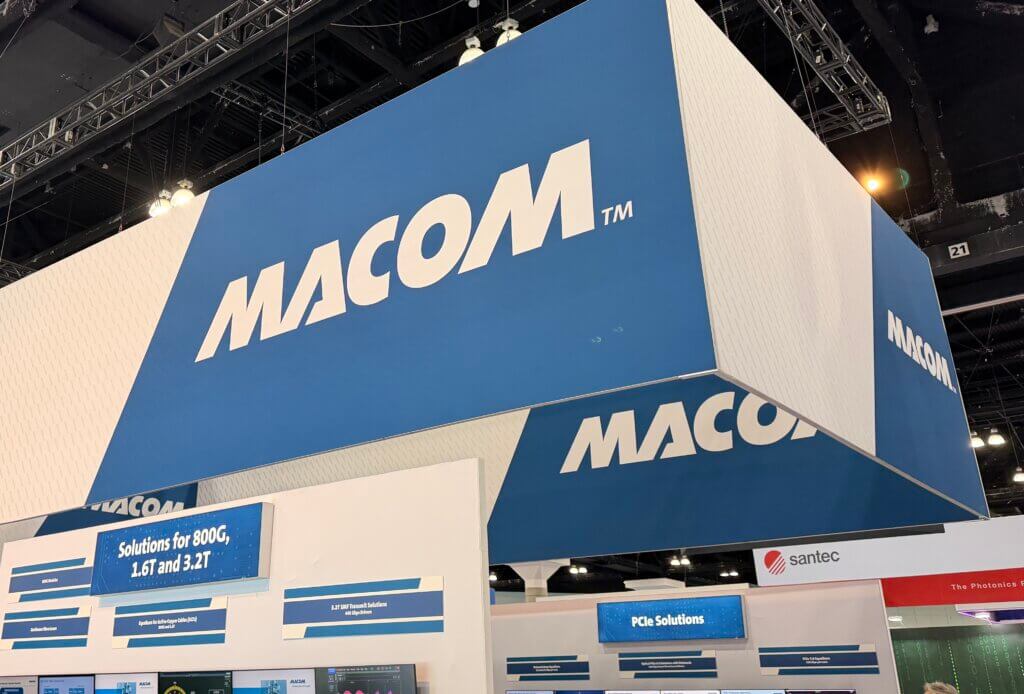
The parts are available as wire-bondable die or bumped die for compact flip-chip packaging, with no external biasing components required. MACOM said that approach can simplify module integration and reduce bill-of-materials cost for transceiver vendors. The company is showing the new drivers at OFC 2026 in Los Angeles, where it is exhibiting at Booth 1227 from March 17-19. MACOM’s broader OFC lineup also includes 3.2T optical transmit solutions built around 400G-per-lane PAM transmission, indicating a broader push into the ecosystem required for next-generation optical links.
- New products: MAOM-025408 Mach-Zehnder Driver and MAOM-022404 EML Driver
- Target applications: 1.6T and 3.2T optical transceivers for AI, ML, and HPC data center networks
- Performance: over 120 GHz RF bandwidth on both devices
- Optical platform support: silicon photonics, EML, and TFLN modulators
- Packaging: wire-bondable die or bumped die for flip-chip designs
- Integration: no external biasing components required
- OFC 2026 location: Booth 1227, Los Angeles, March 17-19, 2026
“We are excited to push the limits with our new 400G per lane driver products. These products can support a wide range of advanced interconnect applications and form factors,” said Stephen G. Daly, President and Chief Executive Officer, MACOM.
🌐 Analysis: MACOM’s announcement aligns with a broader OFC 2026 shift toward 400G-per-lane optical building blocks that can support future 3.2T class modules and denser AI cluster interconnects. The strategic value is not just the raw bandwidth; it is the flexibility to pair the same driver family with silicon photonics, EML, and TFLN approaches as module makers evaluate different optical engine and packaging roadmaps.
🌐 Analysis: Competition in this segment is intensifying as the optical ecosystem works through the transition from 200G-per-lane to 400G-per-lane architectures, while parallel MSA and component announcements at OFC 2026 point to industry-wide work on 1.6T and future 3.2T interconnects. MACOM’s emphasis on die form factors, simplified biasing, and compatibility across modulator technologies suggests it wants to position itself as an enabling analog supplier across several optical module design camps rather than tie itself to a single photonics approach.
🌐 We’re tracking the latest developments in networking silicon. Follow our ongoing coverage at: https://convergedigest.com/category/semiconductors/
🌐 We’re launching the “Data Center Networking for AI” series on NextGenInfra.io and inviting companies building real solutions—silicon, optics, fabrics, switches, software, orchestration—to share their views on video and in our expert report. To get involved, send a note to [email protected] or info@nextgeninfra.