
Marvell is acquiring Polariton Technologies to bring plasmonics-based optical modulation into its portfolio as the industry pushes toward 3.2T interconnects for AI-driven data center networks. Marvell Technology, Inc. said the deal adds high-speed, low-power photonic device technology that extends the performance limits of conventional silicon photonics. Polariton Technologies develops plasmonics-based components designed to enable higher bandwidth density and lower energy per bit in next-generation optical links. Financial terms were not disclosed.
The acquisition targets a growing bottleneck in AI infrastructure: the ability of optical interconnects to scale alongside rapidly increasing model sizes and cluster demands. While the transition to 1.6T optics is underway, hyperscalers and system vendors are already designing for 3.2T and beyond. Plasmonics offers a device-level path forward by enabling ultra-fast modulation in compact footprints, supporting massively parallel optical links with improved power efficiency compared to traditional silicon photonics approaches.
Polariton’s technology is aimed at coherent and data center interconnect (DCI) applications, including ZR and ZR+ pluggable optics. Marvell plans to combine these capabilities with its existing DSP, silicon photonics, and switching portfolio to deliver more tightly integrated optical solutions for scale-across AI architectures and long-haul interconnects. The deal also brings a specialized engineering team with expertise in plasmonics and photonic integrated circuits. Financial terms were not disclosed.
• Adds plasmonics-based modulation to Marvell’s silicon photonics roadmap
• Targets 1.6T to 3.2T optical interconnect scaling for AI and cloud infrastructure
• Focus on coherent optics, DCI, ZR and ZR+ pluggables
• Enables higher bandwidth density with lower energy per bit
• Strengthens Marvell’s integration across DSPs, optics, and switching
• Brings Polariton’s PIC and THz-class modulation expertise
“Marvell continues to invest in advanced optical technologies to support the rapid evolution of AI and cloud data center infrastructure,” said Sandeep Bharathi, President, Data Center Group at Marvell. “The addition of Polariton extends our optical roadmap with differentiated modulation technology and a highly specialized team.”
🌐 Analysis: Marvell’s acquisition reflects a broader shift toward device-level innovation as the industry approaches the physical limits of traditional silicon photonics scaling. Competitors including Broadcom Inc. and NVIDIA are advancing parallel strategies around co-packaged optics, higher-speed DSPs, and tightly integrated interconnect architectures. Plasmonics introduces an alternative path to increase modulation speed and efficiency, which could influence future designs for ultra-high-bandwidth AI clusters as the ecosystem moves beyond 1.6T.
| Profile: Polariton Technologies | |
|---|---|
| Headquarters | Zurich, Switzerland |
| Founded | 2019 (spin-off from ETH Zurich) |
| Founders | Claudia Hoessbacher, Benedikt Baeuerle |
| Technical Origin | Institute for Electromagnetic Fields, ETH Zurich (Prof. Juerg Leuthold) |
| Core Technology | Plasmonics-based silicon photonics enabling sub-wavelength device scaling beyond diffraction limits |
| Modulation Performance | >500 GHz demonstrated; roadmap toward 1 THz |
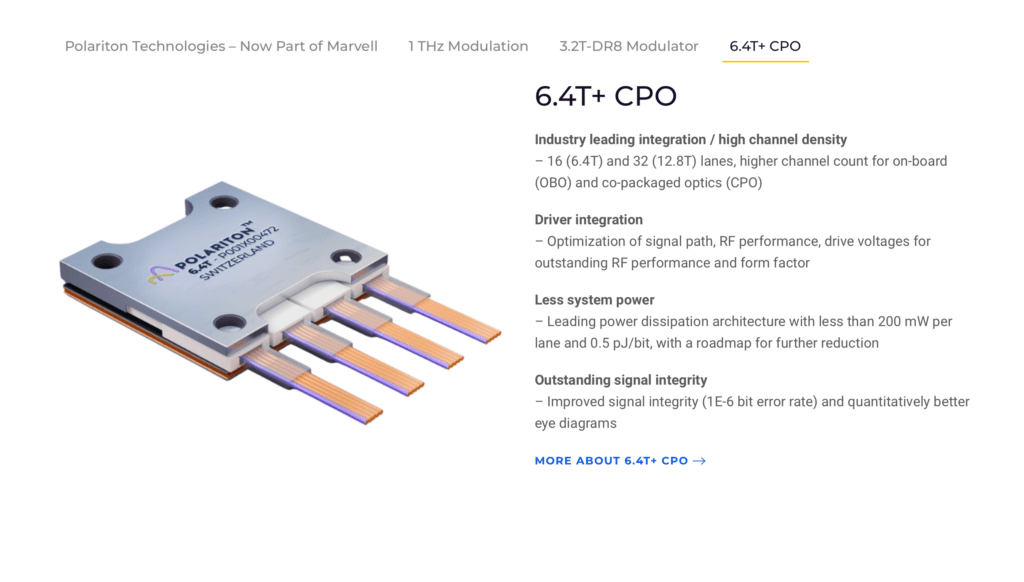
| Power Efficiency | <200 mW per lane; ~0.5 pJ/bit |
| Products | Plasmonic modulators (Mach-Zehnder, Ring Resonator, IQ) |
| Target Applications | 3.2T-DR8, coherent optics, DCI, ZR/ZR+ |
| Design Ecosystem | Process Design Kit (PDK) for PIC integration |
| Operating Bands | O-band (1310 nm), C-band (1550 nm) |
| Key IP | Plasmonic modulators and low-loss device architectures |
| Recent Patents | Integrated optics with poled elements (2024, pending); low-loss plasmonic manufacturing methods (2022, pending) |
| Funding | Early grants (2019); strategic funding (2020); accelerator round (2025) |
| Key Milestones | 2020: Technical validation 2023: First product modules 2025: Collaboration with Lightwave Logic |
| Explainer: Plasmonic Silicon Photonics Compiled based on several resources including ETH Zurich research publications, Polariton Technologies technical materials, and Optica/peer-reviewed photonics literature. | |
|---|---|
| What It Is | A hybrid approach that combines silicon photonics with plasmonic structures at metal-dielectric interfaces to confine and modulate optical signals in nanoscale regions. |
| Core Physics | Excites surface plasmon polaritons (SPPs)—electromagnetic waves coupled to electron oscillations at a metal-dielectric boundary—allowing optical signals to be confined well below the diffraction limit. |
| Why It Matters | Enables sub-wavelength confinement (tens of nanometers), increasing light-matter interaction and allowing much smaller, faster active photonic devices. |
| Standard Silicon Photonics | Provides low-loss optical transport and CMOS compatibility, but modulators typically require longer device lengths and larger footprints. |
| Plasmonic Advantage | Concentrates optical fields into nanoscale regions, enabling compact modulators with low capacitance, reduced drive voltage, and very high-speed potential. |
| How a Plasmonic Modulator Works | Light is funneled into a narrow slot between metal electrodes; strong confinement enables efficient modulation with very small electrical signals over extremely short device lengths. |
| Typical Structure | Hybrid silicon photonics waveguides combined with plasmonic sections, often using metal-insulator-metal geometries. Advanced implementations include plasmonic-organic hybrid (POH) designs using electro-optic polymers. |
| Speed Potential | Intrinsic plasmonic effect supports bandwidths beyond 500 GHz and up to ~1 THz in research devices, reflecting the fundamental electron–photon interaction limits. |
| Commercial Context | Practical implementations today typically operate in the ~110–145 GHz electro-optic bandwidth range due to packaging and system constraints. |
| Power and Density Benefit | Short device lengths reduce capacitance and interconnect overhead, improving bandwidth density and lowering energy per bit. |
| Main Tradeoff | Higher optical loss than dielectric waveguides; mitigated by using silicon photonics for transport and plasmonics only at the modulation site. |
| Marvell Acquisitions & Strategic Moves 2020–2026 | ||||
|---|---|---|---|---|
| Date | Company | Type | Estimated Value | Core Technologies |
| Apr 2026 | Polariton Technologies | Acquisition | Undisclosed | Plasmonics-based silicon photonics; ultra-high-speed modulators for 1.6T/3.2T optical interconnects |
| Feb 2026 | XConn Technologies | Strategic Investment | ~$325M (round participation) | CXL & PCIe switching; memory pooling and scale-up interconnects for AI systems |
| Feb 2026 | Celestial AI | Strategic Investment | ~$3.25B (company valuation/round) | Photonic fabric; optical interconnects for chip-to-chip and rack-scale AI communication |
| May 2022 | Tanzanite Silicon | Strategic / Talent Acquisition | Undisclosed | CXL memory expansion and pooling technologies for composable infrastructure |
| Oct 2021 | Innovium | Acquisition | ~$1.1B | Cloud-optimized Ethernet switching silicon (Teralynx) for hyperscalers |
| Apr 2021 | Inphi Corp. | Acquisition | ~$10B | Electro-optics, PAM4 DSPs, and coherent interconnects (foundation for ZR/ZR+ ecosystem) |
🌐 We’re tracking the latest developments in networking silicon. Follow our ongoing coverage at: https://convergedigest.com/category/semiconductors/