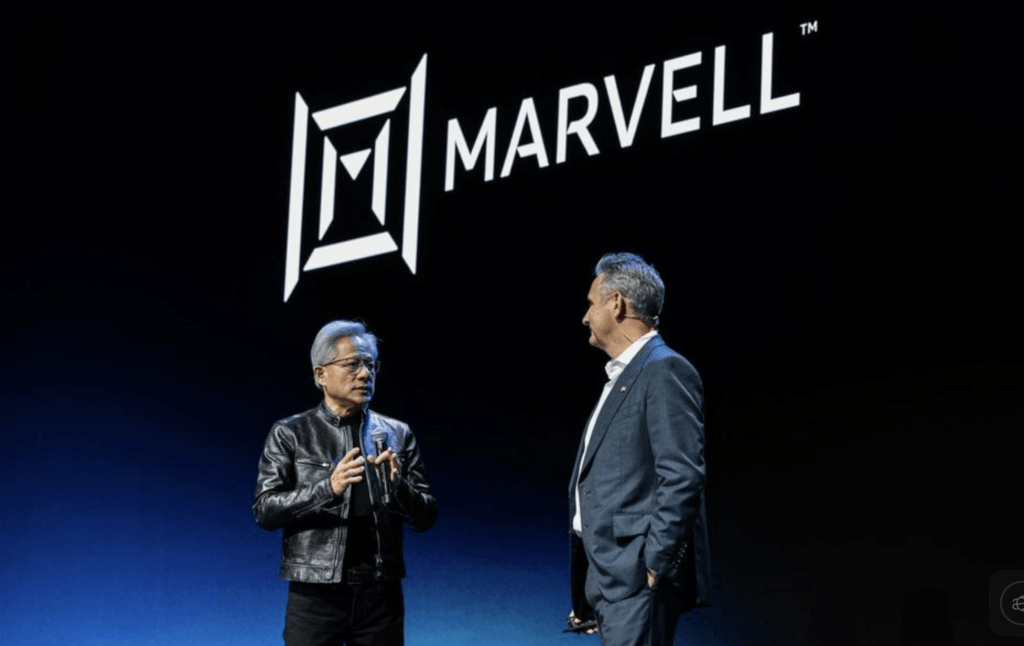
Marvell Chairman and CEO Matt Murphy used his COMPUTEX keynote in Taiwan to argue that the next defining bottleneck in AI infrastructure is no longer compute or memory alone, but connectivity. As AI systems scale from thousands toward millions of processors, Murphy said the architecture, bandwidth, latency, power, and reach of the interconnect fabric will increasingly determine overall system performance.
Murphy framed Marvell’s transformation over the past decade around this thesis. When he joined the company in 2016, data center represented less than 10% of revenue. Since then, Marvell has divested non-core businesses, acquired Cavium, Avera, Aquantia, Inphi, Innovium, Celestial AI, and XConn, and invested heavily in custom silicon, high-speed SerDes, optical DSPs, silicon photonics, switching, advanced packaging, and coherent optics. Murphy said Marvell has invested roughly $36 billion across acquisitions, organic R&D, and portfolio reshaping to build a data infrastructure platform focused on moving, storing, processing, and securing data at massive scale.
The keynote emphasized that AI connectivity spans multiple domains: scale-across links between data centers, scale-out networking inside the data center, scale-up connections inside the rack, and die-to-die links inside advanced packages. Marvell positioned itself as a supplier across each of these layers, from coherent DSPs and PAM4 optical chipsets to Ethernet switching, custom silicon, CPO, electrical SerDes, and advanced packaging.
Key points:
• Murphy said AI infrastructure performance is increasingly defined by connectivity, not just GPUs, XPUs, process nodes, or memory bandwidth.
• Marvell announced a new 100T Ethernet switch for AI data centers, positioning it as a low-power switching platform for next-generation cloud infrastructure.
• The company said it is shipping 800G coherent optics in volume and plans to sample a 1.6T, 2nm coherent optical solution later this year.
• Marvell highlighted its 1.6T PAM4 DSP platform for data center optical connectivity and its role in the transition from 800G to 1.6T links.
• Murphy showed a co-packaged optics switch implementation using Marvell’s 51.2T switch silicon surrounded by 16 optical engines, each supporting 3.2T.
• The company argued that the “copper wall” is moving inside the rack as bandwidth per lane rises from 200G toward 400G, forcing more connections to shift from copper to optics.
• Murphy said copper will remain important where practical, but optics will become increasingly necessary for scale-up, scale-out, and scale-across AI infrastructure.
• NVIDIA CEO Jensen Huang joined Murphy on stage and reinforced the view that agentic AI requires disaggregated, distributed computing, making connectivity foundational to future AI data centers.
• The NVIDIA-Marvell partnership includes collaboration around optics, photonics, custom XPUs, NVLink Fusion-compatible scale-up networking, and NVIDIA’s broader AI factory ecosystem.
• ASE CEO Dr. Tien Wu also joined the keynote, highlighting the importance of Taiwan’s semiconductor manufacturing ecosystem and long-term capacity investment.
Murphy described the coming architecture as a “data center without distance,” where optical connectivity allows compute, memory, networking, and photonics to operate as a unified system. In that model, compute and memory could be pooled, composed dynamically, and optimized around workload requirements rather than fixed server-level ratios. The result would be AI infrastructure designed around the needs of the model, rather than the physical limits of copper interconnects.
🌐 We’re tracking the latest developments in AI infrastructure, optical networking, and data center connectivity. Follow our ongoing coverage at ConvergeDigest.com.