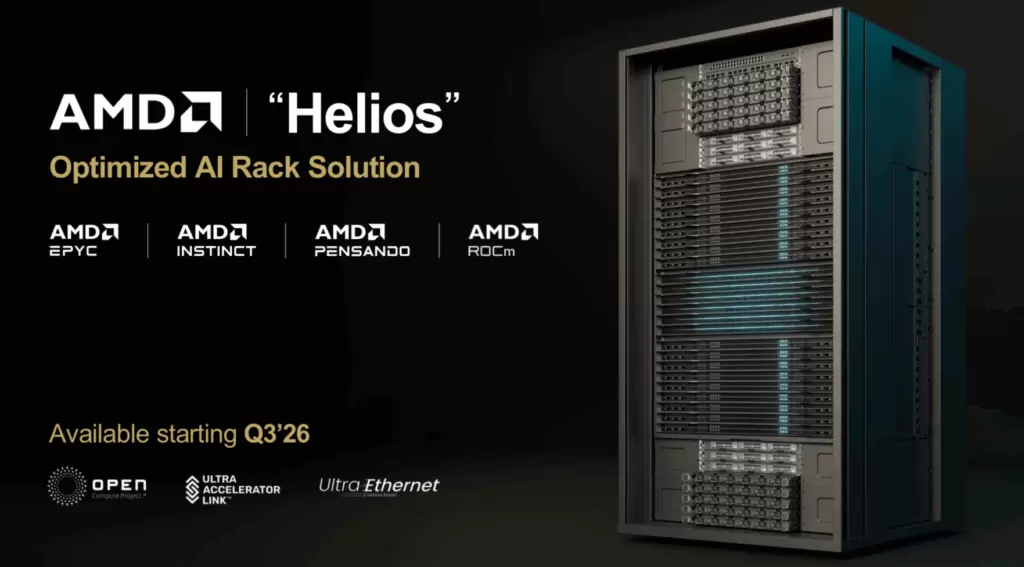
Microsoft will deploy AMD’s next-generation Helios Rackscale Solution across Azure as the companies broaden their long-term partnership spanning AI accelerators, CPUs, networking, and software. The announcement marks one of AMD’s most significant hyperscale AI infrastructure wins to date, with Azure planning to use Helios to support frontier AI model inference for Microsoft, Azure AI services, and enterprise customers. AMD said Helios systems will begin shipping to customers, including Microsoft, in the second half of 2026.
The AMD Helios platform combines Instinct MI455X GPUs, 6th Generation EPYC “Venice” processors, Pensando DPUs, and the ROCm software stack into a rack-scale AI infrastructure designed for large-scale training and inference. Microsoft said Azure customers building frontier AI models will gain access to AMD-powered infrastructure, while enterprise users will be able to deploy production AI workloads through Azure Foundry Managed Compute. Azure is also introducing two new virtual machine families powered by 6th Generation EPYC processors: Azure HDv2 for agentic AI and data pipeline workloads, and Azure HXv2 for semiconductor design applications.
The partnership also expands into cloud networking. Microsoft will broaden its deployment of AMD Pensando DPUs across Azure networking services while integrating AMD silicon with Azure Boost, Microsoft’s infrastructure offload architecture designed to improve networking performance and efficiency at hyperscale. The announcement reflects Microsoft’s continued strategy of offering multiple AI infrastructure options alongside NVIDIA and other silicon suppliers while expanding AMD’s footprint across compute, networking, and cloud software.
• Microsoft will deploy AMD Helios Rackscale Solution for Azure AI inference workloads.
• Helios integrates Instinct MI455X GPUs, EPYC “Venice” CPUs, Pensando DPUs, and ROCm software.
• AMD expects Helios shipments to Microsoft and other customers to begin in the second half of 2026.
• Azure introduces Azure HDv2 VMs for agentic AI and data pipelines.
• Azure introduces Azure HXv2 VMs targeting semiconductor design workloads.
• Microsoft will expand deployment of AMD Pensando DPUs across Azure networking infrastructure.
• AMD technologies will integrate with Azure Boost to improve cloud networking efficiency and connection processing.
“Customers are looking for AI infrastructure that is optimized for a wide range of workloads, from training and inference to data preparation, search, and reinforcement learning,” said Satya Nadella, Chairman and CEO of Microsoft. “Through our collaboration with AMD, we are expanding the Azure infrastructure portfolio with AMD Helios to give customers the performance, scale and choice they need to build and run the next generation of AI applications.”
🌐 Analysis
This announcement illustrates that hyperscalers are increasingly adopting rack-scale AI systems rather than simply purchasing individual GPUs. AMD is positioning Helios as a fully integrated platform that combines compute, networking, and software, mirroring the industry’s move toward complete AI infrastructure architectures. By including Pensando DPUs and ROCm alongside Instinct GPUs and EPYC CPUs, AMD is competing across the entire AI infrastructure stack instead of only the accelerator market.
For Microsoft, the announcement continues its strategy of maintaining multiple AI silicon suppliers while optimizing Azure for diverse workloads. The addition of Venice-powered VM families, expanded Pensando deployment, and Azure Boost integration demonstrates that networking and infrastructure offload have become as important as GPU performance for scaling next-generation AI clusters.