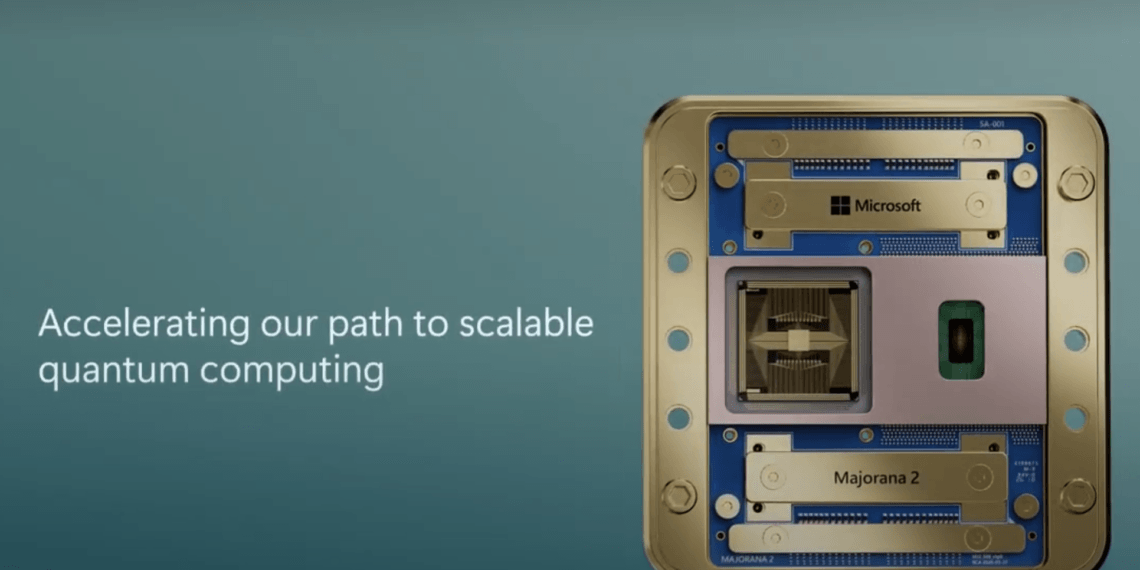
Microsoft introduced Majorana 2, its second-generation topological quantum processor, claiming a 1,000-fold improvement in qubit reliability compared to the company’s first-generation device announced in 2025. The new chip features a redesigned materials stack that replaces aluminum with lead-based superconducting structures, enabling a mean qubit lifetime of 20 seconds, with some qubits maintaining coherence for as long as one minute. Microsoft said the improvements place the company on a path toward a commercially useful, scalable quantum computer by 2029, accelerating its previous roadmap by roughly half.
A key aspect of the announcement is the role of AI in the development process. Microsoft said its quantum engineering teams used autonomous AI agents within the Microsoft Discovery platform to optimize fabrication processes, automate measurements, analyze decades of experimental data, identify hidden defects, and generate new research hypotheses. According to the company, AI-assisted workflows reduced measurement cycles from weeks to dramatically shorter timeframes and helped researchers manage the complex interactions between materials science, device physics, fabrication, and software design.
Microsoft also announced the general availability of Microsoft Discovery, a platform designed to support scientific research and engineering through specialized AI agents. The company said researchers can use the platform to generate hypotheses, optimize experiments, analyze large datasets, and accelerate innovation across industries including semiconductors, materials science, life sciences, energy, and manufacturing. Microsoft additionally introduced a preview version of the Microsoft Discovery application that can run locally with a GitHub Copilot account.
• Majorana 2 delivers a reported 1,000x increase in qubit reliability versus Majorana 1.
• Mean qubit lifetime reaches 20 seconds, with some devices operating for up to one minute.
• Quantum operations execute in approximately one microsecond.
• Individual qubits measure roughly 1/100th of a millimeter.
• Microsoft now targets a scalable quantum computer by 2029.
• The new design uses lead-based topological superconductors instead of aluminum.
• Microsoft Discovery is now generally available for enterprise scientific research.
• A local Microsoft Discovery application is available in preview for individual researchers.
“We need to make improvements each year that will get us closer to delivering a computer that we believe will have massive commercial and societal value,” said Chetan Nayak, Microsoft Technical Fellow. “Where are we relative to last year? We’re 1,000 times better.”
🌐 Analysis: Majorana 2 represents Microsoft’s strongest indication yet that its topological quantum computing approach is progressing beyond proof-of-concept research toward a viable engineering roadmap. The reported jump in qubit lifetime addresses one of the central challenges in quantum computing: maintaining stable quantum states long enough to perform meaningful computations.
| Microsoft Quantum — Technology Profile (Updated June 2026) | |
|---|---|
| Organization | Microsoft Quantum |
| Latest Chip | Majorana 2 (Released June 2026) |
| Quantum Architecture | Topological quantum computing based on Majorana zero modes |
| Key Differentiator | Topological qubits designed for intrinsic error resistance, small physical footprint (1/100th of a mm), and long coherence times |
| Reliability Improvement | 1,000x improvement in qubit reliability versus prior-generation hardware |
| Mean Qubit Lifetime | 20 seconds |
| Peak Qubit Lifetime | Up to 1 minute in specific instances |
| Qubit Operation Speed | ~1 microsecond operations |
| Materials Advancement | Lead-based (Pb) superconducting stack replaces earlier aluminum design to act as a radiation/disturbance shield |
| AI Platform | Microsoft Discovery (An agentic AI platform for Frontier R&D, now generally available) |
| Quantum Goal | Scalable, commercially valuable quantum computer by 2029 (Timeline cut in half) |
| Potential Applications | Global health/drug discovery, food supply, sustainability, energy production, and industrial optimization |