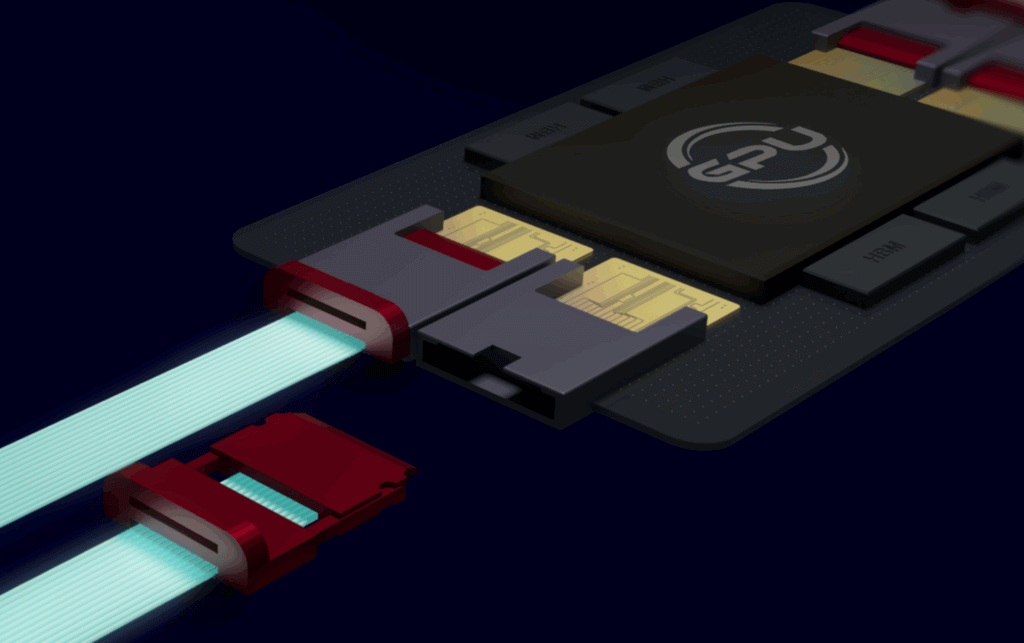
Molex completed its acquisition of Israel-based Teramount Ltd., adding detachable fiber-to-chip optical connectivity technology to its portfolio for AI data center interconnects. Teramount develops passive alignment and coupling solutions designed for co-packaged optics (CPO) and silicon photonics systems, with an emphasis on manufacturability at hyperscale volumes. The technology addresses a growing challenge in optical assembly as AI clusters demand denser and lower-power interconnect architectures beyond conventional pluggable optics.
The acquisition expands Molex’s capabilities in optical networking systems for large-scale AI infrastructure, where GPU clusters increasingly require higher bandwidth, lower latency, and improved power efficiency. Teramount’s TeraVERSE platform provides a field-serviceable interface between optical fiber and silicon photonics chips using passive detachable coupling methods that support semiconductor-grade wafer-level manufacturing processes. The approach aims to simplify optical assembly by increasing tolerance margins while reducing cooling and energy demands in next-generation AI systems.
Molex said it plans to integrate Teramount’s technology into its existing optical interconnect portfolio and global manufacturing operations to accelerate commercialization of co-packaged optics architectures. Industry interest in CPO continues to increase as hyperscalers and AI infrastructure providers seek alternatives to traditional front-panel pluggable optics that are approaching practical power density and bandwidth limitations. The combined portfolio positions Molex to support deployments ranging from prototype systems to volume production environments for AI training and inference fabrics.
- Molex completed the acquisition of Teramount Ltd., an Israeli developer of detachable fiber-to-chip optical connectivity technology.
- Teramount specializes in passive alignment solutions for co-packaged optics and silicon photonics applications.
- The TeraVERSE platform supports semiconductor-grade wafer-level manufacturing processes.
- Molex said the technology improves assembly tolerances and field serviceability for optical stacks.
- The acquisition targets power-efficient optical interconnects for hyperscale AI data centers and GPU clusters.
- Molex plans to integrate the technology into its broader optical interconnect and manufacturing portfolio.
“Teramount’s passive, detachable coupling approach supports large assembly tolerances and semiconductor-grade wafer-level processes—filling a critical gap in the optical stack,” said Aldo Lopez, president of Datacom Solutions at Molex. “By integrating this unique technology into our optical interconnect portfolio, Molex offers a more seamless path from early-stage prototypes to high-volume CPO and other silicon photonics architectures required for the AI era.”
🌐 Analysis: The acquisition reflects accelerating industry investment in co-packaged optics as AI infrastructure scales beyond the practical thermal and power constraints of pluggable optical modules. Hyperscalers and silicon vendors increasingly view optical I/O and fiber-to-chip integration as essential for sustaining bandwidth growth in GPU clusters tied to Ethernet, Ultra Accelerator Link (UALink), NVLink, and custom AI fabrics. The ability to support wafer-level manufacturing processes also aligns with broader industry efforts to move optical assembly closer to semiconductor-style production economics.
| Profile: Teramount | |
| Company | Teramount Ltd. |
| Headquarters | Israel |
| Technology Focus | Detachable fiber-to-chip optical connectivity for silicon photonics and co-packaged optics |
| Core Platform | TeraVERSE passive optical coupling platform |
| Primary Applications | Co-packaged optics (CPO), silicon photonics, AI data center interconnects, hyperscale networking |
| Key Differentiator | Passive detachable coupling supporting large assembly tolerances and wafer-level manufacturing processes |
| Manufacturing Advantage | Enables semiconductor-style high-volume production techniques for optical interconnect assembly |
| Target Market | Hyperscale AI infrastructure and next-generation GPU clusters |
| Industry Relevance | Addresses density, power, cooling, and serviceability challenges in future optical AI fabrics |
| Acquired By | Molex (2026) |