AI is reshaping network architecture at a pace not seen since the rise of the internet, and at MWC 2026 in Barcelona, Justin Hotard, CEO of Nokia, said operators must now design networks around intelligence as the dominant workload. He argued that every generation of infrastructure—from mobile voice to broadband data to streaming video—evolved in response to the prevailing traffic profile. AI, he said, introduces a structurally different pattern that will require a redesign across access, transport, core, and edge domains.
Hotard cited 1.3 trillion annual AI sessions, more than 100 trillion tokens processed daily, and 77 exabytes of AI-related traffic per month, with more than half already carried over mobile networks. Most sessions today involve human-machine interactions such as chatbots and early agentic systems, but he said machine-to-machine engagement will drive the next surge in token exchange and network load. Unlike video traffic, which scales predictably and primarily stresses downlink capacity, AI workloads generate bursty, highly variable, bidirectional flows that demand dynamic orchestration. Static SLAs and pre-allocated network slices, he said, cannot efficiently guarantee deterministic performance for drones, robots, autonomous vehicles, or first responders relying on real-time inference.
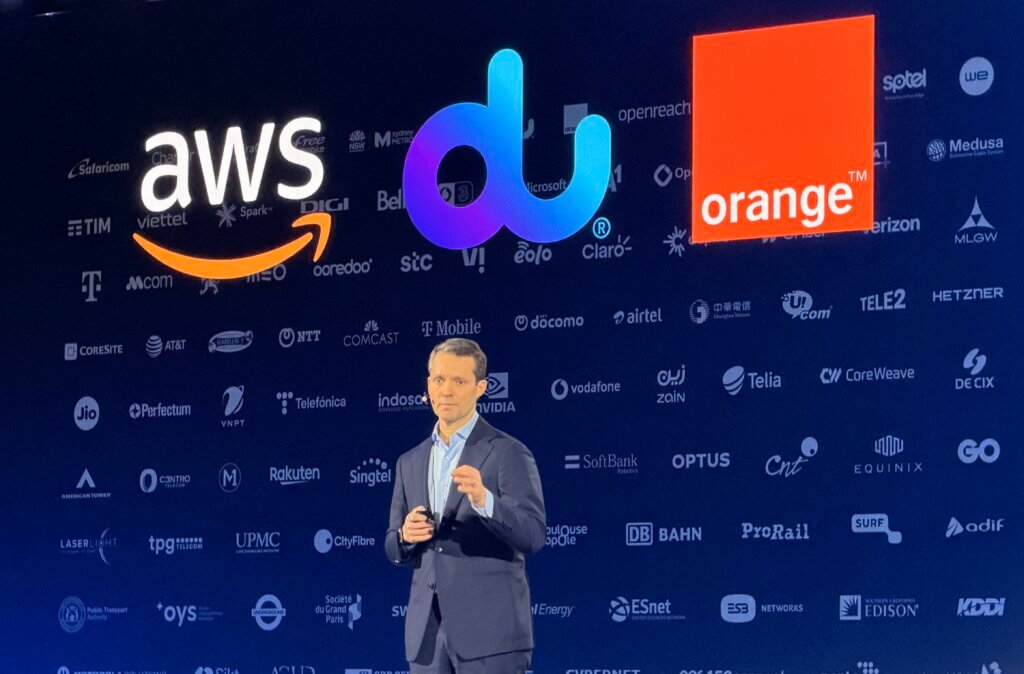
Hotard outlined Nokia’s push toward AI-native networks that tightly integrate compute, connectivity, and control. He called for flattening siloed architectures that historically separated RAN, transport, core, and cloud, and advocated distributed inference capabilities extending to central offices and even the RAN. He also stressed programmable, “glass box” transparency to ensure security, trust, and auditable performance as AI agents exchange tokens across domains. Nokia highlighted recent work with AWS and du on agentic AI slicing, expanded distributed edge infrastructure with Telefónica in Spain, and ongoing AI-RAN collaboration with NVIDIA. Operators participating in AI-native RAN proof-of-concept initiatives include NTT DOCOMO, Vodafone, Elisa, and BT.
• AI generates 1.3 trillion annual sessions, 100+ trillion tokens per day, and 77 exabytes of monthly traffic
• More than 50% of AI traffic already runs on mobile networks
• Machine-to-machine AI expected to sharply increase traffic variability and token exchange
• AI traffic characterized by bursty, bidirectional, latency-sensitive flows
• Static SLAs and fixed slicing insufficient for deterministic AI workloads
• Nokia advocates AI-native integration of compute, control, and connectivity across domains
• Distributed inference at edge, central office, and RAN identified as critical
• Partnerships include AWS, du, Telefónica, NVIDIA, NTT DOCOMO, Vodafone, Elisa, and BT
“We were very successful in building networks that connected people and connected information,” Hotard said. “Now we are innovating on networks that connect intelligence.”