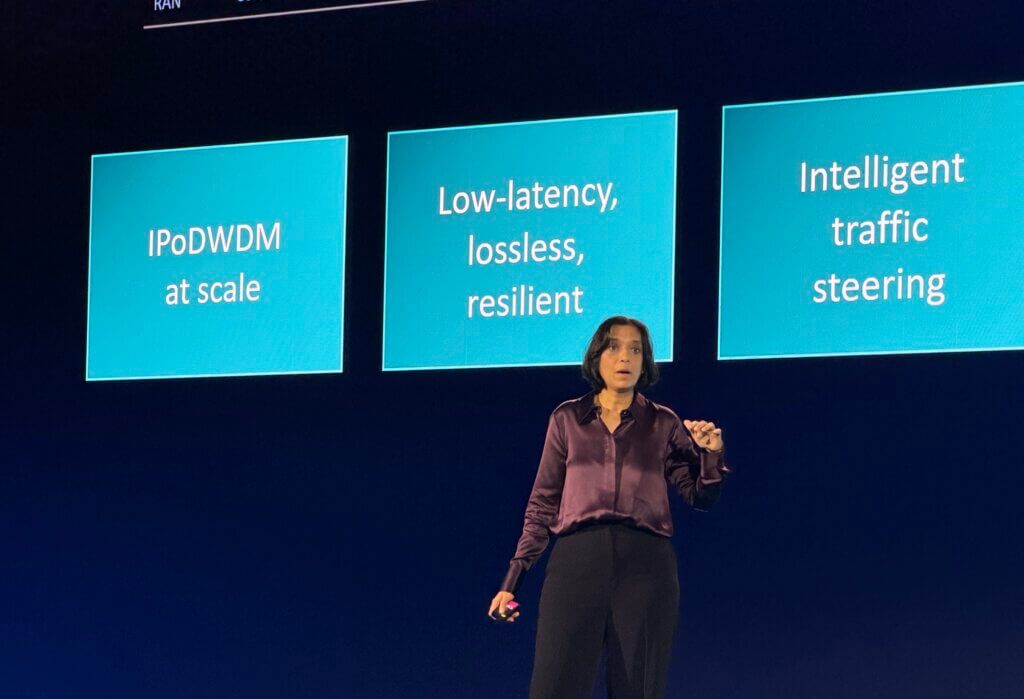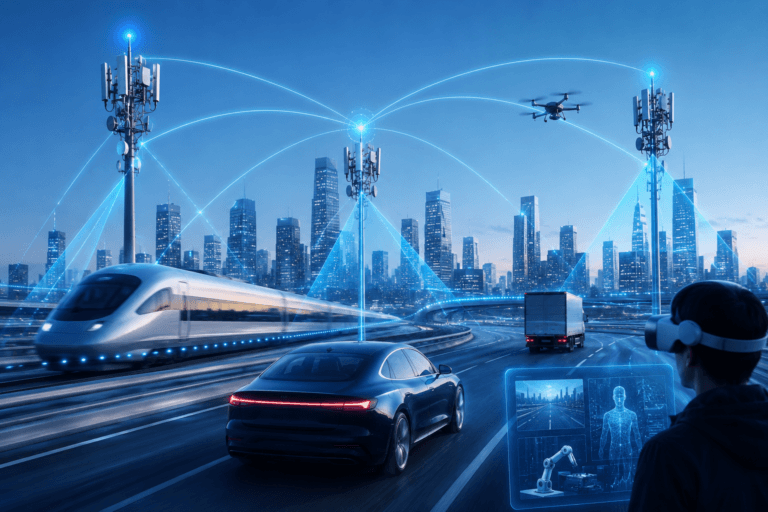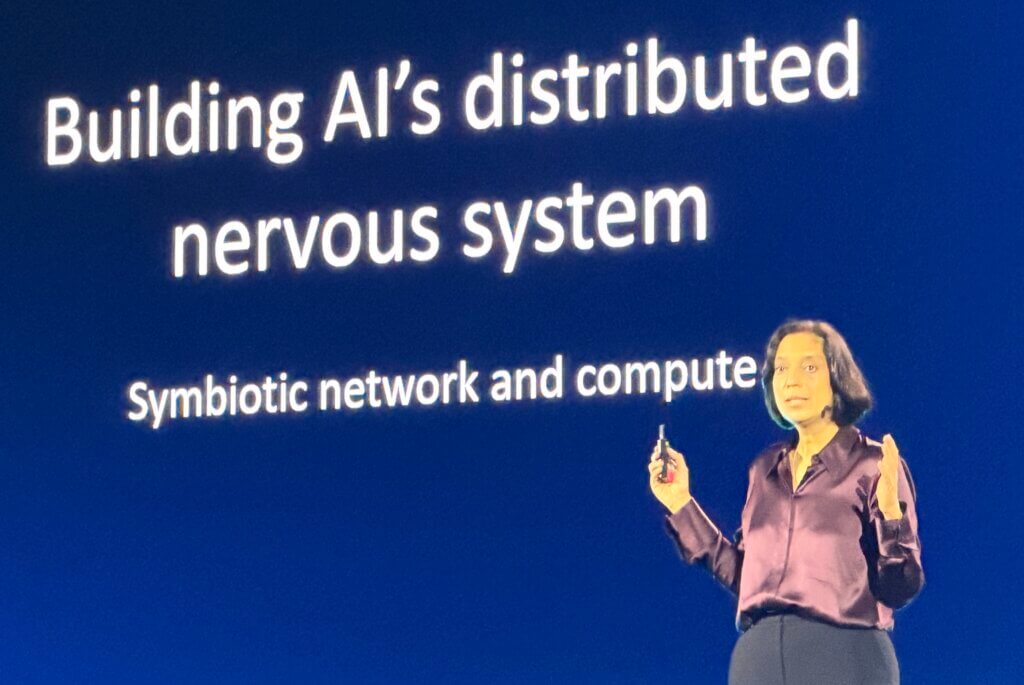
On the eve of MWC 2026 in Barcelona, Nokia’s Chief Technology & AI Officer Pallavi Mahajan recast the telecom network as the backbone of distributed AI—where deterministic latency, coordinated inferencing, and high-capacity optical interconnect determine whether physical AI systems succeed or fail. Framing her keynote around a robot operating in a dynamic environment, she argued that future networks must tightly orchestrate radio, edge compute, core, IP routing, data center switching, and coherent optics as a single execution fabric rather than a collection of independent domains.
Mahajan’s central theme focused on distributed inferencing. In her example, a robot performs local vision processing while offloading a stabilization model requiring one millisecond latency to nearby edge compute. Fleet-level coordination runs in the central office, while large-scale AI training and model updates execute in geographically distributed AI factories. This chain—wireless access and slicing, core control, IP transport, data center fabrics, and optical DCI—must deliver deterministic end-to-end latency and reliability. The metric shifts from peak throughput to guaranteed performance across domains, with automated workload movement between edge and cloud when latency thresholds degrade.
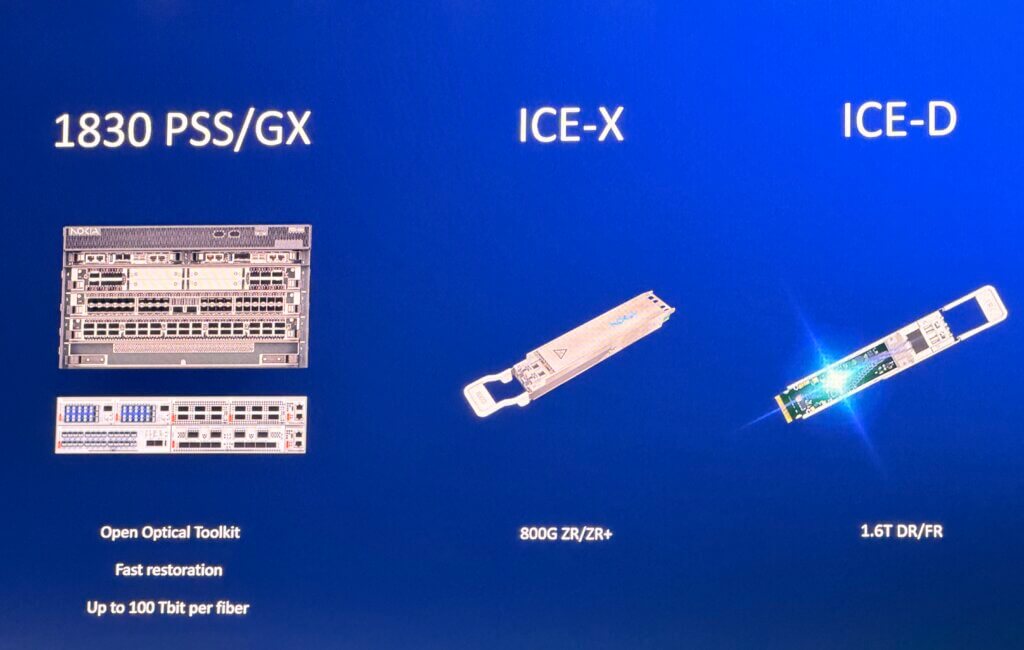
Nokia’s differentiation strategy combines AI-native software architecture with vertically integrated optical innovation. Mahajan emphasized the deliberate decision to use the same AI data center silicon found in hyperscale environments within telco infrastructure, enabling hardware-software decoupling and faster AI model iteration. At the same time, she highlighted Nokia’s end-to-end optical control—from in-house DSPs and photonic integration to coherent pluggables delivering 1.2 Tbps per interface for long-haul DCI. Optical becomes foundational to scaling distributed AI, supporting ultra-low latency, high-capacity interconnect between GPU clusters and across regional AI factories. Commercial AI-RAN trials are planned for 2026, with initial release targeted for 2027.
• AI-native RAN architecture
– AI models embedded into beamforming, channel estimation, and uplink optimization
– GPU-accelerated compute integrated directly into telco workloads
– Hardware-software decoupling to accelerate AI model deployment
– Commercial trial in 2026; release targeted for 2027
• Doksuri next-generation radios
– 30% improvement in power efficiency
– Smaller, lighter form factor
– Designed for uplink-heavy AI and edge workloads
• AI-native core
– Embedded AI across policy control, traffic steering, admission control, and slicing
– Intent-based automation integrated directly into core functions
– Reduced operational complexity and lower total cost of ownership
• IP routing and DCI
– 800G coherent transport for data center interconnect
– Segment routing and deterministic performance at scale
– 7750 and 7220 platforms running SR Linux
– FP5 routing silicon for edge security and deterministic throughput
• Data center switching
– Ethernet-based AI fabrics for cluster scale-out
– Real-time congestion control and load balancing
– Support for SR Linux and SONiC ecosystems
– Event-driven automation interfacing with Kubernetes schedulers
• Optical networking differentiation
– 1.2 Tbps coherent optical interfaces for long-haul and DCI
– Vertical integration from DSP to optics packaging
– Ice chipset portfolio for high-density, low-latency intra-DC connectivity
– Focus on power efficiency and secure supply chain integration
• Cross-domain coordination fabric
– Cloud-native domain controllers with common data foundation
– Autonomous workload shifting between cloud and edge to preserve latency targets
– Human-defined intent with bounded, auditable automation
Mahajan concluded: “The network for us is no longer static connectivity. It is a distributed nervous system for connecting intelligence.”