NTT is repositioning itself from a traditional telecom incumbent into one of the world’s largest AI infrastructure and photonics platforms, using its enormous R&D organization, national fiber footprint, global data center assets, and AIOWN architecture to pursue a central role in the next era of distributed AI computing. The company’s latest financial results and strategic roadmap suggest a more aggressive infrastructure posture than in prior years, especially around photonics, AI-native networking, edge compute, and hyperscale data centers. Rather than simply defending legacy telecom cash flows, NTT is now framing its future around AI infrastructure orchestration spanning GPUs, optical transport, software, edge systems, and photonic-electronic semiconductor technologies.
For the fiscal year ended March 31, 2026, NTT reported operating revenue of ¥14.409 trillion, up 5.1%, operating profit of ¥1.706 trillion, up 3.4%, and profit attributable to NTT of ¥1.037 trillion, up 3.7%. The company forecasts FY2026 revenue of ¥15.060 trillion and operating profit of ¥1.710 trillion. More importantly, NTT revised its medium-term roadmap, delaying its ¥4 trillion EBITDA objective from FY2027 to FY2030 while simultaneously expanding strategic investments in AI, photonics, data centers, software platforms, and quantum technologies. The revised plan reflects both the scale of the transition underway and the challenges of transforming a giant telecommunications operator into an AI infrastructure company.
A major shift is occurring inside NTT’s Global Solutions business, which increasingly resembles a hyperscale infrastructure and enterprise AI platform provider. Operating revenue in the segment rose 7.9% to ¥5.005 trillion while operating profit jumped 50.7% to ¥488.2 billion. NTT says global demand for AI, cloud, security and data center services accelerated growth, especially overseas. The company now claims approximately 2,000 MW of installed data center power capacity across the broader NTT Group, making it one of the world’s largest operators by capacity. NTT plans to expand beyond 2,700 MW and target 3,000 MW by FY2030. The company also continues to reshape its financial structure around these infrastructure assets, including the listing of NTT DC REIT in Singapore to recycle capital and fund further expansion.
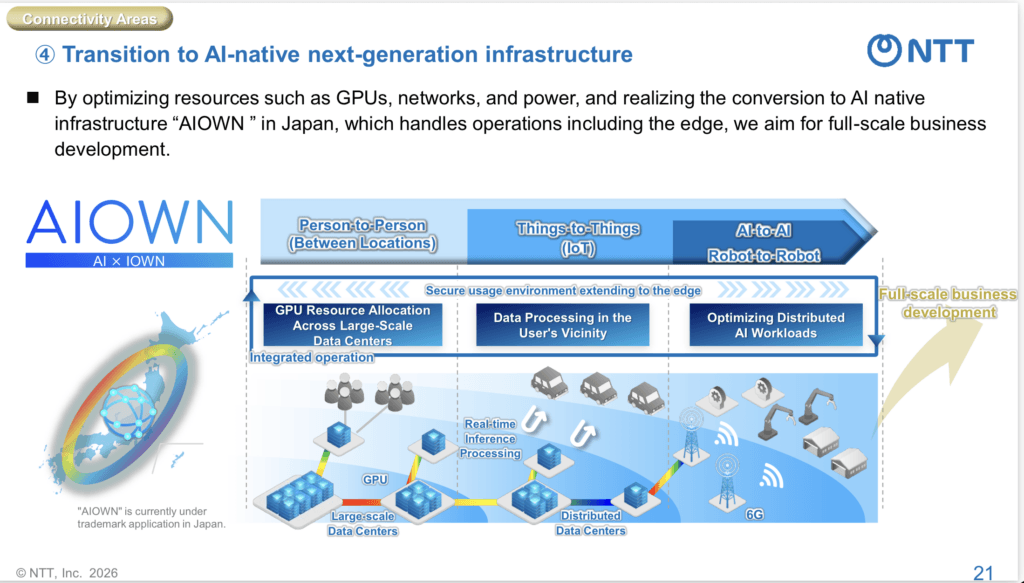
The centerpiece of the strategy is AIOWN, which NTT now describes as AI-native next-generation infrastructure optimized around GPUs, distributed AI workloads, optical networking, edge processing and power efficiency. Unlike earlier IOWN messaging that often appeared abstract or experimental, the latest presentation ties the architecture directly to operational AI systems. NTT describes integrated resource allocation across large-scale and distributed data centers, real-time inference processing near users, secure edge environments, and AI-to-AI communications across a nationwide optical fabric. The architecture increasingly resembles a sovereign Japanese AI infrastructure layer capable of supporting hyperscalers, enterprises, robotics systems, industrial IoT and future 6G workloads.
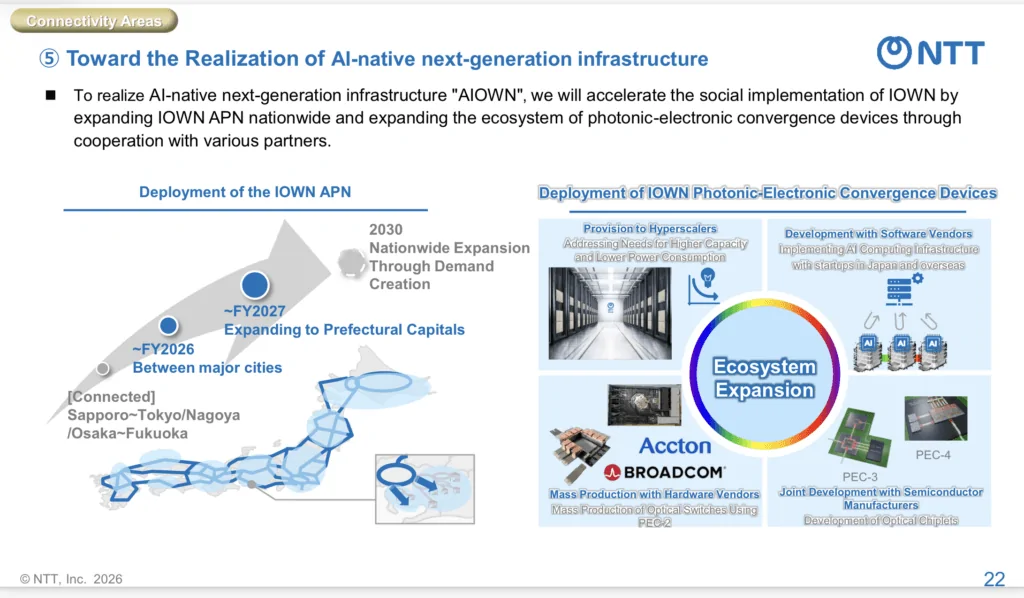
Fiber infrastructure remains foundational to the strategy. NTT plans to expand the IOWN All-Photonics Network across Japan in phases: existing links already connect Sapporo, Tokyo, Nagoya, Osaka and Fukuoka; deployment reaches major cities by FY2026, prefectural capitals by FY2027, and nationwide expansion by 2030. At the same time, NTT EAST and NTT WEST continue shifting Japan’s access infrastructure away from aging copper subscriber systems toward optical and wireless alternatives. The company acknowledged that maintaining legacy metal-based telephone systems beyond roughly 2035 will become increasingly difficult because of declining usage and aging facilities.
NTT also appears increasingly serious about commercializing photonic-electronic convergence devices. The roadmap includes PEC-2 optical switch systems, PEC-3 direct optical interconnect technology between CPUs and GPUs, and PEC-4 optical chiplets. NTT says it has established production and ecosystem partnerships with Broadcom and Accton for optical switching systems using PEC-2 technology. Meanwhile, the company’s research teams are developing PEC-3 devices designed to optically interconnect semiconductor packages across multiple racks for large-scale GPU clusters, with commercial samples targeted for 2028. These efforts place NTT much closer to the emerging AI interconnect ecosystem than traditional telecom operators.
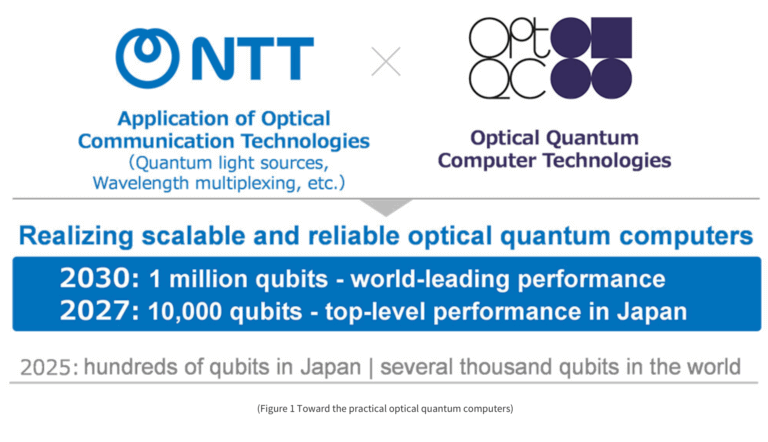
The broader R&D agenda extends well beyond networking. NTT is investing in optical quantum computing, autonomous mobility platforms, satellite optical communications, hydrogen infrastructure, and AI software systems. The company says it aims for optical quantum systems scaling toward 10,000 qubits by 2027 and one million qubits by 2030 through partnerships with OptQC and related initiatives. NTT also established NTT Mobility to support Level 4 autonomous driving systems and continues development with Toyota on a Mobility AI Platform.
• FY2025 operating revenue: ¥14.409 trillion, up 5.1%
• FY2025 operating profit: ¥1.706 trillion, up 3.4%
• FY2025 EBITDA: ¥3.423 trillion
• FY2030 EBITDA target: ¥4 trillion
• Data center capacity: approximately 2,000 MW today
• Data center target: 3,000 MW by FY2030
• IOWN APN rollout: major cities by FY2026, prefectural capitals by FY2027, nationwide by 2030
• Copper network migration: transition toward optical and mobile alternatives around 2035
• Enterprise fiber service: FLET’S Hikari Cross Biz delivers approximately 10 Gbps
• PEC roadmap: PEC-2 optical switching, PEC-3 optical package interconnects, PEC-4 optical chiplets
• Quantum computing target: 10,000 qubits by 2027 and one million qubits by 2030
“We aim to achieve EBITDA of ¥4 trillion by FY2030 by accelerating growth in the Value-added Areas and transforming the Connectivity Areas into an AI-native infrastructure.”
🌐 Analysis: NTT’s latest strategy feels materially different from earlier IOWN eras that often emphasized futuristic architecture without a sufficiently visible commercialization engine. The company now appears to be connecting its research assets directly to hyperscale AI infrastructure demand, especially around photonic switching, GPU interconnects, nationwide optical transport, distributed AI inference and large-scale data center operations. In many respects, NTT is attempting to become Japan’s vertically integrated AI infrastructure champion, spanning fiber, compute, software, semiconductors, edge systems and power-efficient photonics.
🌐 Analysis: The competitive challenge remains substantial. NVIDIA, Broadcom, Cisco, Arista, AWS, Microsoft and emerging AI cloud operators continue moving rapidly in AI fabrics, optical networking and distributed inference systems. Yet few companies possess NTT’s combination of telecom scale, global data center reach, optical research depth, and domestic fiber infrastructure. The next several years will determine whether AIOWN evolves into a globally relevant AI infrastructure architecture or remains primarily a Japan-centered strategic framework.
Profile: NTT AIOWN and Next-Generation Infrastructure
| Area | Significant facts |
|---|---|
| Global scale | NTT operates one of the world’s largest telecom and digital infrastructure groups, spanning fiber, mobile, IT services, AI, cloud and data centers. |
| FY2025 results | Revenue of ¥14.409 trillion; operating profit of ¥1.706 trillion; EBITDA of ¥3.423 trillion. |
| Medium-term target | Revised EBITDA target of ¥4 trillion by FY2030. |
| AIOWN architecture | AI-native infrastructure integrating GPUs, optical networking, distributed AI workloads, edge compute and 6G-era systems. |
| IOWN APN rollout | Expansion from major Japanese metro corridors to nationwide deployment by 2030. |
| Photonic roadmap | PEC-2 optical switches, PEC-3 GPU/CPU optical package interconnects, PEC-4 optical chiplets. |
| Data centers | Approximately 2,000 MW of installed capacity today; targeting 3,000 MW by FY2030. |
| Fiber transition | Migration away from aging copper subscriber infrastructure toward optical and mobile systems by around 2035. |
| Enterprise networking | FLET’S Hikari Cross Biz provides enterprise-grade approximately 10 Gbps optical connectivity. |
| Quantum initiative | Targeting 10,000 qubits by 2027 and one million qubits by 2030 through optical quantum computing research. |