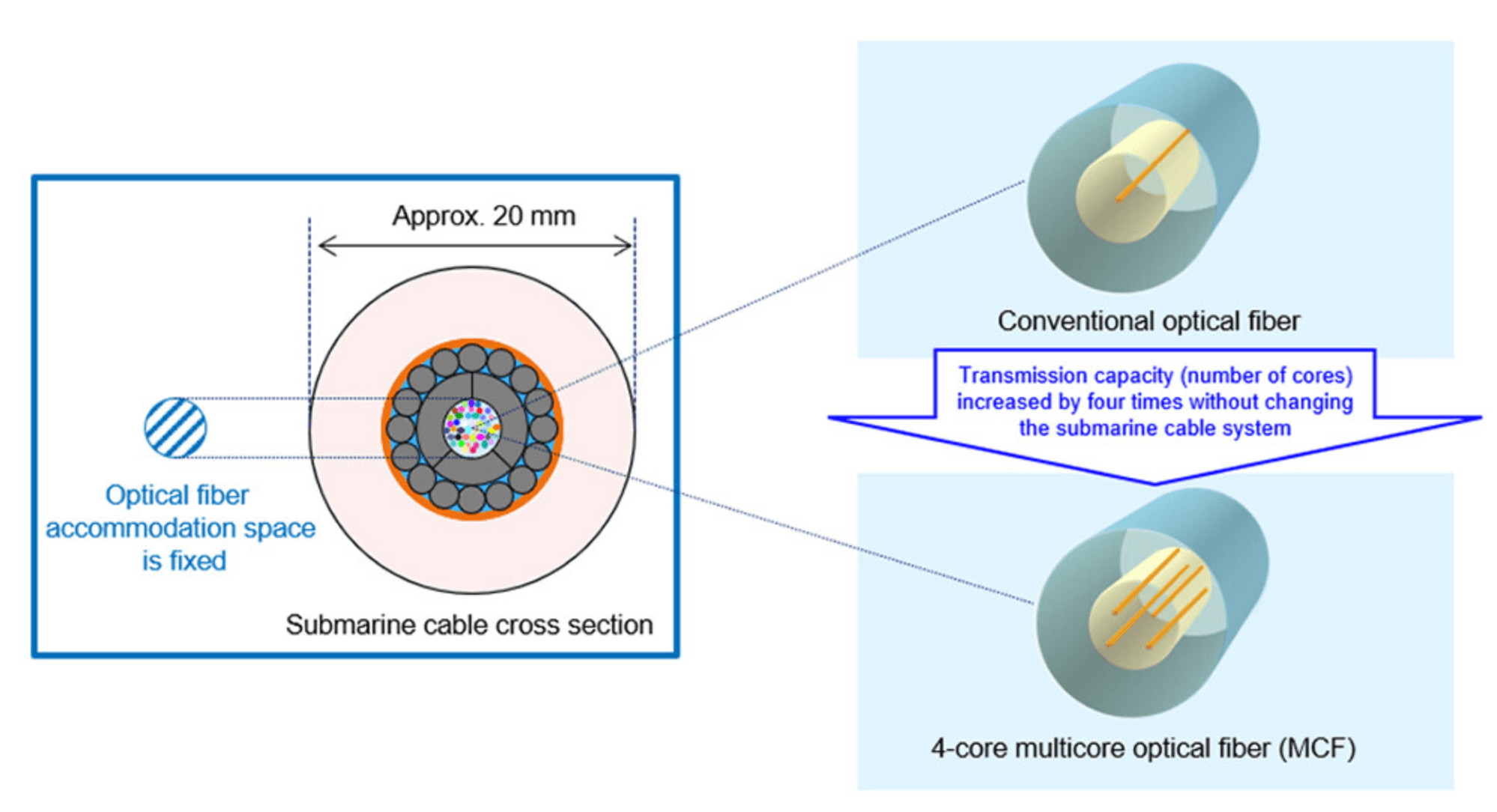
NTT has developed a 192-core submarine cable system based on four-core multicore optical fiber, a design it says can raise transmission capacity by 4x without changing the overall submarine cable system architecture. The March 13 announcement covers not only the fiber itself, but also a commercial lineup of supporting components including a submarine cable, joint boxes, and terminal-rack equipment for landing stations.
At the center of the system is a four-core multicore fiber that keeps the same overall fiber diameter as conventional optical fiber while carrying four optical paths inside a single glass fiber. NTT said a submarine cable with an outer diameter of about 20 mm can accommodate up to 48 of these four-core fibers, bringing the total to 192 cores. The company also said the design maintains low transmission loss and low crosstalk while preserving compatibility with existing submarine cable systems and conventional optical-fiber connections in landing facilities.
NTT framed the development as a way to expand subsea capacity without increasing cable diameter, a major constraint in wet-plant engineering where systems must withstand depths of up to 8,000 meters, operate for more than 25 years, and remain compatible with current laying vessels and installation processes. The company said those economics matter as traffic demand rises with 5G, generative AI, and video services, and it is targeting practical deployment around 2029.
- NTT’s system uses four-core multicore optical fiber to multiply capacity inside a fiber with the same diameter as conventional optical fiber.
- A cable carrying 48 such fibers reaches 192 cores, versus the 48-fiber limit NTT cites for current submarine cable designs.
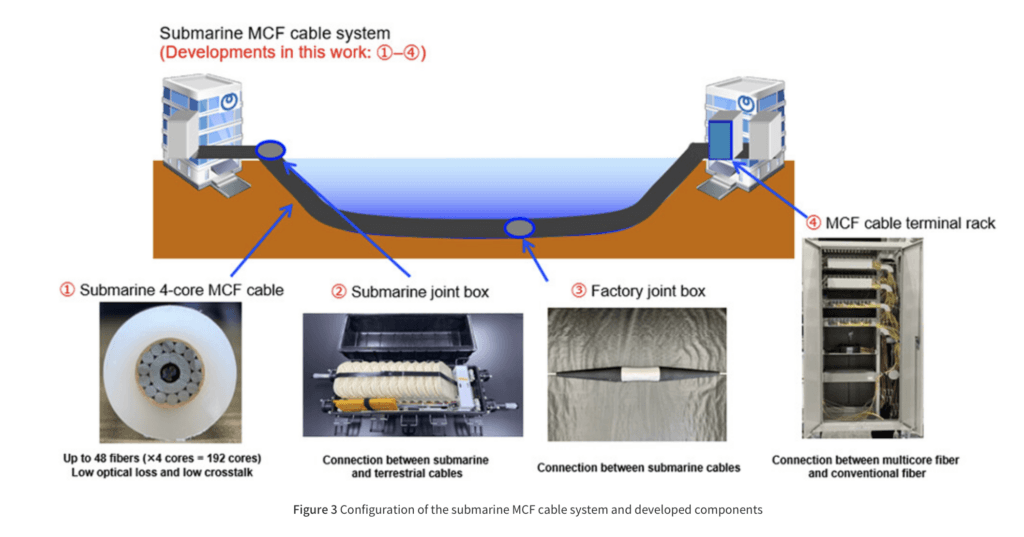
- The announcement includes a full component lineup for commercial deployment: submarine cable, submarine joint box, factory joint box, and MCF terminal rack.
- The submarine joint box links submarine MCF cable to terrestrial cable using conventional optical fibers, while the factory joint box supports MCF-to-MCF seabed connections using fusion splicing and side-view image alignment.
- NTT said the work supports its IOWN roadmap and could lower deployment costs by increasing capacity without requiring a larger cable system.
Akira Shimada, President and CEO of NTT, positioned the development as a path toward “the economical development of high-capacity submarine networks capable of meeting the growing demand for transmission capacity.”
🌐 Analysis: NTT’s announcement pushes multicore fiber closer to a full submarine-system commercialization story, which is more important than a lab fiber result alone. OFC’s 2026 program shows the sector is now actively debating whether the broader MCF ecosystem is ready across fibers, connectors, amplifiers, measurement tools, interoperability, and standards.
NTT is not alone in this direction. NEC and partners in 2022 outlined foundational multicore submarine-cable work, including a 3,000 km-class system feasibility study and a four-core design aimed at 4x capacity, while OFS introduced its SCUBA 4X multicore ocean fiber portfolio in 2023 for similar subsea scaling goals. The timing also lines up with a broader subsea investment cycle: TeleGeography says the value of new submarine cables planned to enter service between 2025 and 2027 exceeds $13 billion, and NTT DATA in January announced a new company to build and operate the Intra-Asia Marine Cable linking Japan, Malaysia, and Singapore with additional regional connectivity.
🌐 We’re tracking the latest developments in subsea cable infrastructure, policy, and deployments. Follow our ongoing coverage at: https://convergedigest.com/category/subsea/