NTT and Ireland-based MBRYONICS have signed a memorandum of understanding (MoU) to collaborate on next-generation optical communications for space applications. The agreement focuses on extending NTT’s Innovative Optical and Wireless Network (IOWN) technologies beyond terrestrial infrastructure and into satellite and space-based networking systems. The companies will jointly pursue business development opportunities and advance optical communications technologies designed for future space networks.
The collaboration comes as satellite constellations generate increasing demand for higher-capacity, lower-latency communications links between satellites and between space and ground stations. Under the agreement, MBRYONICS will develop optical transceiver modules incorporating NTT’s digital coherent optical technology. These modules are intended for integration into optical communication terminal (OCT) systems from multiple vendors serving commercial space applications.
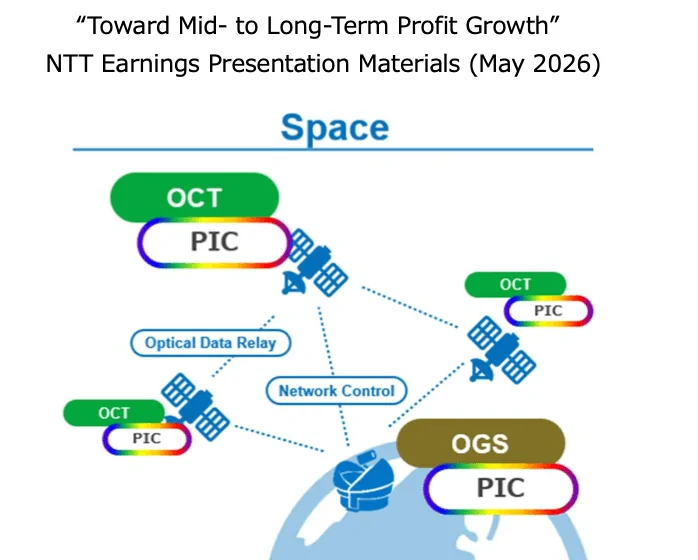
NTT and MBRYONICS said the resulting optical communications systems could deliver data transmission speeds more than ten times faster than conventional space communications approaches. The initiative also aligns with NTT’s broader “NTT C89” space business program, which seeks to expand the company’s presence in space infrastructure and services. Validation activities will evaluate the application of NTT’s coherent optical technologies in space environments and help determine commercial deployment opportunities.
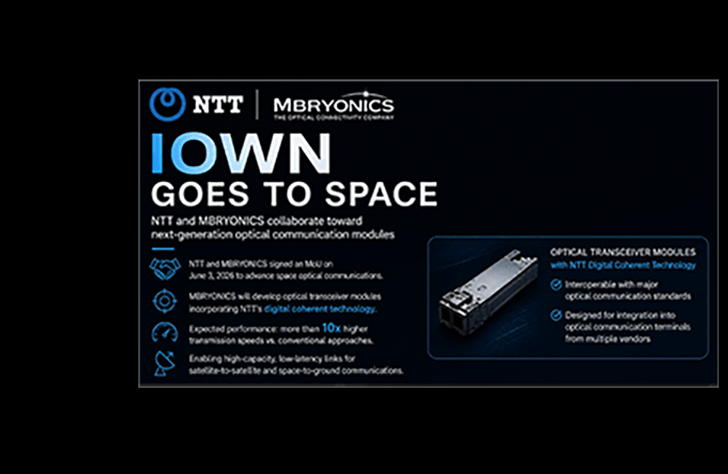
- NTT and MBRYONICS signed an MoU on June 3, 2026.
- Focus area: space-based optical communications infrastructure.
- MBRYONICS will develop optical transceiver modules using NTT digital coherent technology.
- Modules are designed for integration into optical communication terminal systems from multiple vendors.
- Target applications include satellite-to-satellite and space-to-ground communications.
- Expected performance: more than 10x higher transmission speeds compared to conventional approaches.
- Initiative supports NTT’s IOWN vision and NTT C89 space business program.
- MBRYONICS currently develops interoperable 25Gbps to 800Gbps optical communications platforms for LEO, MEO, and GEO satellite constellations.
“Building on this partnership, NTT and MBRYONICS will explore opportunities to expand the application of NTT’s optical communications technologies in the space domain and evaluate their potential through validation activities. This initiative represents an important step toward bringing the IOWN vision into space.”
🌐 Analysis: For NTT, the project extends its coherent optical networking expertise into a new domain at a time when governments, hyperscalers, and satellite operators are exploring integrated terrestrial-space networking architectures. The use of coherent optics in space could eventually enable higher-capacity backbone connections between satellites, creating opportunities to apply technologies originally developed for long-haul terrestrial optical transport networks.
| Company | MBRYONICS Ltd. |
| Headquarters | Galway, Ireland |
| Founded | 2014 |
| Sector | Space Communications Silicon Photonics |
| Core Focus | Laser-based optical communications for satellite, orbital, and deep space networks. |
| Key Technology | Integrated optical communication terminals (OCTs) and multi-gigabit transceiver platforms tailored for satellite-to-satellite (inter-satellite) and space-to-ground links. |
| Product Portfolio | High-capacity transport platforms supporting 25Gbps to 800Gbps coherent transmission optimized for Low Earth Orbit (LEO), Medium Earth Orbit (MEO), and Geostationary (GEO) satellite constellations. |
| Unique Positioning | Provides a specialized interoperability layer engineered to natively bridge distinct major optical communication standards utilized across competing orbital systems. |
| Target Applications | Inter-satellite links (ISLs), optical feeder links, high-throughput Earth observation, global broadband mega-constellations, and secure military/defense communication layers. |
| Recent Milestone | June 2026: Executed a milestone Memorandum of Understanding (MoU) with NTT to develop advanced space-bound optical transceiver modules. The solution embeds NTT’s cutting-edge digital coherent DSP chip technology into MBRYONICS’ hardware architecture, unlocking an immediate 10x transmission speed boost for next-generation commercial orbital networks. |
| Partnerships | Commercial satellite bus primes, optical terminal vendors, European Space Agency (ESA) framework programs, and NTT’s space network divisions. |
| Strategic Goal | To supply the high-speed routing and optical backbone infrastructure required to construct a standardized, scalable “Internet in Space.” |