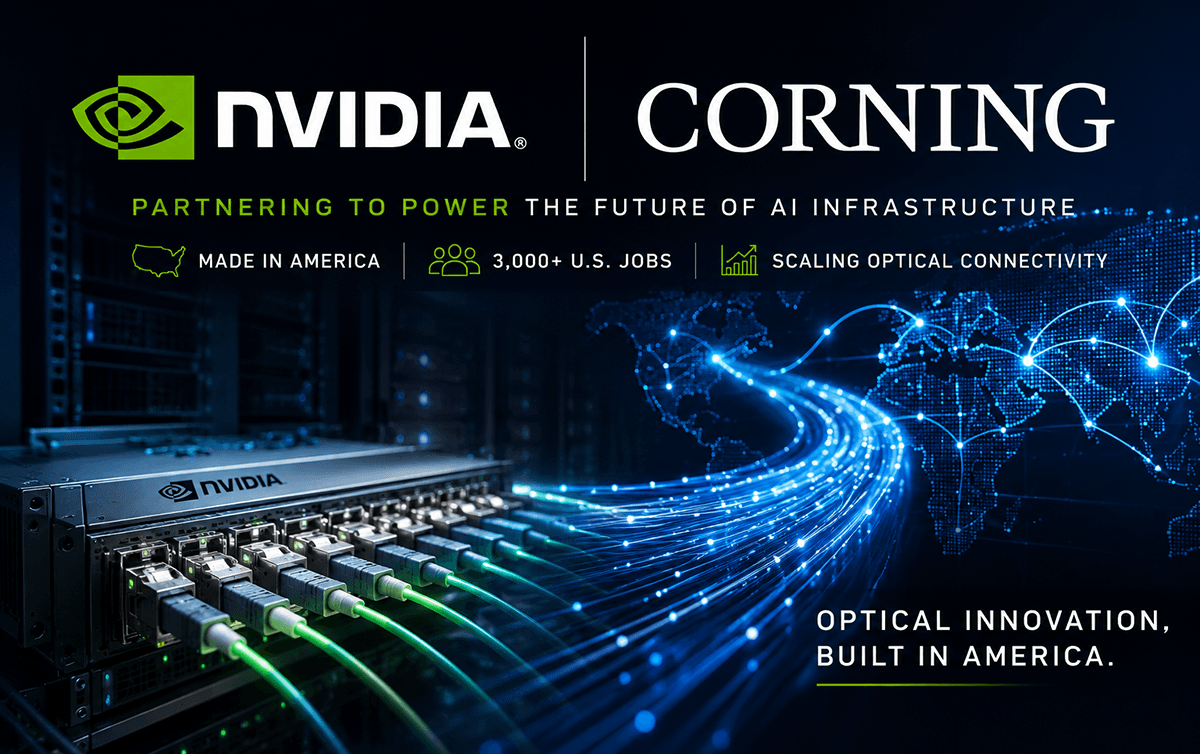
NVIDIA and Corning announced a multiyear commercial and technology partnership aimed at expanding U.S.-based manufacturing capacity for the optical connectivity systems required in large-scale AI infrastructure.
Under the agreement, Corning plans to increase its U.S. optical connectivity manufacturing capacity by 10x and expand domestic fiber production capacity by more than 50%. The expansion includes three new advanced manufacturing facilities in North Carolina and Texas and is expected to create more than 3,000 jobs.
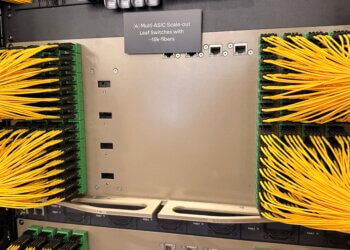
The companies said the added capacity will support hyperscale AI data centers deploying NVIDIA-accelerated computing systems at scale. As AI factories grow to thousands of GPUs, optical fiber, connectivity, and photonics are becoming central to moving data across increasingly dense compute clusters.
Jensen Huang, founder and CEO of NVIDIA, said, “AI is driving the largest infrastructure buildout of our time – and a once-in-a-generation opportunity to reinvigorate American manufacturing and supply chains. Together with Corning, we are inventing the future of computing with advanced optical technologies – building the foundation for AI infrastructure where intelligence moves at the speed of light while advancing the proud tradition of Made in America.”
Wendell P. Weeks, chairman, CEO, and president of Corning, said, “What NVIDIA is doing is nothing short of extraordinary, not just for the future of artificial intelligence, but for the American advanced manufacturing workforce. Their commitment is directly fueling the expansion of our U.S. manufacturing footprint and creating more than 3,000 new high-paying jobs for American workers. This partnership is proof that AI is not just a technology story. It is a manufacturing story, and it is happening here in the United States. Together with NVIDIA, we are ensuring the critical technologies powering AI are invented, engineered, and built in America.”
Key points:
• Corning will expand U.S. optical connectivity manufacturing capacity by 10x.
• Corning will increase U.S. fiber production capacity by more than 50%.
• The expansion includes three new advanced manufacturing facilities in North Carolina and Texas.
• More than 3,000 U.S. jobs are expected to be created.
• The partnership targets optical connectivity for NVIDIA-accelerated AI data centers.
• The announcement highlights optics and photonics as strategic components of AI factory infrastructure.
🌐 The NVIDIA-Corning partnership underscores how AI infrastructure demand is extending beyond GPUs, switches, and power systems into the optical supply chain itself. As AI clusters scale to thousands and eventually tens of thousands of accelerators, the volume of fiber, connectors, structured cabling, and photonic interconnect infrastructure required inside and between data centers increases sharply.
For Corning, the agreement positions optical connectivity as a growth pillar tied directly to AI factory buildouts. For NVIDIA, the partnership reinforces a broader ecosystem strategy: securing domestic supply capacity for the physical infrastructure needed to deploy accelerated computing at hyperscale.
The announcement also fits a broader trend in which AI infrastructure is becoming a manufacturing and supply-chain story. The buildout now spans advanced semiconductors, high-speed optics, liquid cooling, power delivery, data center construction, and fiber connectivity. Corning’s expansion suggests that optical infrastructure is moving from a supporting role to a strategic bottleneck category for AI-scale deployment.
🌐 NVIDIA’s partnership with Corning also extends a broader strategy the company has pursued over the past several months to secure the optical supply chain underpinning next-generation AI factories. In March, NVIDIA announced separate multiyear strategic agreements and $2 billion investments in both Coherent and Lumentum to expand U.S.-based manufacturing and R&D for advanced lasers, silicon photonics, and optical networking products used in AI infrastructure. The Corning announcement reinforces the view that NVIDIA increasingly sees optics as a strategic control point for scaling AI clusters — alongside GPUs, networking fabrics, and power infrastructure. Together, the deals suggest NVIDIA is proactively locking in long-term access to fiber, lasers, photonic components, and optical interconnect technologies needed to support the transition toward 800G, 1.6T, co-packaged optics, and eventually photonic-scale AI fabrics.