Rambus introduced a DDR5 9600 Server RDIMM chipset for next-generation CPU-based server platforms, increasing supported memory data rates to 9600 MT/s. The chipset centers on the company’s new sixth-generation Registering Clock Driver (RCD06), which raises the data rate by 20% compared with Rambus’ previous-generation solution as server vendors increase processor core counts, memory capacity and aggregate memory bandwidth for AI, HPC and other data-intensive workloads.
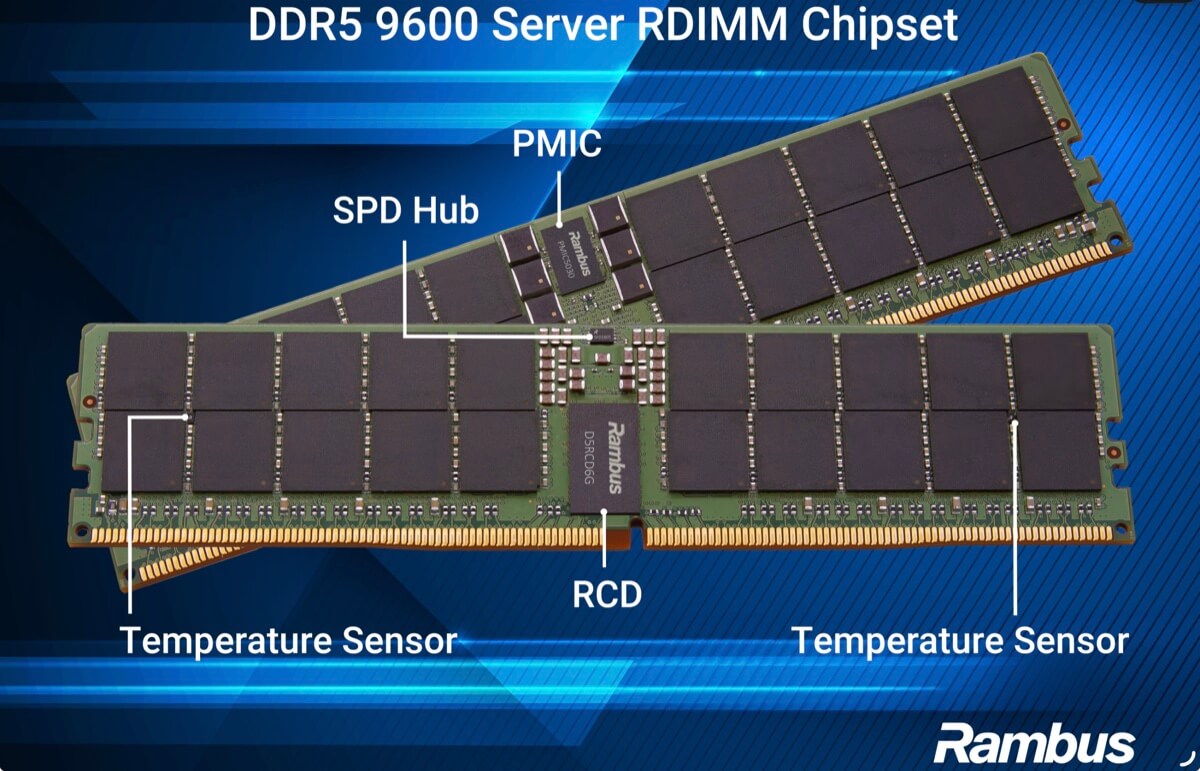
The complete chipset combines the RCD06 with Rambus’ PMIC5030 power management IC, an SPD Hub with an integrated temperature sensor, and dedicated Temperature Sensor ICs. The integrated architecture provides clocking, control, power management, module configuration and thermal telemetry functions required by high-speed DDR5 RDIMMs. Rambus said the chipset supports memory module manufacturers in maintaining signal and power integrity at higher data rates while reducing the complexity of developing RDIMMs for advanced server platforms.
Rambus positioned DDR5 9600 as part of the infrastructure response to rising server memory requirements from AI inference and agentic AI workloads. Large language model inference can increase memory bandwidth and capacity requirements through techniques such as KV caching, while CPU platforms continue to add cores and memory channels. These architectural trends increase the importance of memory bandwidth, capacity, power delivery and thermal monitoring in determining overall server throughput.
• New RCD06 supports DDR5 RDIMMs operating at up to 9600 MT/s.
• Data rate increases 20% compared with Rambus’ previous-generation RCD solution.
• Complete chipset includes the RCD06, PMIC5030, SPD Hub with integrated temperature sensor, and dedicated Temperature Sensor ICs.
• PMIC5030 provides high-current, low-voltage power management for advanced DDR5 RDIMM configurations.
• Rambus targets next-generation CPU-based servers running agentic AI, AI inference, HPC and other memory-intensive workloads.
• The chipset addresses signal integrity, power integrity, module configuration and thermal telemetry requirements as server memory speeds and capacities increase.
“The rapidly accelerating adoption of agentic AI and AI inference workloads is driving unprecedented demand for higher memory bandwidth and capacity in the data center,” said Rami Sethi, SVP and general manager of Memory Interface Chips at Rambus. “With our DDR5 9600 RDIMM chipset featuring the new RCD06, Rambus continues to extend its leadership in high-speed memory interface solutions, enabling our customers to deliver the performance and reliability required for next-generation server platforms.”
🌐 Analysis: DDR5 9600 extends the server memory roadmap as CPU vendors increase core counts and memory subsystem performance to support larger AI inference, HPC and data-intensive workloads. Rambus’ complete-chipset strategy places the company across several critical RDIMM functions—clocking, power management, configuration and thermal sensing—as memory module designs move toward higher signaling rates and tighter power and signal-integrity margins.