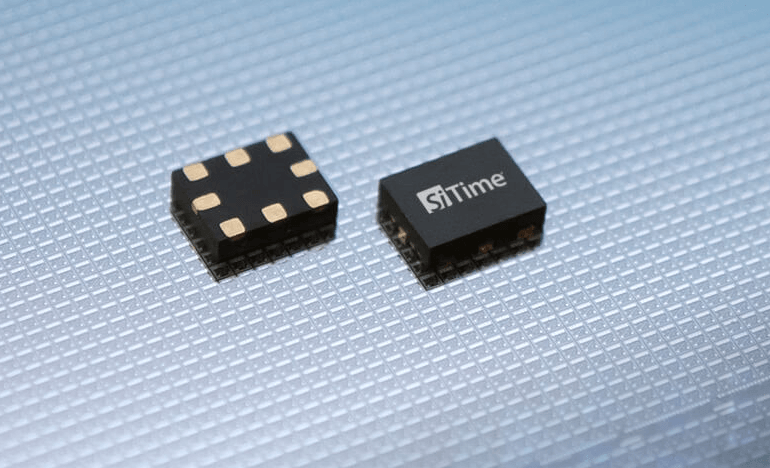
SiTime introduced its Elite 2 Super-TCXO oscillator aimed at improving GPU utilization in AI data centers by tightening time synchronization across large-scale clusters. The device delivers sub-nanosecond synchronization accuracy, positioning it well beyond the emerging industry target of roughly 10 nanoseconds for coordinated AI workloads. SiTime said the product addresses a cumulative $1.5 billion market opportunity through 2030 as hyperscalers and AI infrastructure providers push for higher efficiency from expensive GPU resources.
AI training and inference workloads depend on tightly synchronized operations across thousands of GPUs. Timing drift or jitter forces idle cycles to prevent data corruption and can trigger system-level inefficiencies, including GPU timeouts. SiTime argues that current synchronization levels—often around 1 microsecond—create a significant bottleneck, with reported GPU utilization rates as low as 20–40 percent. The Elite 2 Super-TCXO aims to reduce these inefficiencies by improving thermal stability and short-term frequency accuracy, enabling more deterministic coordination across distributed compute nodes.
The Elite 2 Super-TCXO integrates into timing architectures with a compact footprint and digitally tunable frequency control, simplifying system-level design for timing-aware networks. The device is sampling now, with volume production expected in Q3 2026. SiTime offers the component in both plastic and ceramic packaging options, targeting deployment across next-generation AI data center platforms.
- Sub-nanosecond synchronization accuracy, up to 100x better than typical approaches
- ±2 ppb/°C frequency temperature slope, up to 25x improvement
- Allan deviation of 6 × 10⁻¹², improving short-term stability by up to 8x
- ±50 ppb frequency stability across -40°C to 105°C operating range
- Compact 3.2 mm × 2.5 mm footprint (8 mm²), up to 2x smaller than alternatives
- Digital frequency tuning for simplified timing-aware system design
- Improved resilience to shock, vibration, and board-level stress
“Industry reports show GPU utilization in AI clusters can be as low as 20 to 40 percent—a large and largely hidden tax on AI infrastructure,” said Piyush Sevalia, chief business officer at SiTime.
🌐 Analysis
This announcement highlights a less visible but increasingly critical constraint in AI infrastructure: time synchronization at scale. As clusters grow to tens of thousands of GPUs, coordination overhead becomes a material limiter of effective compute throughput. SiTime’s positioning aligns with broader industry efforts around deterministic networking, including work in Precision Time Protocol (PTP), co-packaged optics, and emerging scale-up interconnects, all of which depend on tighter timing budgets.
The move also reflects a shift toward system-level optimization in AI data centers, where incremental gains in utilization translate directly into capex efficiency. Hyperscalers and AI platform providers—including those building custom silicon and interconnect fabrics—are increasingly scrutinizing timing subsystems alongside networking and memory bandwidth. SiTime’s approach places precision oscillators as a lever for improving overall cluster economics, complementing parallel innovations from vendors focused on interconnects, switching, and synchronization software.