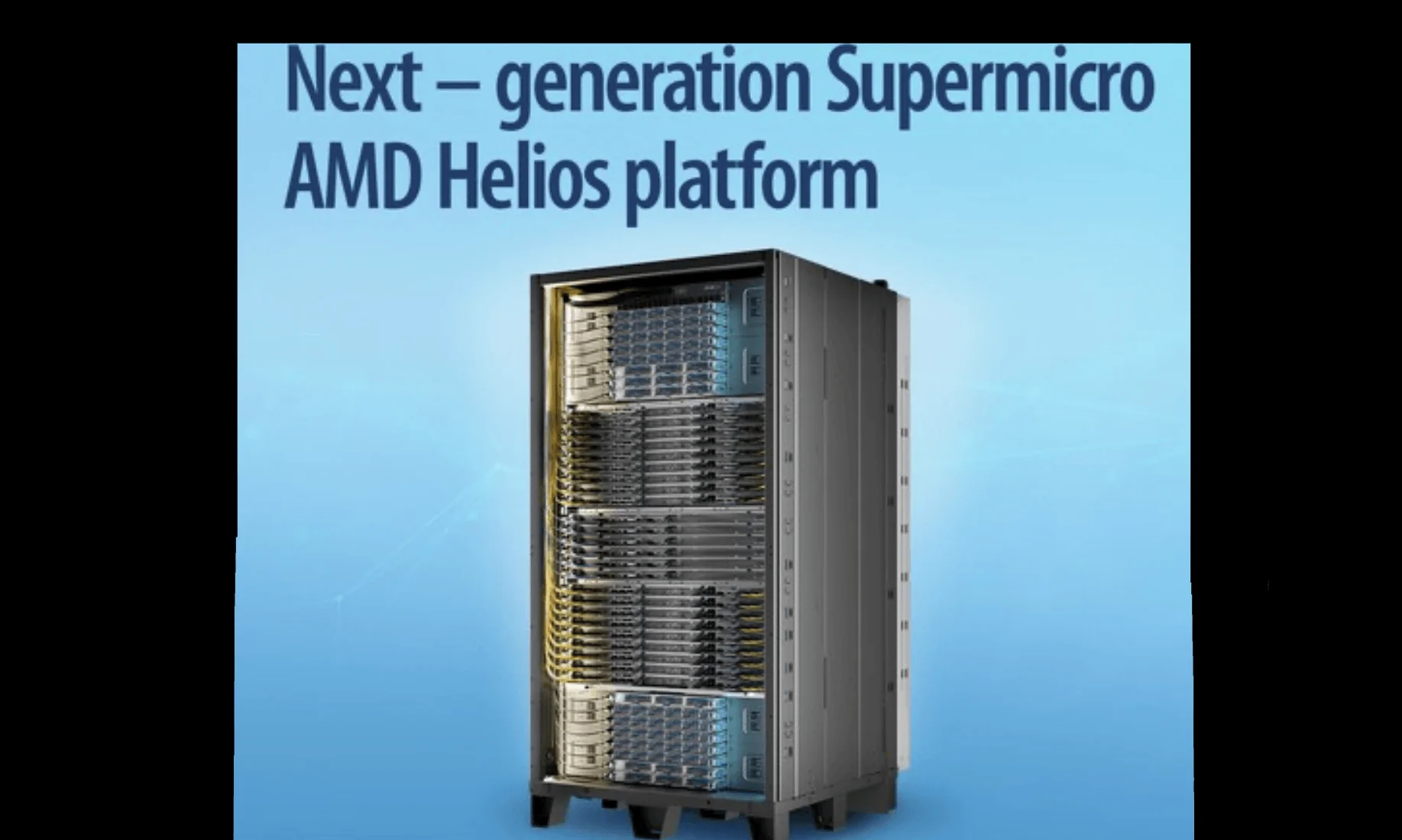
Supermicro unveiled its next-generation AMD Helios rack-scale AI platform at Computex, highlighting a new architecture designed to support large-scale AI training and inference deployments. Developed in close collaboration with AMD, the Helios platform combines 72 AMD Instinct MI455X GPUs, 6th Generation AMD EPYC CPUs, AMD Pensando networking, and the ROCm software stack into a double-width rack-scale system targeting cloud service providers, hyperscalers, NeoCloud operators, and enterprises building large AI clusters.
The Helios platform is built around Supermicro’s Data Center Building Block Solutions (DCBBS) architecture, which shifts infrastructure design from individual servers toward pre-integrated rack-scale systems. Supermicro said the modular approach enables customers to deploy AI infrastructure ranging from single racks to hyperscale clusters while simplifying expansion and reducing deployment complexity. The company also emphasized liquid-cooling support and high-density system integration to improve power efficiency as AI cluster sizes continue to grow.
At the center of the platform is a 72-GPU rack powered by AMD’s upcoming Instinct MI455X accelerators. Helios supports both scale-up and scale-out networking architectures, integrated security capabilities, virtualization support, and software acceleration features designed for large language model training, inference, fine-tuning, and sovereign AI deployments. Supermicro positions the platform as part of its “A+A+A” strategy, combining Architecture, Accelerators, and Advancements into a unified AI infrastructure offering.
• 72 AMD Instinct MI455X GPUs in a double-width rack-scale configuration
• Powered by 6th Gen AMD EPYC processors and AMD Pensando networking technologies
• Uses the open AMD ROCm software ecosystem for AI training and inference workloads
• Supports both scale-up and scale-out AI networking architectures
• Designed for LLM training, fine-tuning, inference, sovereign AI, and agentic AI workloads
• Based on Supermicro’s DCBBS modular architecture for deployment from individual racks to hyperscale AI clusters
• Incorporates advanced cooling technologies to improve power efficiency in dense AI environments
• Demonstrated publicly at Computex 2026 in Taipei
“By combining Supermicro’s DCBBS with AMD Instinct MI455X GPU architecture, we deliver unprecedented AI performance, improved power efficiency through advanced cooling, and scalable infrastructure for next-generation AI workloads,” said Charles Liang, president and CEO of Supermicro.
🌐 Analysis: The AMD Helios announcement reflects a broader industry shift toward rack-scale AI system design, where compute, networking, storage, cooling, and software are increasingly delivered as integrated infrastructure platforms rather than discrete servers. Similar strategies are emerging from NVIDIA with its Vera Rubin systems, while hyperscalers continue to push for pre-integrated AI factories that reduce deployment time and simplify cluster management.
The platform also highlights AMD’s expanding AI infrastructure strategy. Beyond GPUs, AMD is assembling a full-stack offering that includes EPYC CPUs, Pensando networking, ROCm software, and rack-scale reference architectures. Helios positions AMD more directly against NVIDIA’s end-to-end AI infrastructure approach, while giving system partners such as Supermicro an opportunity to deliver differentiated AI clusters based on open architectures and multi-vendor ecosystems.Supermicro unveiled its next-generation AMD Helios rack-scale AI platform at Computex, highlighting a new architecture designed to support large-scale AI training and inference deployments. Developed in close collaboration with AMD, the Helios platform combines 72 AMD Instinct MI455X GPUs, 6th Generation AMD EPYC CPUs, AMD Pensando networking, and the ROCm software stack into a double-width rack-scale system targeting cloud service providers, hyperscalers, NeoCloud operators, and enterprises building large AI clusters.
The Helios platform is built around Supermicro’s Data Center Building Block Solutions (DCBBS) architecture, which shifts infrastructure design from individual servers toward pre-integrated rack-scale systems. Supermicro said the modular approach enables customers to deploy AI infrastructure ranging from single racks to hyperscale clusters while simplifying expansion and reducing deployment complexity. The company also emphasized liquid-cooling support and high-density system integration to improve power efficiency as AI cluster sizes continue to grow.
At the center of the platform is a 72-GPU rack powered by AMD’s upcoming Instinct MI455X accelerators. Helios supports both scale-up and scale-out networking architectures, integrated security capabilities, virtualization support, and software acceleration features designed for large language model training, inference, fine-tuning, and sovereign AI deployments. Supermicro positions the platform as part of its “A+A+A” strategy, combining Architecture, Accelerators, and Advancements into a unified AI infrastructure offering.
• 72 AMD Instinct MI455X GPUs in a double-width rack-scale configuration
• Powered by 6th Gen AMD EPYC processors and AMD Pensando networking technologies
• Uses the open AMD ROCm software ecosystem for AI training and inference workloads
• Supports both scale-up and scale-out AI networking architectures
• Designed for LLM training, fine-tuning, inference, sovereign AI, and agentic AI workloads
• Based on Supermicro’s DCBBS modular architecture for deployment from individual racks to hyperscale AI clusters
• Incorporates advanced cooling technologies to improve power efficiency in dense AI environments
• Demonstrated publicly at Computex 2026 in Taipei
“By combining Supermicro’s DCBBS with AMD Instinct MI455X GPU architecture, we deliver unprecedented AI performance, improved power efficiency through advanced cooling, and scalable infrastructure for next-generation AI workloads,” said Charles Liang, president and CEO of Supermicro.
🌐 Analysis: The AMD Helios announcement reflects a broader industry shift toward rack-scale AI system design, where compute, networking, storage, cooling, and software are increasingly delivered as integrated infrastructure platforms rather than discrete servers. Similar strategies are emerging from NVIDIA with its Vera Rubin systems, while hyperscalers continue to push for pre-integrated AI factories that reduce deployment time and simplify cluster management.
The platform also highlights AMD’s expanding AI infrastructure strategy. Beyond GPUs, AMD is assembling a full-stack offering that includes EPYC CPUs, Pensando networking, ROCm software, and rack-scale reference architectures. Helios positions AMD more directly against NVIDIA’s end-to-end AI infrastructure approach, while giving system partners such as Supermicro an opportunity to deliver differentiated AI clusters based on open architectures and multi-vendor ecosystems.