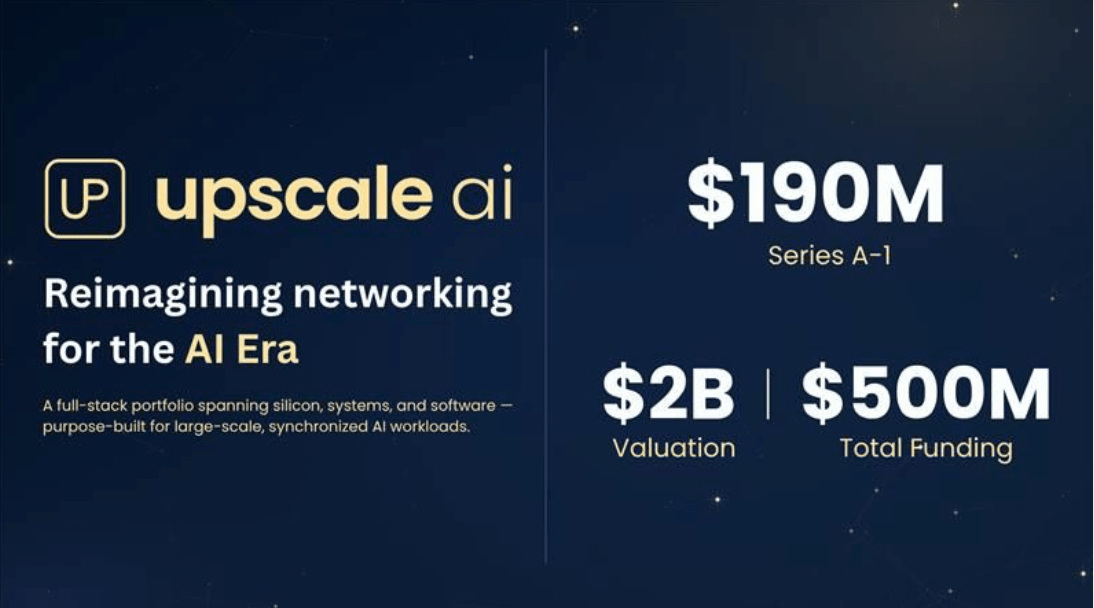
Upscale AI announced a $190 million Series A-1 financing extension, bringing its total funding to $500 million and valuing the company at $2 billion. The round was led by Premji Invest and included new investments from NVIDIA, Salesforce Ventures, Seligman Ventures, and Temasek, alongside continued participation from Maverick Silicon, Mayfield, Prosperity7 Ventures, StepStone Group, and Tiger Global.
The Santa Clara-based startup is positioning itself as a full-stack AI networking infrastructure company spanning silicon, systems, and software. Its architecture focuses on creating an open-standard AI fabric that links accelerators, memory, and storage into a unified infrastructure platform designed to reduce networking bottlenecks across large-scale AI training and inference clusters. The company said it is currently engaged with multiple hyperscalers and neocloud providers, with customer evaluations and deployments underway across both scale-up and scale-out AI networking environments.
Upscale AI said it will use the new capital to accelerate product development and scale its operations as demand grows for AI-native networking infrastructure. The company has emphasized open standards, interoperability, and ultra-low-latency networking as key elements of its strategy, positioning itself as an alternative to more vertically integrated AI infrastructure approaches. The financing follows increasing investor focus on networking as a critical constraint in AI infrastructure, alongside compute, memory, power, and cooling.
“AI infrastructure is being redefined at cluster scale, and networking is one of the most critical bottlenecks. Upscale AI is building a high-performance, open-standard AI fabric purpose-built for large-scale, synchronized workloads,” said Barun Kar, CEO of Upscale AI.
Profile: Upscale AI AI Networking Infrastructure Company | |
| Headquarters | Santa Clara, California |
| Leadership | Barun Kar (CEO), Rajiv Khemani (Executive Chairman) |
| Total Funding | $500 Million |
| Latest Round | $190 Million Series A-1 Extension led by Premji Invest |
| Valuation | $2 Billion (June 2026) |
| Technology Focus | AI networking infrastructure spanning silicon, systems, and software |
| Architecture | Open-standard AI fabric designed to connect accelerators, memory, and storage into a unified infrastructure platform |
| Target Workloads | Large-scale AI training, inference, and generative AI deployments |
| Positioning | Emphasizes open standards, interoperability, heterogeneous compute support, and ultra-low-latency networking |
| Notable Investors | Premji Invest, NVIDIA, Salesforce Ventures, Temasek, Mayfield, Tiger Global, Prosperity7 Ventures, StepStone Group, Maverick Silicon |
| Market Engagement | Engaged with unnamed hyperscalers and neocloud infrastructure providers; customer evaluations and deployments are underway, according to the company. |
🌐 Analysis: AI infrastructure is creating one of the largest networking platform transitions in decades. Frontier AI training and inference clusters impose new requirements around deterministic latency, congestion management, fault tolerance, collective communications, and synchronized accelerator-to-accelerator data movement. The industry is responding with new technologies and standards, including Ultra Ethernet, UALink, Scale-Up Ethernet efforts such as ESUN and SUE, Multipath Reliable Connection (MRC), and co-packaged or near-package optics for higher-radix AI switching. Whole new networking platforms are being designed around AI fabrics rather than conventional enterprise or cloud traffic patterns. This shift creates an opening for startups targeting AI-native switching silicon, systems, and software.
🌐 Analysis: Upscale AI’s leadership team brings experience from the networking silicon sector. CEO Barun Kar previously held senior roles at Broadcom, while Executive Chairman Rajiv Khemani previously co-founded Innovium, which developed Teralynx Ethernet switch silicon and was acquired by Marvell. That background helps explain investor interest in the company’s full-stack AI networking strategy before the disclosure of named customers or production wins. The key question for the industry is whether AI-specific open networking architectures can establish durable differentiation as hyperscalers, neocloud providers, accelerator vendors, and incumbent silicon suppliers all push competing approaches into scale-up and scale-out AI fabrics.
Why Investors Are Watching AI Networking Key infrastructure trends driving investment | ||
| Trend | Impact | |
| Larger AI Clusters | Training clusters increasingly span tens of thousands of accelerators, increasing network demands. | |
| Scale-Out Fabrics | Ethernet-based AI fabrics are evolving rapidly to support distributed AI training and inference. | |
| Open Standards | Industry initiatives such as Ultra Ethernet and UALink seek broader interoperability. | |
| Inference Growth | Agentic AI and frontier models are increasing east-west traffic requirements inside AI clusters. | |
| Infrastructure Efficiency | Reducing network congestion can improve accelerator utilization and overall AI economics. | |