Verizon Communications closed out 2025 with its strongest quarterly net additions since 2019, signaling an inflection point driven by network investment discipline and a renewed focus on mobility–broadband convergence. The company reported more than 1 million total net additions across mobility and broadband in the fourth quarter, including 616,000 postpaid phone net adds, alongside continued expansion of fixed wireless access (FWA) and fiber broadband. Capital expenditures reached $17.0 billion for the year, underscoring Verizon’s emphasis on sustaining network performance while managing free cash flow.
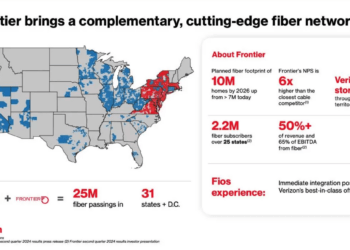
A central pillar of Verizon’s infrastructure strategy is the acquisition of Frontier Communications, which closed on January 20, 2026. The deal expands Verizon’s fiber reach to more than 30 million homes and businesses and strengthens its ability to pair dense fiber backhaul with nationwide 5G and FWA deployments. By year-end 2025, Verizon reported over 5.7 million FWA subscribers and 16.3 million combined fixed wireless and fiber connections, positioning fiber as a long-term anchor for both consumer broadband and mobile network densification.
Looking ahead, Verizon’s 2026 guidance points to sustained infrastructure investment with capital expenditures of $16.0–$16.5 billion, including at least 2 million new fiber passings. The company also updated its long-term MVNO agreements with Charter Communications and Comcast, reinforcing wholesale network utilization and spectrum efficiency. Management framed these moves as foundational to scaling traffic growth without sacrificing network quality as data demand continues to rise.
- Best quarterly postpaid phone net additions since 2019, reflecting improved network-driven customer retention
- Frontier acquisition expands fiber footprint to over 30 million passings, supporting 5G backhaul and FWA growth
- Fixed wireless access base surpasses 5.7 million subscribers, highlighting convergence of wireless and broadband
- 2026 capex guidance of up to $16.5 billion, including at least 2 million new fiber passings
- Updated MVNO agreements with Charter and Comcast extend wholesale network economics
“We are exiting 2025 with strong momentum, delivered by a team that is intensely focused on winning through healthy volumes and fiscally responsible growth,” said Dan Schulman. “The closing of our Frontier acquisition is another pivotal step, significantly scaling our fiber footprint and reinforcing our commitment to network excellence.”
Key points from the quarter investor call
- CEO Dan Schulman said Verizon plans to launch a new customer value proposition in the first half of 2026, while building an in-year “war chest” of $5 billion in operating-expense savings and pursuing “significant” integration synergies from the Frontier Communications acquisition (management raised its synergy target to more than $1 billion of run-rate operating cost savings by 2028, double its initial estimate).
- Schulman opened by addressing a network outage earlier in the month, saying Verizon “did not meet” its reliability standard, and pointed to winter-storm performance as evidence of operational resilience under stress.
- Management framed 2026 as a “transitional” revenue year, prioritizing volume-based growth over standalone price actions; Schulman said Verizon will avoid price increases that do not include added value, citing churn impacts from prior pricing moves.
- Churn reduction emerged as a primary operating lever: Schulman attributed churn to “price increases without corresponding value,” plus friction in onboarding/billing/care, and said convergence lowers churn meaningfully (he cited ~40% lower churn for bundled mobility + broadband versus standalone mobility).
- Schulman said Verizon expects to use AI at scale to simplify offers, personalize interactions, and reduce churn with predictive models that anticipate customer issues before they occur.
- CFO Tony Skiadas detailed a cost transformation program that includes workforce reduction, real-estate rationalization, contract renegotiations, and automation; he said Verizon reduced headcount by about 13,000 in 4Q (with most off payroll in the quarter and the rest exiting in 1Q).
- Skiadas said Verizon intends to apply the same “rigor” to CapEx as OpEx, shifting capital toward mobility and broadband while cutting or exiting lower-return or structurally unprofitable areas; he referenced business/legacy wireline, legacy copper and voice platforms, and projects with long payback periods as examples of areas under reduction.
- On spectrum buildout, Skiadas said Verizon’s C-band deployment is about 90% complete and covers ~300 million POPs, with remaining work skewing toward small cells that require lower incremental CapEx.
- Verizon outlined additional balance-sheet and capital allocation actions: the board pulled forward the annual dividend increase to the first declaration of the year (an annualized increase of $0.07 per share, about 2.5%) and authorized up to $25 billion of share repurchases over three years, including at least $3 billion in 2026.
- Skiadas said Verizon completed funding for the Frontier transaction in 4Q and moved quickly on deleveraging post-close, including paying down roughly $5.7 billion of Frontier debt by late January; he also said Verizon’s pension became fully funded by end of 4Q following $1.3 billion in discretionary contributions in 2025.
🌐 Analysis
Verizon’s results highlight how U.S. operators are increasingly aligning fiber expansion with 5G and fixed wireless strategies, rather than treating them as separate businesses. The Frontier deal mirrors broader industry moves toward deeper fiber ownership to control backhaul costs and support higher-capacity radio networks, while revised MVNO agreements suggest operators are prioritizing network utilization and predictable traffic profiles amid slowing wireless ARPU growth.
Dan Schulman used the call to signal that Verizon’s upcoming “new value proposition” will likely pair a simplified consumer-facing offer set with tighter execution across distribution and ecosystem partners, without previewing specific bundles or pricing mechanics. His emphasis on “conjoined analysis” market research, plus repeated framing around reducing churn drivers (friction, perceived value gaps, and inconsistent experiences), points to a design goal that looks less like a single promotion and more like a durable operating model—standardized packaging, fewer edge-case plan variants, and clearer attach paths for broadband, perks, and device economics.
Schulman’s comments about the renewed MVNO alignment with Comcast and Charter Communications suggest Verizon aims to integrate partner-sourced volumes into the same “value-with-discipline” playbook, strengthening network utilization while keeping acquisition economics predictable. The practical implication for network and infrastructure trends is that Verizon can drive higher loads onto a network it views as largely built-out on C-band coverage, while leaning on fiber expansion (including Frontier markets) and AI-driven care workflows to protect customer experience as scale increases—an approach consistent with maximizing return on both spectrum and fiber assets without resorting to value-destructive price moves.
🌐 We’re tracking the latest developments in networking and digital infrastructure. Follow our ongoing coverage at: https://convergedigest.com/category/networks/