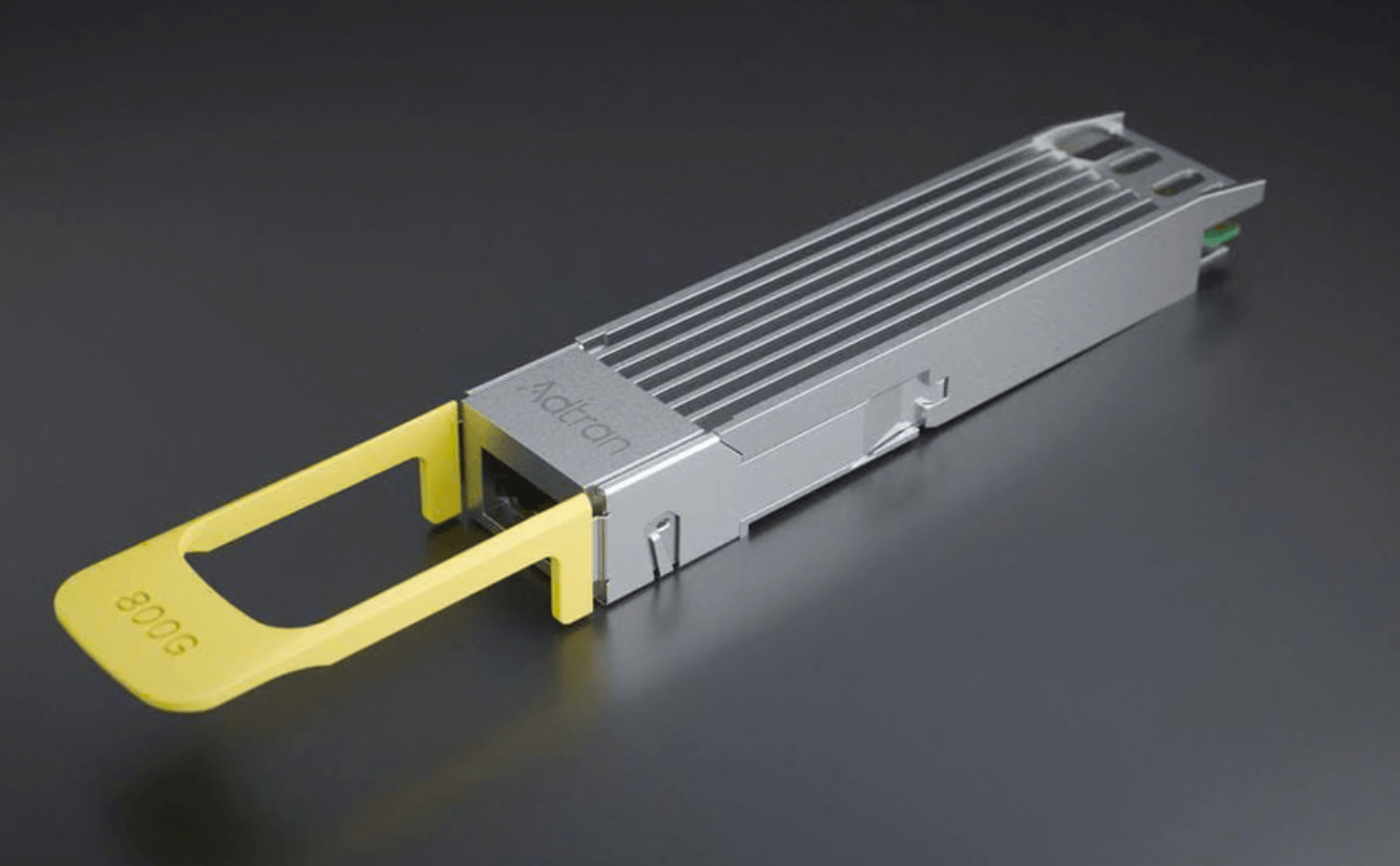
Adtran unveiled its LiteWave800 800Gbit/s DR8 linear pluggable optics (LPO) module, targeting the growing power and thermal constraints of AI data center fabrics. The new module is designed for short-reach intra-data-center links connecting GPUs, switches and high-density server racks. As AI clusters scale to thousands of accelerators, operators increasingly face limits on power budgets, cooling capacity and rack density.
LiteWave800 introduces a fully redesigned architecture optimized for energy efficiency and latency. The module operates at approximately 1pJ per bit and consumes about 0.8W, establishing a new power class for 800G optics. By comparison, Adtran states that LiteWave800 consumes roughly 12 to 18 times less power than DSP-based optical transceivers and six to ten times less than first-generation LPO designs. The company positions the module as a way for operators to scale AI infrastructure without proportionally increasing power and cooling requirements.
The module combines single-mode VCSEL technology with Adtran’s in-house low-power electronics and integration expertise to simplify the signal path and reduce latency. LiteWave800 supports the LPO MSA specification and uses a standardized 100Gbit/s-DR-LPO optical interface in an OSFP form factor. The design aims to ensure interoperability with existing host systems and multi-vendor environments. Adtran will demonstrate LiteWave800™ at OFC 2026 in Los Angeles from March 17 to 19.
- LiteWave800™ delivers 800Gbit/s DR8 connectivity for short-reach intra-data-center links
- Energy efficiency of approximately 1pJ per bit with about 0.8W power consumption
- Designed for GPU fabrics, AI clusters and high-density server racks
- Up to 12–18× lower power than DSP-based optical transceivers
- 6–10× lower power consumption than first-generation LPO modules
- OSFP pluggable form factor supporting the LPO MSA specification
- Based on standardized 100Gbit/s-DR-LPO optical interfaces
“Data center operators are hitting a wall on power and thermal budgets as AI workloads continue to scale,” said Christoph Glingener, CTO of Adtran. “LiteWave800™ sets a new benchmark for 800Gbit/s optics by dramatically improving energy efficiency while reducing the power and cooling envelope required to scale AI clusters.”
🌐 Analysis
Energy consumption is becoming one of the primary constraints in scaling AI infrastructure. As GPU clusters expand and intra-rack bandwidth requirements rise, optics vendors increasingly focus on reducing energy per bit rather than simply increasing throughput. LPO architectures remove the DSP from the optical module and shift signal processing into the host system, which reduces module power consumption and latency for short-reach links inside AI fabrics.
Adtran’s LiteWave800™ arrives as hyperscalers and AI infrastructure vendors evaluate LPO as a potential alternative to traditional DSP-based pluggables for 800G and 1.6T deployments. Companies such as Broadcom, Marvell and Nvidia have also explored LPO approaches for AI fabrics. If the claimed efficiency gains are realized in production deployments, ultra-low-power modules like LiteWave800™ could play a role in improving the energy profile of large-scale GPU clusters and next-generation AI data center architectures.
🌐 We’re tracking the latest developments in networking silicon. Follow our ongoing coverage at: https://convergedigest.com/category/semiconductors/
🌐 We’re launching the “Data Center Networking for AI” series on NextGenInfra.io and inviting companies building real solutions—silicon, optics, fabrics, switches, software, orchestration—to share their views on video and in our expert report. To get involved, send a note to [email protected] or [email protected]