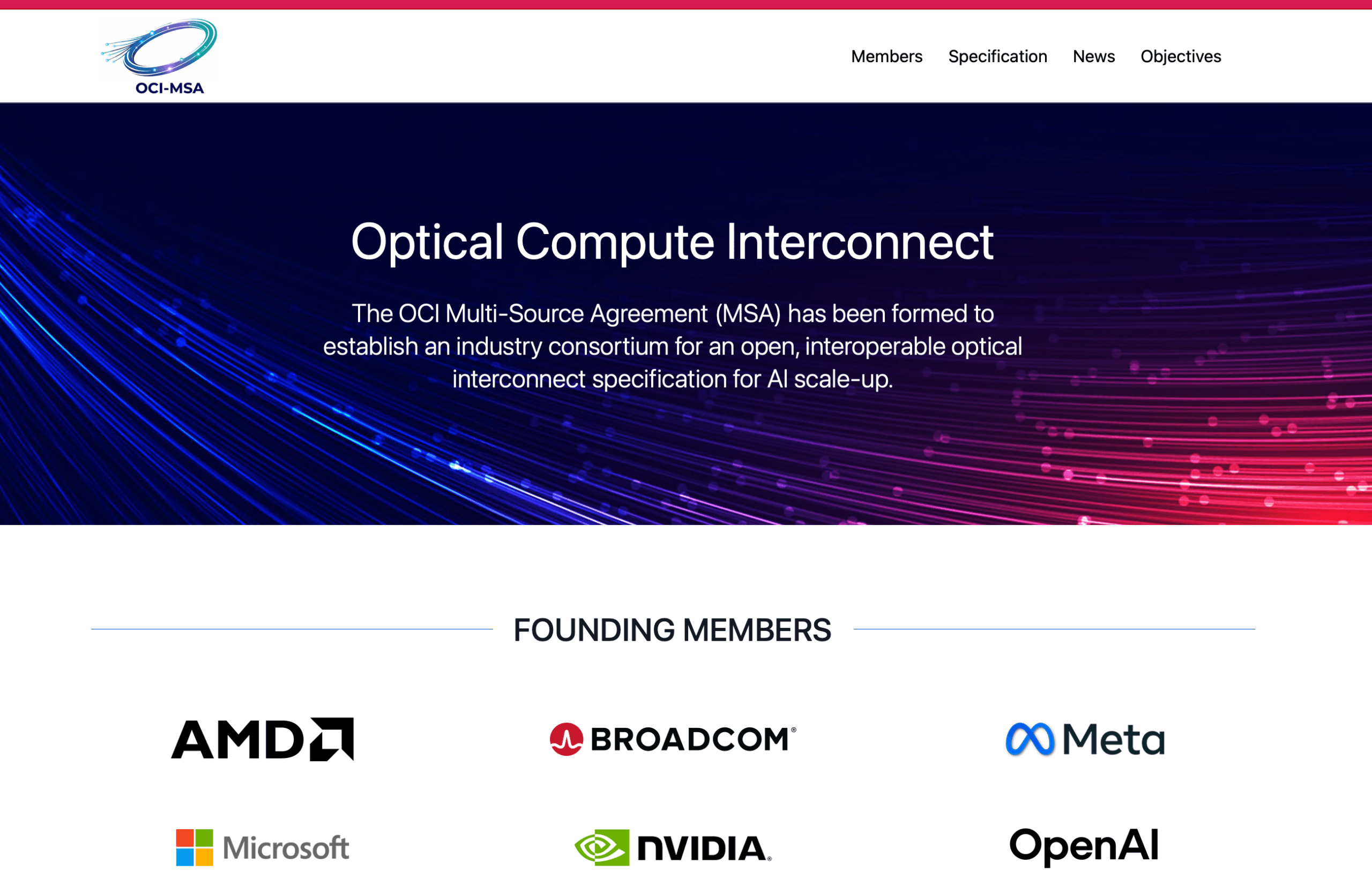
A new industry consortium called the Optical Compute Interconnect (OCI) Multi-Source Agreement (MSA) has formed to develop an open optical interconnect specification for next-generation AI infrastructure. Founding members include AMD, Broadcom, Meta, Microsoft, NVIDIA, and OpenAI. The initiative aims to create a multi-vendor ecosystem for optical scale-up interconnects that link processors, accelerators, and switches within large AI systems.
The consortium addresses a growing constraint in AI cluster design: the physical reach and power limitations of copper interconnects used for scale-up networking inside high-performance AI systems. The OCI specification proposes a silicon-centric optical physical layer designed to tightly integrate optics with compute and networking ASICs. The architecture combines non-return-to-zero (NRZ) signaling with wavelength-division multiplexing (WDM) to deliver higher bandwidth density while reducing power consumption relative to traditional copper-based links.
OCI defines a roadmap for interoperable optical PHYs that can support pluggable optics, on-board optics, and co-packaged optics (CPO). By standardizing the physical layer between processors and scale-up switches, the consortium aims to enable a plug-and-play ecosystem where hyperscalers can mix compute engines and optical interconnect technologies from multiple vendors while maintaining compatibility across generations of AI systems.
- Founding members: AMD, Broadcom, Meta, Microsoft, NVIDIA, OpenAI
- Objective: open specification for optical scale-up interconnects in AI infrastructure
- OCI GEN1: 4 wavelengths × 50 Gbps NRZ per direction (200 Gbps per direction)
- OCI GEN2: 400 Gbps per direction BiDi architecture
- Maximum fiber capacity roadmap: scaling toward 3.2 Tbps per fiber
- Optical technologies used: NRZ modulation combined with wavelength-division multiplexing (WDM)
- Supported integration models: pluggable optics, on-board optics, and co-packaged optics (CPO)
- Target systems: large-scale AI clusters and rack-scale compute fabrics
Brian Amick, Senior Vice President of Technology & Engineering at AMD, said: “The growing need for optical scale-up interconnect to support large AI systems later this decade is clear. AMD is a founding member and strong supporter of the OCI MSA as it establishes an open specification for the industry to foster a robust, multi-vendor optical scale-up interconnect ecosystem.”
🌐 Analysis
The OCI initiative reflects a broader shift toward optical interconnects inside AI scale-up domains, where bandwidth and power requirements exceed what copper links can economically deliver. Hyperscalers have begun exploring architectures that integrate optics closer to compute ASICs using technologies such as co-packaged optics and optical chiplets. OCI’s silicon-centric PHY approach aligns with these trends by standardizing the optical interface between accelerators and scale-up switches.
The consortium also signals increasing hyperscaler influence over interconnect standards. Companies including NVIDIA, Broadcom, and AMD already develop high-speed networking silicon and optical platforms, while Meta and Microsoft have pushed disaggregated hardware architectures through initiatives such as the Open Compute Project. OCI adds a new industry effort focused specifically on optical scale-up fabrics for AI clusters, which are expected to grow to tens of thousands of accelerators per training domain.