• Home
  • About
  • Events Calendar
  • Blueprint Guidelines
  • Privacy Policy
  • Manage Email Delivery
  • NextGenInfra.io
No Result
View All Result
Converge Digest
Wednesday, June 3, 2026
  • Home
  • About
  • Events Calendar
  • Blueprint Guidelines
  • Privacy Policy
  • Manage Email Delivery
  • NextGenInfra.io
No Result
View All Result
Converge Digest
No Result
View All Result

Home » Credo Begins Shipping 800G ZeroFlap Transceivers for AI Cluster Stability

Credo Begins Shipping 800G ZeroFlap Transceivers for AI Cluster Stability

March 19, 2026
in Optical
A A

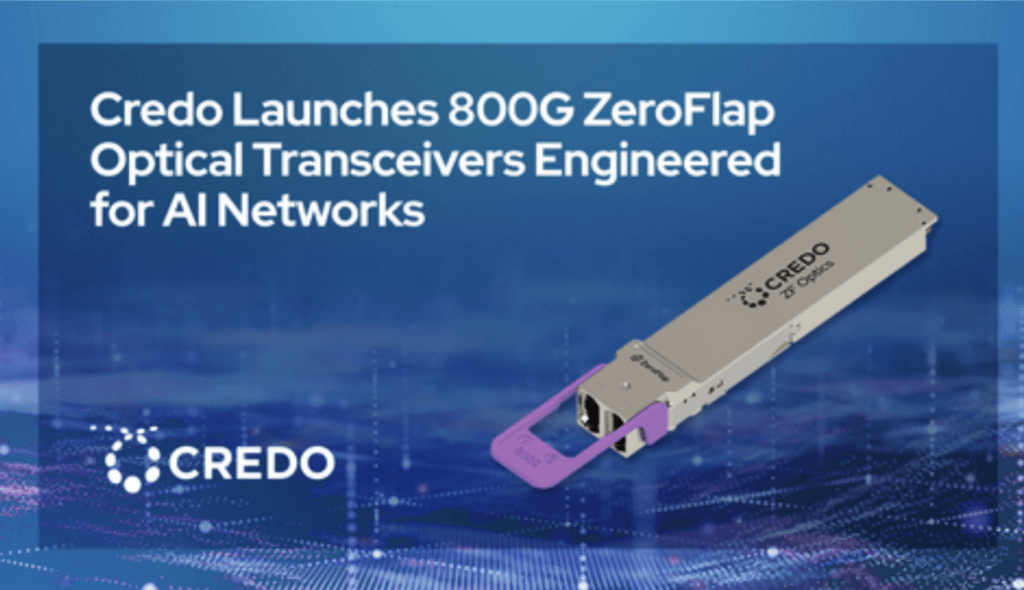
Credo announced general availability for its 800G 2 x DR4 ZeroFlap transceivers, positioning the product as a way to reduce optical link flaps that can disrupt AI cluster performance and slow deployment. The company said the modules aim to improve time to first token and overall cluster productivity by adding telemetry, fault isolation, and automated remediation directly into the transceiver.

The 800G 2 x DR4 ZeroFlap transceivers integrate in-band remote telemetry, automated responses to detect and mitigate link instability, and smart ticketing intended to simplify service requests. Credo said the products use PILOT extensions on network switches to extract optics telemetry and stream it to monitoring agents, with support for SONiC and other switch operating systems. The company is targeting operators that need better visibility into link health across large-scale AI infrastructure.

Credo said the modules also support remote telemetry collection from either endpoint of a link, non-volatile event logging for historical analysis, and compatibility with a range of network architectures including fiber shuffle designs. The products are available in both Integrated Heat Sink and Riding Heat Sink versions for switch-side and server-side deployments. The release focuses on a practical issue in AI networking: reducing link instability that can interrupt training and inference workloads at scale.

  • General availability of 800G 2 x DR4 ZeroFlap transceivers
  • Focused on reducing optical link flaps in AI clusters
  • In-band remote telemetry for real-time link monitoring
  • Automated fault localization, remediation, and prevention
  • Smart ticketing to speed service and troubleshooting workflows
  • Uses PILOT switch extensions for telemetry extraction and streaming
  • Supports SONiC and other switch operating systems
  • Remote access to telemetry from both sides of a link
  • Non-volatile event logging for historical troubleshooting
  • Supports multiple architectures, including fiber shuffle
  • Offered in Integrated Heat Sink and Riding Heat Sink versions

“By harnessing real-time telemetry inside the transceiver, we’re enabling networks to predict and prevent failures before they impact services,” said Chris Collins, AVP of Sales & Optical Product Marketing at Credo.

🌐 Analysis: Credo is trying to differentiate in 800G optics by addressing operational reliability, not just bandwidth or power efficiency. That aligns with a broader shift in AI infrastructure toward tighter integration of telemetry, automation, and fault management as clusters scale and downtime becomes more expensive. Competitors across the optical interconnect market are also emphasizing manageability and system-level efficiency, but Credo’s message here centers specifically on the persistent problem of link flaps in large AI deployments.

Tags: CredoOFC26
ShareTweetShareSummarizeSummarize
Previous Post

Broadcom Launches End-to-End PQC-Safe Fibre Channel Encryption 

Next Post

Cisco Expands Security with NVIDIA from Core Data Center to Edge

Jim Carroll

Jim Carroll

Editor and Publisher, Converge! Network Digest, Optical Networks Daily - Covering the full stack of network convergence from Silicon Valley

Related Posts

Financials

Credo Completes DustPhotonics Acquisition, Adds Silicon Photonics PICs

May 28, 2026
Semiconductors

Rebellions Integrates Credo ZeroFlap AECs

May 20, 2026
Optical

Credo to Acquire DustPhotonics in $750M Deal for AI Interconnects

April 13, 2026
All

Credo Settles AEC Patent Disputes with TE Connectivity and Molex

March 30, 2026
Semiconductors

TeraSignal Introduces Intelligent Redriver for 200G+ Copper Interconnects

March 26, 2026
Optical

NLM Photonics Advances Silicon-Organic Hybrid PICs

March 26, 2026
Next Post

Cisco Expands Security with NVIDIA from Core Data Center to Edge

Categories

  • 5G / 6G / Wi-Fi
  • AI Infrastructure
  • All
  • Automotive Networking
  • Blueprints
  • Clouds and Carriers
  • Data Centers
  • Enterprise
  • Explainer
  • Feature
  • Financials
  • Last Mile / Middle Mile
  • Legal / Regulatory
  • Optical
  • Quantum
  • Research
  • Security
  • Semiconductors
  • Space
  • Start-ups
  • Subsea
  • Sustainability
  • Video
  • Webinars

Archives

Tags

5G All AT&T Australia AWS Blueprint columns BroadbandWireless Broadcom China Ciena Cisco Data Centers Dell'Oro Ericsson FCC Financial Financials Huawei Infinera Intel Japan Juniper Last Mile Last Mille LTE Mergers and Acquisitions Mobile NFV Nokia Optical Packet Systems PacketVoice People Regulatory Satellite SDN Service Providers Silicon Silicon Valley StandardsWatch Storage TTP UK Verizon Wi-Fi
Converge Digest

A private dossier for networking and telecoms

Follow Us

  • Home
  • About
  • Events Calendar
  • Blueprint Guidelines
  • Privacy Policy
  • Manage Email Delivery
  • NextGenInfra.io

© 2026 Converge Digest - A private dossier for networking and telecoms.

No Result
View All Result
  • Home
  • About
  • Events Calendar
  • Blueprint Guidelines
  • Privacy Policy
  • Manage Email Delivery
  • NextGenInfra.io

© 2026 Converge Digest - A private dossier for networking and telecoms.

This website uses cookies. By continuing to use this website you are giving consent to cookies being used. Visit our Privacy and Cookie Policy.
Go to mobile version