
Credo agreed to acquire DustPhotonics for $750 million in cash plus stock, positioning the company to vertically integrate silicon photonics into its high-speed connectivity portfolio for AI infrastructure. The deal targets tighter integration across electrical and optical interconnects as hyperscalers scale clusters toward 800G, 1.6T, and emerging 3.2T architectures.
The acquisition brings DustPhotonics’ silicon photonics photonic integrated circuit (PIC) technology in-house, adding capabilities across 400G, 800G, and 1.6T optical modules, with a roadmap to 3.2T. These PICs integrate multiple optical functions onto a single chip, reducing component count, improving yields, and lowering cost at scale. The technology is already deployed in hyperscale AI clusters and is under development for Near-Port Optics (NPO) and Co-Packaged Optics (CPO) architectures, both considered critical for next-generation AI fabrics.
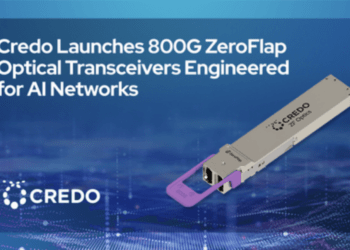
Credo said the combination of DustPhotonics’ PICs with its own SerDes and DSP portfolio enables a full-stack connectivity platform spanning copper and optical links. The company expects its optical business—including ZeroFlap transceivers, DSPs, and silicon photonics—to exceed $500 million in revenue by fiscal 2027, reflecting growing demand for power-efficient, high-reliability interconnects in large-scale AI deployments.
- $750M upfront consideration (cash + ~0.92M shares), plus up to ~3.21M shares in contingent earnout
- Expected close: Q2 2026, subject to regulatory approvals
- Accretive to non-GAAP EPS by fiscal 2027
- DustPhotonics brings silicon photonics PICs spanning 400G → 1.6T, roadmap to 3.2T
- Targets NPO and CPO architectures for AI cluster scale-out and scale-up
- Silicon photonics market projected to reach ~$6B by 2030 (company estimate citing LightCounting)
- Combined platform integrates SerDes, DSP, silicon photonics, and system-level design
“Combining forces with DustPhotonics marks a defining step in Credo’s strategy to lead across the full spectrum of AI connectivity… we are building a vertically integrated connectivity platform that spans from copper to optical and from chip to cluster—allowing us to solve for the two constraints that matter most at scale: reliability and power efficiency,” said William Brennan, Chairman and CEO of Credo.
🌐 Analysis:
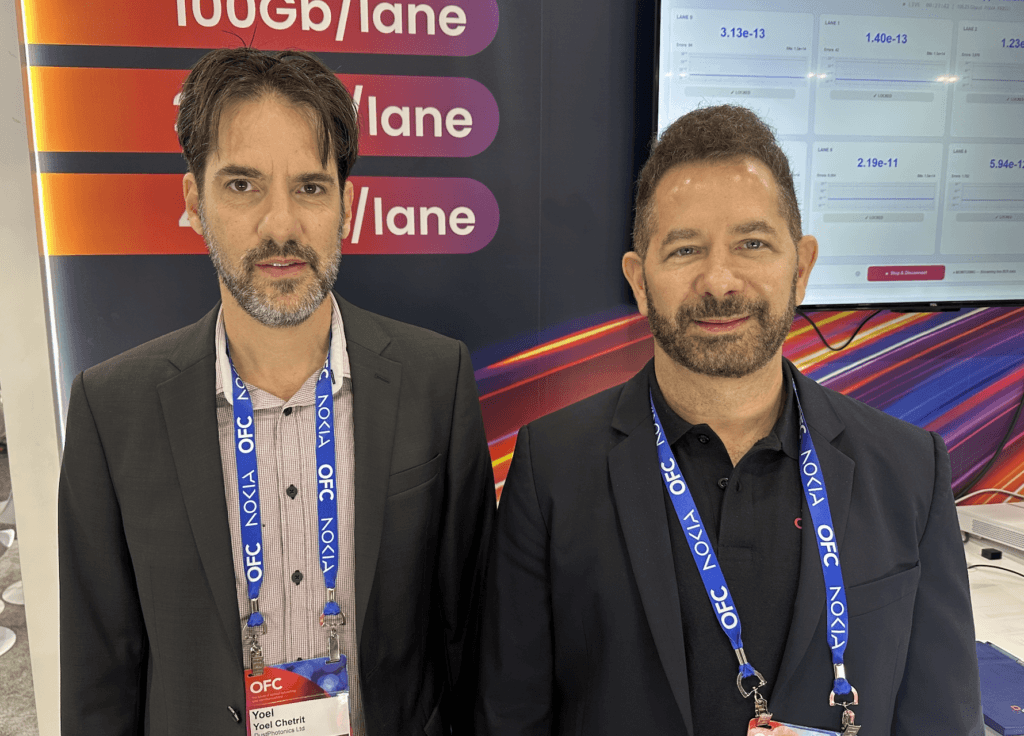
DustPhotonics is an Israeli startup founded in 2017 and headquartered in Israel. Its senior management team, including CEO Ronnen Lovinger (with prior operating roles at Mellanox and Innoviz), draws on deep expertise from leading networking and semiconductor companies, while co-founder and Chief R&D Officer Yoel Chetrit brings strong technical leadership in photonics; the company is chaired by prominent Israeli semiconductor entrepreneur Avigdor Willenz, known for his successes with Galileo Technology, Annapurna Labs, and Habana Labs.
At its core, DustPhotonics develops a comprehensive silicon photonics platform centered on photonic integrated circuits (PICs) and advanced laser-integration techniques, notably its proprietary low-loss laser coupling (L3C) approach. This enables higher bandwidth, lower power consumption, reduced cost, and scalable manufacturability for optical engines used across pluggable, near-package optics (NPO), and co-packaged optics (CPO) in AI and hyperscale data-center interconnects.
The current product portfolio includes:
- Carmel4 — 400G DR4 Silicon Photonics Engine
- Carmel8 — 800G DR8 Silicon Photonics Engine
- Oz4 — 800G DR4 Silicon Photonics Engine
- Oz8 — 1.6T DR8 Silicon Photonics Engine
- Tamar — 800G-2xFR4 Silicon Photonics Chip with integrated multiplexer
- Tamar200 — 1.6T-2xFR4 Silicon Photonics Chip (industry’s first merchant 1.6T-2xFR4 PIC)
The company’s publicly articulated roadmap extends these capabilities beyond 1.6T, building on its differentiated PICs that integrate key optical functions onto a single chip to improve yields, density, power efficiency, and reliability for next-generation AI infrastructure.
🌐 Analysis: In 2005, Credo acquired Hyperlume, a start-up based in Ottawa, Canada, that focused on microLED-based optical interconnect technology, specifically using arrays of microLEDs as highly efficient light sources for short-reach, high-bandwidth data center links. Its approach replaces traditional laser-based sources with microLED emitters that can be directly modulated at high speeds, offering advantages in power efficiency, integration density, and potentially lower cost for intra-rack and rack-to-rack connectivity. This architecture is particularly relevant for AI clusters where short-reach optical links dominate and where reducing watts per bit is critical.
Credo’s acquisition of Hyperlume (financial terms were not disclosed) adds a complementary optical front-end technology to its SerDes and DSP portfolio, giving it more flexibility in how it addresses different interconnect tiers—from copper to optical—especially in power-constrained AI environments. MicroLED-based links could also play a role alongside silicon photonics in future hybrid architectures, particularly for very short reach, high-density deployments.
For additional context, see prior coverage:
https://convergedigest.com/credo-acquires-hyperlume-to-advance-low-power-optical-interconnects/
🌐 We’re tracking the latest developments in networking silicon. Follow our ongoing coverage at: https://convergedigest.com/category/semiconductors/