
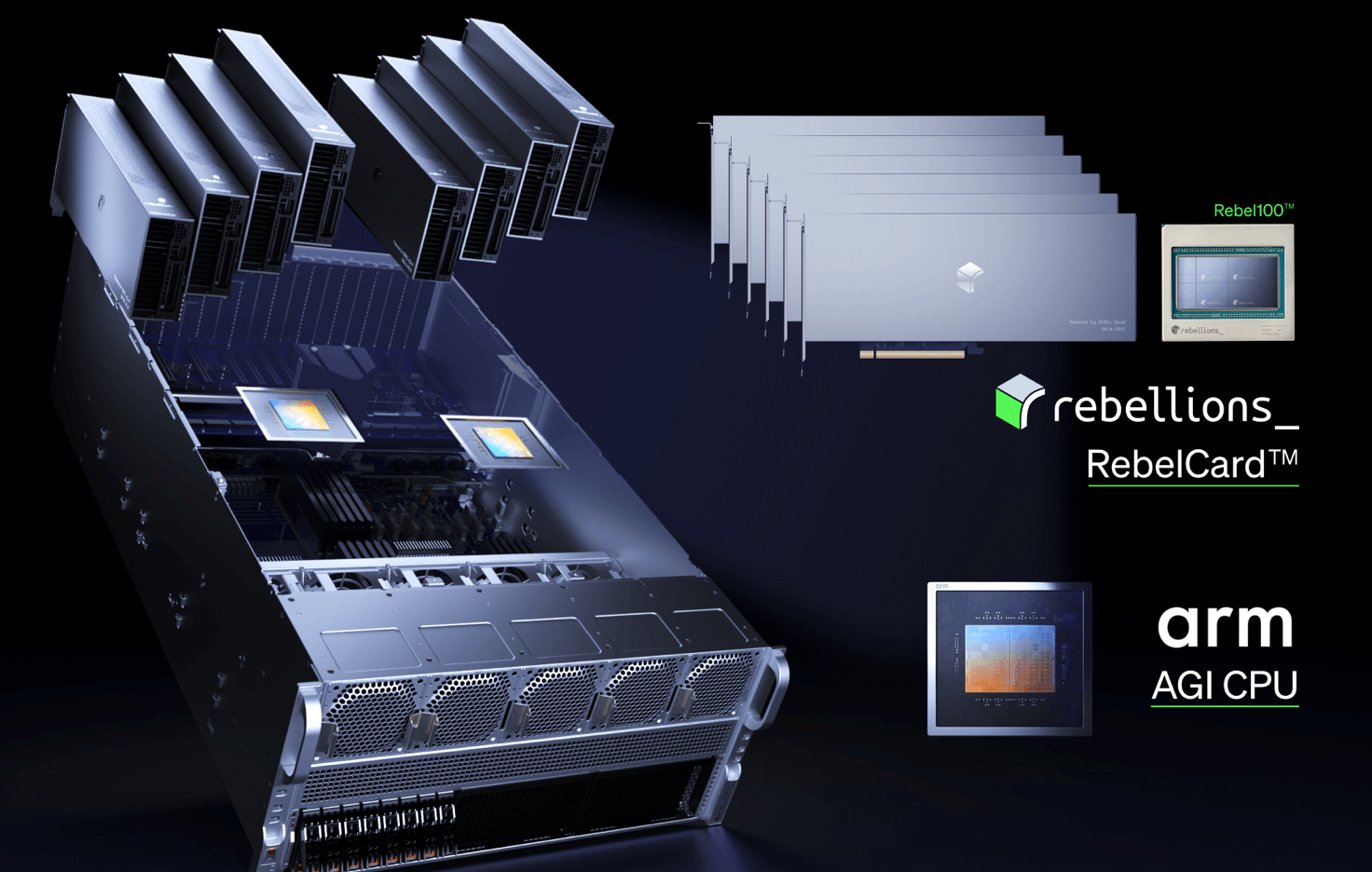
Rebellions, Arm, and SK Telecom announced a joint initiative to develop AI inference infrastructure tailored for sovereign AI and telecommunications data center environments. The collaboration centers on integrating Arm’s forthcoming AGI CPU—its first data center CPU design—with Rebellions’ RebelCard™ accelerator, with validation planned inside SK Telecom’s AI data centers.
The partners will co-design both hardware and software, spanning firmware through full-stack optimization, to support large-scale inference workloads and telco-specific AI applications. The platform will combine Arm’s AGI CPU, built on Neoverse CSS V3, with Rebellions’ RebelCard™, which incorporates four NPU chiplets and HBM3E memory. SK Telecom will test the system in live environments, including potential deployment of its proprietary A.X K1 foundation model, to verify performance, stability, and operational readiness.
Following validation, the companies plan to commercialize the solution globally, targeting telecom operators and public sector organizations seeking sovereign AI infrastructure. The effort reflects growing demand for regionally controlled AI systems and aims to establish a reference architecture for energy-efficient inference platforms that can scale across national and enterprise deployments.
• Joint development of AI inference servers combining Arm AGI CPU and Rebellions RebelCard™
• Full-stack co-optimization, including firmware and software for telco and sovereign AI workloads
• Validation in SK Telecom’s AI data centers, including potential use of A.X K1 foundation model
• Focus on energy-efficient, air-cooled infrastructure as an alternative to GPU-based systems
• Target markets include telecom operators and public sector sovereign AI deployments globally
• RebelCard™ integrates four NPU chiplets with HBM3E, optimized for multimodal and MoE models
“Arm AGI CPU, built on Arm Neoverse CSS V3, was designed to deliver the performance and efficiency required for large-scale AI deployments. Together with Rebellions and SK Telecom, we’re enabling scalable infrastructure for sovereign AI and telecommunications markets,” said Eddie Ramirez, vice president of go-to-market, Cloud AI Business Unit at Arm.

🌐 Analysis: This collaboration aligns with a broader industry shift toward sovereign AI, where governments and telecom operators seek localized control over AI infrastructure and data. Similar efforts are emerging across Europe, the Middle East, and Asia, often combining national cloud initiatives with customized silicon and software stacks. Rebellions’ focus on inference-specific accelerators positions it against GPU-centric ecosystems from companies like NVIDIA, particularly in deployments where power efficiency and cost constraints dominate.
🌐 Analysis: Arm continues to expand its footprint in data center AI through Neoverse-based CPUs and ecosystem partnerships, while telecom operators like SK Telecom are evolving into AI platform providers. The integration of CPU, accelerator, and telco-grade validation reflects a move toward vertically integrated AI infrastructure stacks optimized for specific industry workloads rather than general-purpose cloud deployments.
🌐 Analysis: Rebellions is headquartered in Seoul, South Korea, and was founded in 2020 by CEO Sunghyun Park, a former quantitative researcher at Morgan Stanley, alongside a team with expertise in semiconductor design and high-performance computing. The company focuses on purpose-built AI inference silicon, positioning its Rebel series as an alternative to GPU-based architectures for large-scale deployment. Rebellions has attracted backing from strategic and financial investors including Saudi Aramco (via Prosperity7 Ventures), Samsung Electronics, SK Hynix, KT Corporation, and SK Telecom. In March 2026, the company closed a $400 million pre-IPO funding round led by Mirae Asset Financial Group and the Korea National Growth Fund, bringing total funding to approximately $850 million and valuing the company at about $2.34 billion.



