Following its Ising model announcement, NVIDIA’s quantum computing lead Krysta Svore outlines how AI, GPUs, and open platforms will transform today’s noisy qubits into scalable, fault-tolerant quantum systems.
This article follows our coverage of NVIDIA’s announcement of its Ising open model family for quantum computing, which introduces AI models for calibration and error correction. Here, we take a deeper look at the system-level architecture and roadmap presented by Krysta Svore during NVIDIA Quantum Day, including how these models fit into a broader push toward scalable quantum computing.
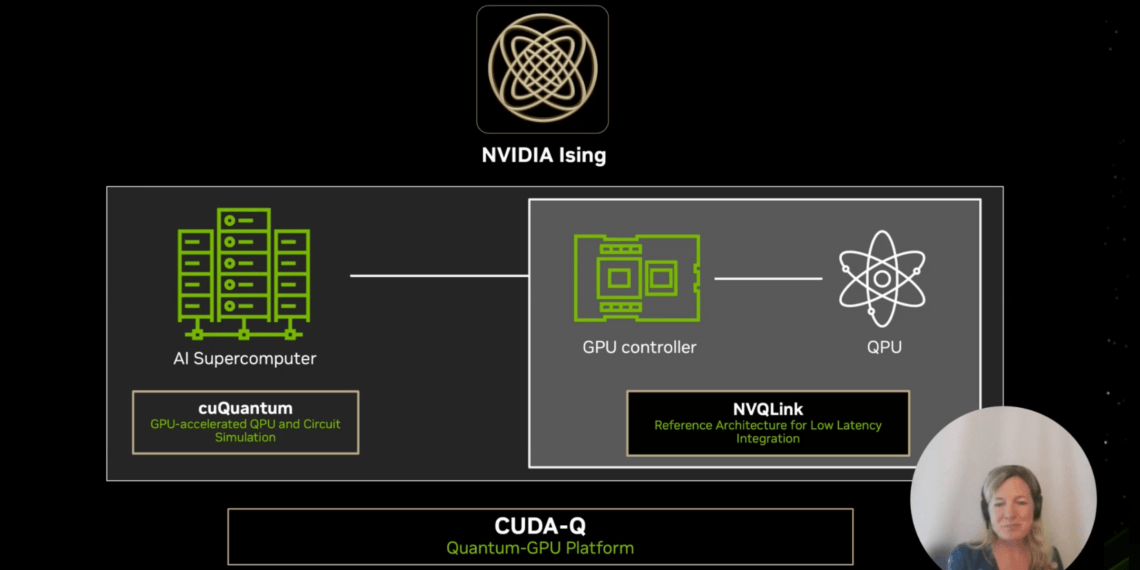
At NVIDIA’s World Quantum Day event, Krysta Svore, Vice President of Quantum Computing and Distinguished Engineer at NVIDIA, laid out a system-level vision for scaling quantum computing from experimental hardware into practical, fault-tolerant machines. Her central thesis: quantum computing will only become useful when tightly integrated with AI and accelerated computing, forming what NVIDIA describes as a quantum GPU supercomputer.
Svore compared quantum computing to transformative scientific instruments such as the microscope—tools that enabled entirely new fields of discovery. In a similar way, she argued, quantum systems have the potential to unlock breakthroughs in chemistry, materials science, drug discovery, and energy systems. However, realizing that potential requires more than increasing qubit counts; it demands building reliable, scalable computational systems capable of sustained, error-free operation.
A key challenge is the inherently noisy nature of today’s qubits. The industry is converging on the need for logical qubits—error-corrected virtual qubits composed of many physical qubits—to enable longer and more complex computations. Achieving this requires continuous calibration, real-time error decoding, and tight coupling between quantum processors (QPUs) and classical compute resources such as GPUs.
Svore emphasized that this is fundamentally a systems engineering problem, not just a physics milestone. The path forward involves integrating quantum hardware with AI-driven software stacks, real-time data processing, and simulation environments. NVIDIA’s broader quantum platform—including CUDA-Q, high-performance simulation tools, and GPU-QPU interconnect architectures—aims to provide the foundation for this hybrid approach.
Key Points:
- Focus shifts from raw qubit counts to logical qubits and system reliability
- NVIDIA advancing quantum GPU supercomputer architecture integrating QPUs with GPUs
- CUDA-Q enables hybrid quantum-classical application development
- AI plays a central role in calibration, decoding, simulation, and system modeling
- New Ising open models target QPU calibration and quantum error correction
- Calibration model automates a complex, manual process using a 35B-parameter AI model
- Tasks reduced from hours to seconds in early deployments
- New QCal benchmark standardizes calibration performance across platforms
- Decoding models deliver 2.5× speed gains and 3× improved error correction accuracy
- Open datasets and models aim to accelerate ecosystem-wide innovation
Central to this vision is the role of AI in managing quantum system complexity. Svore described workloads such as calibration, error correction, and system modeling as inherently AI-driven. These tasks involve interpreting large volumes of noisy data, optimizing system parameters, and making real-time decisions during computation—capabilities well suited to modern machine learning models.
In calibration, AI models analyze experimental data and automatically tune qubit parameters, replacing what is today a largely manual and time-intensive process. In decoding, AI models process error syndromes and infer corrective actions with extremely low latency, enabling real-time quantum error correction. Together, these capabilities directly impact the reliability and scalability of quantum systems.
“Quantum workloads are ultimately AI workloads,” Svore noted, underscoring the convergence between the two fields.
A notable aspect of NVIDIA’s approach is its emphasis on open models and datasets. Svore highlighted that much of today’s quantum data remains proprietary, limiting collaboration and slowing progress. By releasing open models, benchmarks, and training data through the Ising initiative, NVIDIA aims to enable researchers and developers worldwide to build, fine-tune, and extend quantum AI capabilities across diverse hardware platforms.
Ultimately, Svore framed the next phase of quantum computing as a transition from isolated devices to fully integrated computational systems. Progress will depend not only on advances in qubit technology, but also on the ability to orchestrate complex workflows across quantum and classical resources in real time.
Analysis:
NVIDIA’s Quantum Day presentation reinforces its strategy to position GPUs and AI as the control layer for future quantum systems. Rather than focusing on building QPUs, NVIDIA is targeting the surrounding infrastructure—software, simulation, and real-time control—where it can leverage its strengths in accelerated computing.
The introduction of open AI models for calibration and decoding could help standardize critical workflows across a fragmented quantum hardware landscape. If broadly adopted, this approach may reduce duplication of effort among QPU developers and accelerate progress toward fault-tolerant systems.
More broadly, the framing of quantum computing as a hybrid AI-driven architecture suggests that near-term advances will come from system integration rather than standalone quantum breakthroughs. In this model, GPUs handle simulation, optimization, and control, while QPUs perform specialized quantum operations—together forming a tightly coupled computational platform.
🌐 Related: NVIDIA Introduces Ising Open Models for Quantum Calibration and Error Correction
🌐 Context: NVIDIA Quantum Day – AI + Quantum Computing Convergence