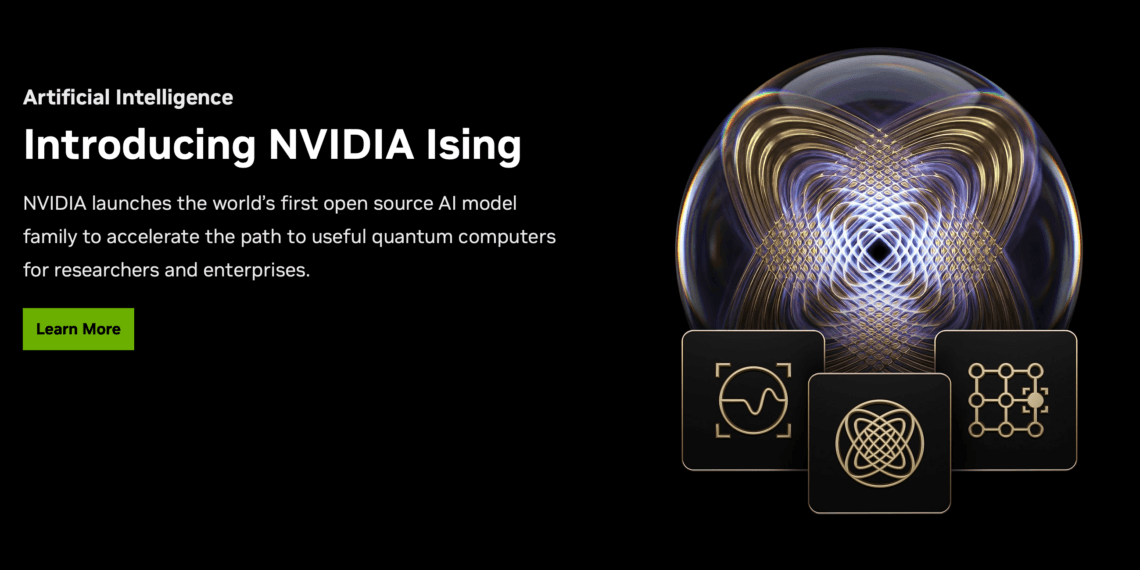
NVIDIA introduced a new family of open AI models, called Ising, targeting two of the most difficult engineering barriers in quantum computing: processor calibration and quantum error correction. The models aim to improve the reliability and scalability of quantum systems by applying AI to interpret quantum measurements and manage error-prone qubits in real time.
The Ising model family includes tools for automated calibration and decoding of quantum errors. NVIDIA said its Ising Decoding models deliver up to 2.5x faster performance and 3x higher accuracy compared to approaches such as pyMatching. The Ising Calibration model uses a vision-language architecture to continuously analyze quantum system outputs, reducing calibration cycles from days to hours. These capabilities are designed to support hybrid quantum-classical systems, where GPUs work alongside quantum processing units (QPUs).
Adoption spans a wide ecosystem, including Fermi National Accelerator Laboratory, Lawrence Berkeley National Laboratory, Harvard John A. Paulson School of Engineering and Applied Sciences, and companies such as IonQ and IQM Quantum Computers. NVIDIA is also releasing supporting workflows, training datasets, and deployment tools via its NIM microservices, enabling developers to customize models for specific quantum hardware while maintaining local data control.
The Ising models integrate with NVIDIA’s broader quantum stack, including CUDA-Q for hybrid programming and NVQLink for QPU-GPU interconnects. This positions AI as a control layer for quantum systems, helping stabilize qubits and accelerate progress toward commercially viable quantum computing.
“AI is essential to making quantum computing practical,” said Jensen Huang. “With Ising, AI becomes the control plane — the operating system of quantum machines — transforming fragile qubits to scalable and reliable quantum-GPU systems.”
• First open AI model family focused on quantum calibration and error correction
• Up to 2.5x faster and 3x more accurate decoding versus existing methods
• Vision-language model automates quantum processor calibration
• Broad adoption across national labs, universities, and quantum startups
• Integrates with CUDA-Q and NVQLink for hybrid quantum-classical systems
🌐 Analysis: NVIDIA is extending its GPU-centric AI platform into quantum computing by positioning AI as the orchestration layer for hybrid systems. This aligns with its broader strategy seen in CUDA-Q and NVLink/NVQLink, where tight coupling between compute elements drives system-level performance. Competitors such as IBM and Google continue to focus on hardware scaling and error correction research, but NVIDIA is differentiating by abstracting complexity through AI-driven control and open model distribution.
The term “Ising” originates from the Ising model, a foundational framework in statistical mechanics that describes how simple binary elements (spins) interact locally to produce complex global behavior—an abstraction that maps closely to quantum systems, where qubits interact, accumulate noise, and require coordinated control. In quantum computing, many optimization and error-correction problems can be expressed in Ising-like formulations, making it a natural conceptual bridge between physics and computation. NVIDIA adopts the name for its NVIDIA Ising models to signal this connection: its AI systems learn and manage the intricate interactions among qubits, automating calibration and improving error correction by treating the quantum processor as a complex, interacting system similar to an Ising lattice. The naming underscores NVIDIA’s strategy of using AI—running on GPUs—as a real-time control layer for quantum hardware, effectively translating a historically theoretical model into a practical tool for stabilizing and scaling quantum computers.