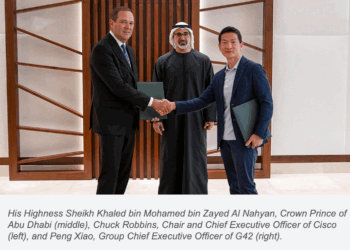
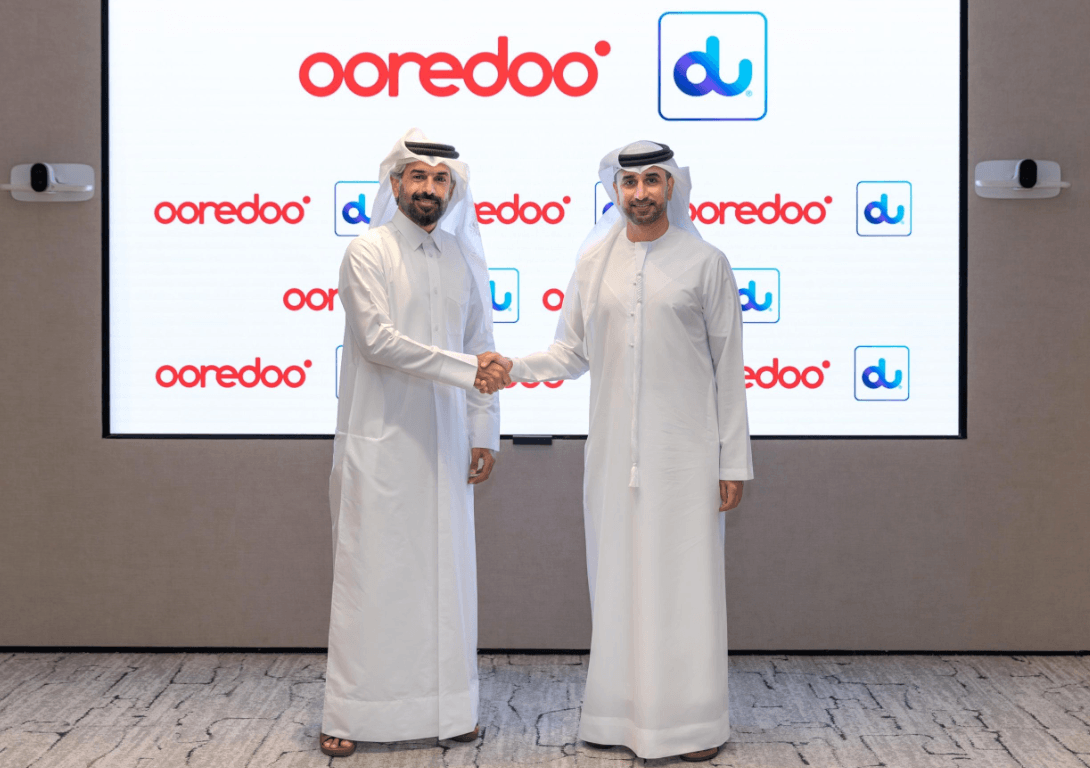
Ooredoo Group and du announced plans to land the Fibre in the Gulf (FIG) subsea cable system at a du cable station in the UAE, extending regional connectivity infrastructure designed to support hyperscaler traffic, AI workloads, and cloud demand across the Gulf Cooperation Council (GCC). The announcement marks another milestone for the FIG project, a multi-country subsea network led by Ooredoo Fibre Networks to improve resilience and route diversity across the Middle East.
The FIG system is designed to deliver up to 720 Tbps of total capacity across 24 fibre pairs in a loop architecture interconnecting Qatar, the UAE, Bahrain, Saudi Arabia, Kuwait, Iraq, and Oman. The UAE landing enhances redundancy for regional and international traffic flows linking the Middle East with Europe and Asia while creating additional paths for enterprise, cloud, and AI-related traffic. Operators across the Gulf continue to accelerate subsea and terrestrial infrastructure investments as AI inference, training clusters, and sovereign cloud deployments increase bandwidth and latency requirements.
The project reflects broader regional efforts to position the Gulf as a major interconnection hub between Asia, Europe, and Africa. Demand from hyperscalers and AI platform providers continues to drive upgrades in international transport capacity, particularly in markets with expanding data center footprints and government-backed digital transformation initiatives. Ooredoo and du are positioning the FIG system as foundational infrastructure for next-generation digital services and high-capacity cloud connectivity across the GCC.
• Announced May 7, 2026
• 24 fibre pairs
• Up to 720 Tbps total system capacity
• Connectivity across Qatar, UAE, Bahrain, Saudi Arabia, Kuwait, Iraq, and Oman
• New landing at du’s cable station in the UAE
• Designed to support hyperscalers, cloud providers, and AI platforms
• Loop architecture intended to improve resiliency and route diversity
“FIG reflects our continued focus on building high-capacity, resilient connectivity infrastructure aligned with how demand is evolving. This partnership with du marks another step in the execution of the project,” said Aziz Aluthman Fakhroo, Group CEO of Ooredoo.
🌐 Analysis: The FIG project advances at a time of elevated geopolitical instability across the Middle East, where ongoing conflicts and maritime security concerns continue to shape subsea infrastructure planning. Operators increasingly prioritize route diversity, redundant landing points, and alternative terrestrial backhaul options as risks rise around strategic chokepoints and shipping corridors. Recent attacks on regional infrastructure, persistent instability linked to the Israel-Hamas conflict, Houthi activity in the Red Sea, and broader tensions involving Iran have heightened awareness of the vulnerability of submarine cable systems that carry a significant portion of global internet and cloud traffic. The Gulf region nevertheless has been one of the fastest-growing markets for subsea investment due to surging AI infrastructure demand, hyperscaler expansion, and sovereign digital initiatives. New systems such as FIG, 2Africa, Blue-Raman, and Gulf-focused terrestrial bypass projects reflect an industry-wide effort to improve resilience while reducing dependence on single transit routes.
🌐 Analysis: Multiple subsea cable projects and repair operations in the Middle East and Red Sea have been delayed, suspended, or materially disrupted this year because of the expanding regional conflict involving Iran, Israel, the U.S., and Houthi activity in the Red Sea.
The clearest example is the “Pearls” segment of Meta’s 2Africa system, which connects Gulf states, Pakistan, and India. Cable-laying contractor Alcatel Submarine Networks (ASN) reportedly declared force majeure and suspended operations in the Persian Gulf because conditions became unsafe for cable ships.
Industry reports indicate that:
- Cable-laying ships halted operations in parts of the Persian Gulf
- Some repair vessels could not safely enter affected waters
- Insurance and war-risk premiums increased sharply
- Permitting and naval security coordination became more complex
- Operators began evaluating alternative terrestrial bypass routes around Red Sea and Hormuz chokepoints
The broader concern is not only direct attacks, but collateral damage and operational paralysis. In 2024 and continuing into 2025–2026, several Red Sea cable outages were linked to drifting or damaged ships after Houthi-related attacks. Repair timelines stretched dramatically because specialized cable repair ships could not safely operate in the area.
Reuters recently highlighted the Strait of Hormuz as a “digital chokepoint” because major systems including:
- AAE-1
- FALCON
- Gulf Bridge International
- FIG
- SEA-ME-WE routes