HPE unveiled a broad set of enhancements to its GreenLake hybrid cloud platform and HPE Morpheus Software portfolio at HPE Discover 2026, positioning the company to address growing enterprise demand for AI-driven operations, virtualization alternatives, and unified management across traditional and AI infrastructure. The announcement centers on “agentic” IT operations, where AI agents assist with observability, orchestration, governance, and automated remediation across hybrid environments.
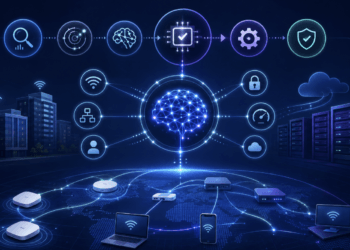
A key element is the expansion of GreenLake Intelligence, HPE’s agentic AI framework for hybrid cloud and AI operations. New capabilities include a centralized agent registry, orchestration services, governance controls, and the HPE OpsRamp Operations Copilot, which adds observability for AI agents, large language models (LLMs), and AI infrastructure. The platform can monitor AI utilization, track token consumption, analyze costs, correlate telemetry across the stack, and perform agentic root-cause analysis. HPE is also partnering with ServiceNow to integrate GreenLake Intelligence with ServiceNow’s autonomous AI workforce platform, creating a unified operational framework spanning infrastructure observability through automated service delivery.
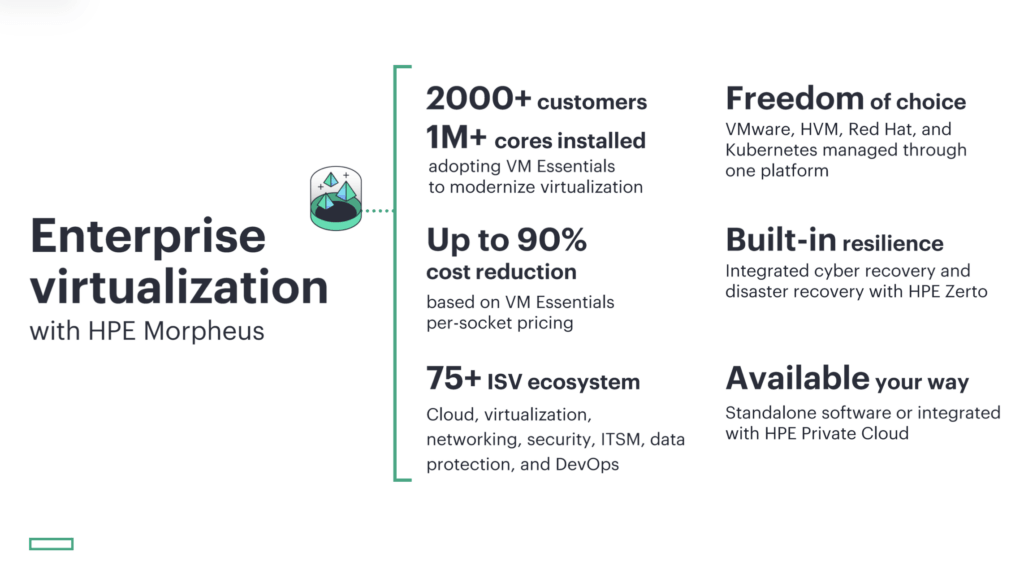
HPE also expanded its virtualization and private cloud portfolio through HPE Morpheus Software. New capabilities include Morpheus Orchestration Copilot for AI-assisted provisioning and workflow automation, Morpheus Central for centralized management across deployments, generally available software-defined networking, Juniper Apstra integration for intent-based network automation, stretched-cluster support for metro resiliency, and HPE Zerto-based migration tools aimed at VMware displacement opportunities. HPE further announced plans to deepen collaboration with Citrix, including future support for Citrix Desktop-as-a-Service on GreenLake and integration with Morpheus virtualization platforms.
• GreenLake Intelligence introduces centralized governance, orchestration, and lifecycle management for enterprise AI agents.
• OpsRamp Operations Copilot adds observability for AI agents, LLMs, token consumption, and AI infrastructure costs.
• HPE and ServiceNow plan to integrate infrastructure observability with autonomous AI-driven service management workflows.
• Morpheus Orchestration Copilot automates infrastructure provisioning and operational workflows through a bring-your-own-model architecture.
• Software-defined networking for Morpheus is now generally available, enabling zero-trust networking, multitenancy, and VXLAN overlays.
• Juniper Apstra integration provides intent-based, closed-loop network validation and policy enforcement.
• HPE is offering migration incentives for organizations seeking alternatives to VMware, including free licensing offers and discounted Zerto migration software.
• Air-gapped versions of HPE Private Cloud PC3000 and PC7000 will support sovereign, defense, and regulated deployments, including readiness for Department of Defense IL4 certification.
“ As enterprises scale AI, they need a simpler way to govern AI infrastructure and modernize operations across hybrid environments without fragmentation or unpredictable costs,” said Fidelma Russo, EVP, President and GM, Hybrid Cloud and CTO at HPE. “The latest advancements in GreenLake give enterprises a proven, unified path for agentic hybrid operations today and a foundation for future autonomous operations.”
🌐 Analysis
HPE is building a software and operations layer spanning AI factories, private cloud infrastructure, networking, and enterprise IT operations. While much of the industry focus remains on GPUs and AI infrastructure hardware, HPE is increasingly emphasizing operational automation, governance, and lifecycle management as enterprises move from AI pilots to production deployments. The GreenLake Intelligence framework also extends HPE’s effort to position itself as a control plane for heterogeneous AI environments rather than solely an infrastructure supplier.
The Morpheus portfolio continues to play an important strategic role following HPE’s acquisition of Morpheus Data in 2024. Since then, HPE has steadily expanded Morpheus into a VMware alternative while integrating it across GreenLake, private cloud, and hybrid operations offerings. The timing is significant as many enterprises continue evaluating virtualization alternatives following Broadcom’s VMware licensing changes. HPE’s combination of virtualization, automation, observability, disaster recovery, and networking integration seeks to capture a larger share of infrastructure modernization projects.
For networking professionals, the integration of Juniper Apstra with Morpheus is notable because it extends intent-based networking concepts into cloud and AI infrastructure operations. Combined with GreenLake Intelligence, HPE is moving toward a model where infrastructure, networking, virtualization, and AI operations share a common automation framework.
| Date | Article | Coverage Area |
| June 16, 2026 | HPE’s Antonio Neri: Architecting AI Begins With the Network | AI infrastructure, networking, governance, power, and operations |
| June 17, 2026 | Vultr Selects HPE and NVIDIA for Next-Generation AI Infrastructure | HPE and NVIDIA AI factory deployments |
| June 17, 2026 | HPE Unifies Agentic IT Operations Across GreenLake and Morpheus | Agentic AIOps, virtualization, and hybrid cloud control |
| What is HPE Morpheus? | |||
| Origin | Functionality | Primary Competitor | Other Competitors |
| Acquired technology. HPE acquired Morpheus Data in 2024 and integrated its hybrid cloud management software into GreenLake and HPE Private Cloud. | Provides hybrid cloud management, VM and container provisioning, self-service automation, orchestration, governance, multicloud operations, and virtualization management through HPE Morpheus Software and VM Essentials. | VMware vSphere / VMware Cloud Foundation. HPE explicitly markets Morpheus VM Essentials as a VMware alternative for customers seeking lower cost and reduced lock-in. | Microsoft Hyper-V, Nutanix Cloud Platform / AHV, Red Hat Enterprise Linux / OpenShift-related virtualization options, SUSE Linux Enterprise Server, OpenStack/KVM, and other private cloud platforms. |