
• Home
  • Events Calendar
  • Blueprint Guidelines
  • Privacy Policy
  • Subscribe to Daily Newsletter
  • NextGenInfra.io
No Result
View All Result
Converge Digest
Thursday, May 14, 2026
  • Home
  • Events Calendar
  • Blueprint Guidelines
  • Privacy Policy
  • Subscribe to Daily Newsletter
  • NextGenInfra.io
No Result
View All Result
Converge Digest
No Result
View All Result

Home » HPE Pushes Agentic AIOps with Self-Driving Network Actions

HPE Pushes Agentic AIOps with Self-Driving Network Actions

May 6, 2026
in Enterprise
A A

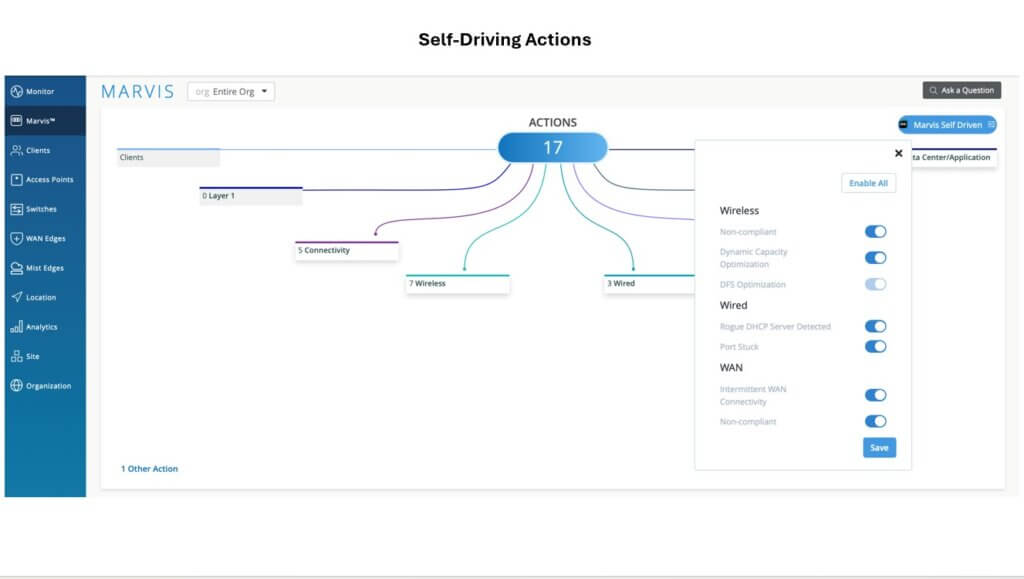
HPE introduced new self-driving network capabilities across HPE Mist and HPE Aruba Central, moving its AI-native networking strategy from operational insights toward autonomous remediation. The new architecture uses microservices, autonomous agents, and an agentic mesh to detect, diagnose, and resolve network issues in real time without human intervention.

The company said the new self-driving actions target common enterprise network problems, including wireless capacity bottlenecks, VLAN misconfiguration, rogue DHCP servers, DFS channel disruption, client roaming issues, and first-connect Wi-Fi latency. HPE also expanded OpenRoaming integration and added Zero Trust enhancements, including inline microsegmentation and NAC sandbox testing.

The UK Ministry of Justice cited a roughly 75% reduction in Service Desk tickets and the in-house management of about 15,000 devices after deploying HPE Self-driving Network capabilities across a complex, multi-vendor digital estate.

  • Dynamic Capacity Optimization adjusts RF parameters including band selection, channel bandwidth, and power levels based on learned utilization patterns.
  • Autonomous Missing VLAN Remediation fixes access-layer VLAN errors to prevent client traffic blackholing.
  • Rogue DHCP Protection detects and remediates unauthorized DHCP servers.
  • Real-time DFS optimization helps avoid frequently impacted wireless channels.
  • Client Roaming Optimization analyzes connectivity and location metrics to improve mobility.
  • User Experience Latency Metrics provide visibility from first Wi-Fi connection through cloud access.
  • OpenRoaming integration simplifies secure Wi-Fi access across locations.
  • Inline Microsegmentation extends consistent wired and wireless policy enforcement.
  • NAC dry-run testing validates policies before deployment.
  • HPE Networking 723H APs are now generally available as dual-platform Wi-Fi 7 access points supporting either HPE Mist or HPE Aruba Central.

“The self-driving network is no longer aspirational; it’s operational,” said Rami Rahim, executive vice president, president and general manager, Networking, HPE. “The network HPE now delivers represents a pivotal shift for our customers, and marks a breakaway moment for them to capture the benefits of the next frontier of autonomous actions.”
🌐 Analysis: HPE is positioning autonomous networking as the next stage of enterprise AIOps, shifting the value proposition from dashboards and recommendations to closed-loop remediation. The announcement also reflects the strategic importance of HPE’s Juniper acquisition path, with Mist’s AI-native architecture becoming a central pillar for HPE’s broader networking portfolio.

Tags: HPE
ShareTweetShareSummarizeSummarize
Previous Post

AMD Q1 Revenue Rises 38% as Data Center Becomes Core Growth Engine

Next Post

Corning Extends “Springboard” Growth Plan on AI Photonics

Jim Carroll

Jim Carroll

Editor and Publisher, Converge! Network Digest, Optical Networks Daily - Covering the full stack of network convergence from Silicon Valley

Related Posts

Security

AI-Driven: Security & Autonomous Troubleshooting

March 31, 2026
Security

HPE Rolls Out SRX400 Firewalls and AI Security Stack

March 24, 2026
Enterprise

HPE Brings Edge AI and Fault-Tolerant Core Systems to Retail 

January 12, 2026
Financials

HPE Cites Surging AI Infrastructure Momentum and Networking Growth

December 4, 2025
All

HPE’s New Networking Stack for AI, 102.4T Data Center Switch,  1.6T Edge Router

December 3, 2025
All

HPE Expands GreenLake and Morpheus

December 3, 2025
Next Post

Corning Extends “Springboard” Growth Plan on AI Photonics

Categories

  • 5G / 6G / Wi-Fi
  • AI Infrastructure
  • All
  • Automotive Networking
  • Blueprints
  • Clouds and Carriers
  • Data Centers
  • Enterprise
  • Explainer
  • Feature
  • Financials
  • Last Mile / Middle Mile
  • Legal / Regulatory
  • Optical
  • Quantum
  • Research
  • Security
  • Semiconductors
  • Space
  • Start-ups
  • Subsea
  • Sustainability
  • Video
  • Webinars

Archives

Tags

5G All AT&T Australia AWS Blueprint columns BroadbandWireless Broadcom China Ciena Cisco Data Centers Dell'Oro Ericsson FCC Financial Financials Huawei Infinera Intel Japan Juniper Last Mile Last Mille LTE Mergers and Acquisitions Mobile NFV Nokia Optical Packet Systems PacketVoice People Regulatory Satellite SDN Service Providers Silicon Silicon Valley StandardsWatch Storage TTP UK Verizon Wi-Fi
Converge Digest

A private dossier for networking and telecoms

Follow Us

  • Home
  • Events Calendar
  • Blueprint Guidelines
  • Privacy Policy
  • Subscribe to Daily Newsletter
  • NextGenInfra.io

© 2026 Converge Digest - A private dossier for networking and telecoms.

No Result
View All Result
  • Home
  • Events Calendar
  • Blueprint Guidelines
  • Privacy Policy
  • Subscribe to Daily Newsletter
  • NextGenInfra.io

© 2026 Converge Digest - A private dossier for networking and telecoms.

This website uses cookies. By continuing to use this website you are giving consent to cookies being used. Visit our Privacy and Cookie Policy.
Go to mobile version