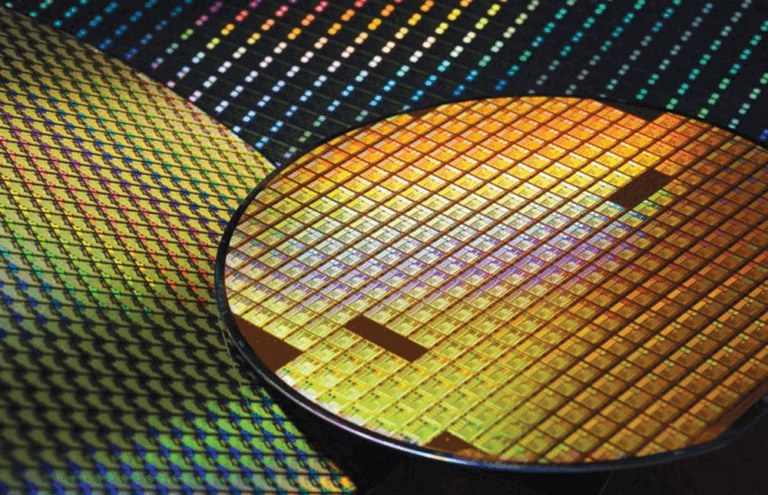
Marvell’s first 3nm silicon is now in fabrication with Taiwan Semiconductor Manufacturing Company (TSMC) on its 3nm shuttle. Marvell said this advancement will enable it to develop some of the most advanced multi-die, multi-chiplet systems-in-package (SiP) for its infrastructure products and co-development of custom ASIC solutions optimized for some of the most challenging infrastructure use cases, such as machine learning.
The 3nm platform includes foundational IP building blocks such as long reach SerDes, PCIe Gen6 PHY, and several standards-based die-to-die interconnect technologies for managing data flow across the data infrastructure.
This 3nm development follows numerous 5nm solutions from Marvell – in production or development – that span electro-optics, switch, PHY, compute, 5G baseband, and storage products, as well as a wide range of custom ASIC programs.
Additionally, this IP portfolio is compatible with 2.5D packaging technologies such as TSMC’s leading-edge 2.5D Chip-on-Wafer-on-Substrate (CoWoS)
Hugh Durdan provides a perspective.
Share this article
Help others discover this reporting.
Editorial responsibility
Staff
Editor & Publisher
Every article published by Converge Digest is researched, curated, fact-checked and editorially reviewed by Jim Carroll, Editor & Publisher. AI-assisted drafting may be used to accelerate production, but all content is reviewed, refined and approved prior to publication.
You just read about Semiconductors. A name from the archive that helped shape it:
PMC-Sierra built Storage, optical, access and communications semiconductors. What became of it?
PMC-Sierra brought Storage, optical, access and communications semiconductors to Semiconductor. That work was distinctive enough to lead to its acquisition by Microsemi for US$2.5B. The standalone name now passes into the archive — but the team and technology continue inside Microsemi today. One of 430 names here whose work outlived the company.
You just read about Semiconductors. A technology from the archive that helped get us here:
Itanium (IA-64 / EPIC) served 2001–2021. What ultimately replaced it?
Itanium (IA-64 / EPIC) a VLIW-style 'EPIC' design that pushed instruction scheduling onto the compiler for wide parallelism - elegant in theory, brutal to compile for in practice. Its job passed to x86-64 (AMD64) — but the problem it solved, and the ideas it proved, live on in what replaced it. The standard rests here in the archive. One of 198 technologies here that opened a door and then held it for the next.