
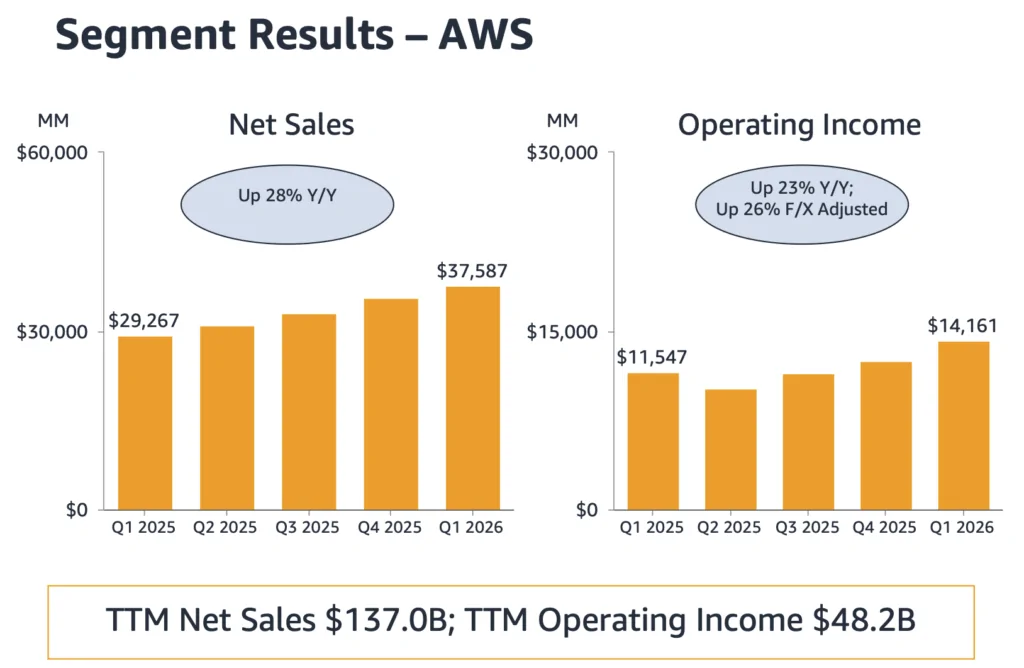
Amazon reported strong first-quarter 2026 results, driven by accelerating growth in its cloud and AI infrastructure businesses, with Amazon Web Services (AWS) and custom silicon emerging as central pillars. Total net sales rose 17% year-over-year to $181.5 billion, while AWS revenue climbed 28% to $37.6 billion—its fastest growth rate in 15 quarters. AWS operating income reached $14.2 billion, underscoring the segment’s continued profitability as enterprises scale AI workloads. Net income surged to $30.3 billion, supported in part by gains from Amazon’s investment in Anthropic.
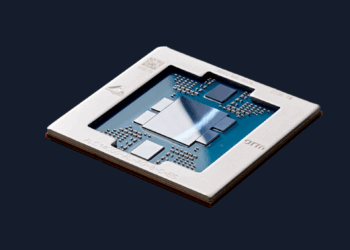
Amazon’s AI infrastructure strategy is increasingly defined by vertical integration across silicon, systems, and services. The company disclosed that its custom chip portfolio—including Graviton CPUs, Trainium AI accelerators, and Nitro DPUs—has surpassed a $20 billion annual revenue run rate, growing at triple-digit rates. Over the past year, Amazon deployed more than 2.1 million AI chips, with Trainium accounting for more than half, while also preparing to roll out over one million NVIDIA GPUs starting in 2026. Strategic commitments highlight growing hyperscaler reliance on AWS silicon, including multi-gigawatt agreements with OpenAI and Anthropic to power next-generation model training and inference.
At the platform level, AWS continues to expand its AI software and services stack. Amazon Bedrock saw a 170% quarter-over-quarter increase in customer spend, fueled by new capabilities such as Managed Agents, AgentCore infrastructure, and integrations with leading models including OpenAI’s GPT-5.4 and Anthropic’s Claude Opus 4.7. The company also announced collaborations with Cerebras to deliver high-performance inference, and with major enterprises including Meta and Uber to deploy Graviton and Trainium at scale. These moves position AWS as both a cloud provider and a vertically integrated AI platform spanning silicon to applications.
- AWS revenue: $37.6 billion, up 28% year-over-year
- AWS operating income: $14.2 billion (vs. $11.5 billion YoY)
- Custom silicon business: exceeded $20 billion annual revenue run rate, triple-digit growth
- AI infrastructure scale: 2.1 million+ AI chips deployed in past 12 months
- GPU expansion: 1 million+ NVIDIA GPUs planned for deployment starting 2026
- Strategic AI commitments:
- OpenAI: ~2 GW Trainium capacity commitment (ramping in 2027)
- Anthropic: up to 5 GW of Trainium capacity
- Amazon Bedrock: 170% QoQ growth in customer spend; expanded agentic AI capabilities
- Major enterprise deployments: Meta (Graviton), Uber (Graviton + Trainium), Cerebras (inference integration)
- Free cash flow: declined to $1.2 billion TTM, reflecting $59.3 billion increase in AI-driven CapEx
“We’re in the middle of some of the biggest inflections of our lifetime… AWS is growing 28% on a very large base, and our chips business topped a $20 billion revenue run rate… We’re well positioned to lead,” said Andy Jassy.
Addendum: Key infrastructure, AI, and silicon takeaways from Amazon’s Q1 2026 investor call
- AWS reached a $150 billion annualized revenue run rate, with management emphasizing that AI demand is also driving growth in core cloud services such as compute, storage, databases, analytics, and security.
- Amazon said AWS’s AI revenue run rate exceeded $15 billion within the first three years of the current AI wave, compared with a $58 million AWS revenue run rate three years after AWS launched.
- Management framed agentic AI as a major driver of future cloud demand, citing post-training, reinforcement learning, tool usage, multi-step orchestration, and real-time reasoning as workloads that increase demand for both AI accelerators and CPUs.
- Amazon said its custom silicon business grew nearly 40% quarter-over-quarter in Q1. Jassy said that if the chip business were treated like a standalone vendor selling chips to AWS and third parties, it would represent a $50 billion annual revenue run rate.
- AWS disclosed more than $225 billion in revenue commitments tied to Trainium, reflecting demand from large AI labs and enterprise customers.
- Trainium2 remains largely sold out, while Trainium3 is nearly fully subscribed. Amazon said much of Trainium4, still about 18 months from broad availability, has already been reserved.
- Amazon said Trainium2 delivers about 30% better price performance than comparable GPUs, while Trainium3 improves price performance by another 30% to 40% versus Trainium2.
- Amazon expects Trainium to reduce its own CapEx by tens of billions of dollars annually at scale and provide several hundred basis points of operating margin advantage for inference compared with relying on external chips.
- AWS said Bedrock runs a consistent majority of workloads on Trainium, and Amazon reported a 4x improvement in Trainium2 token throughput during 2025.
- Graviton emerged as a key part of Amazon’s AI infrastructure thesis. Jassy argued that agentic AI will sharply expand CPU demand as workloads shift from answering questions to taking actions.
- Amazon said Graviton is used by 98% of the top 1,000 EC2 customers and delivers up to 40% better price performance than x86 alternatives.
- AWS backlog stood at $364 billion at the end of Q1, excluding the recently announced Anthropic commitment of more than $100 billion.
- Amazon reiterated that AI infrastructure CapEx requires cash outlays for land, power, buildings, chips, servers, and networking gear six to 24 months before monetization begins.
- Q1 cash CapEx was $43.2 billion, primarily tied to AWS and generative AI.
- Amazon said memory and storage costs have “skyrocketed,” but management indicated that large cloud providers are receiving priority supply from strategic vendors, which may accelerate enterprise migration from on-premises infrastructure to cloud.
- Jassy said AWS may sell Trainium racks over the next couple of years, but near-term allocation remains constrained by internal demand and large customer commitments.
- Amazon emphasized its ongoing NVIDIA partnership, saying customers will continue to run NVIDIA infrastructure on AWS even as Amazon scales Trainium.
- Amazon Leo adds a satellite-networking dimension to AWS’s infrastructure strategy. Jassy said enterprises and governments want to move satellite data into AWS for storage, analytics, and AI workloads.
- Amazon said Leo has more than 250 satellites in orbit, with more than 20 launches planned this year and more than 30 launches planned in 2027.
- Management said the pending Globalstar acquisition would add direct-to-device capabilities and spectrum assets, with Apple expected to use Amazon Leo for satellite services on iPhone and Apple Watch.