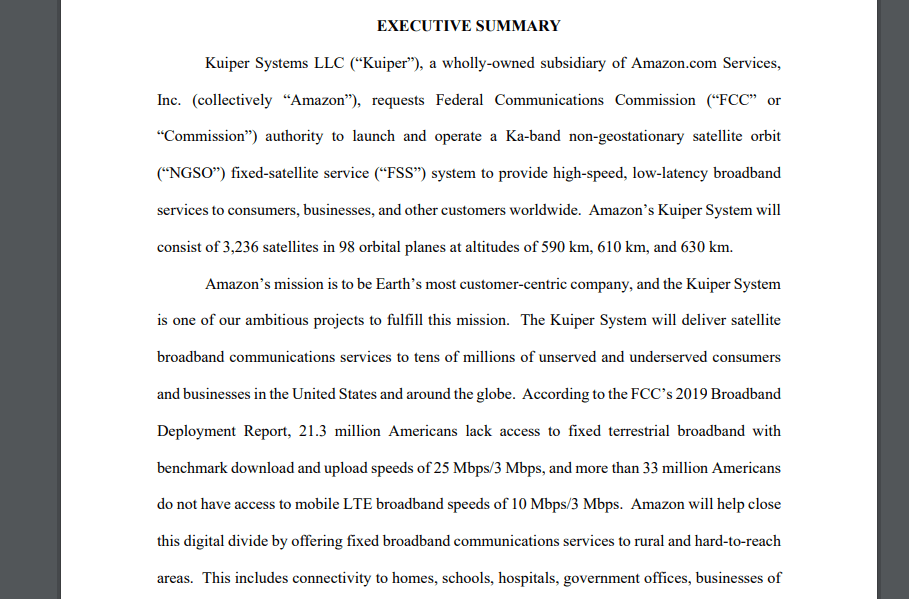
Amazon filed an application with the FCC to launch up to 3,236 low-Earth orbit satellites for delivering advanced broadband services.
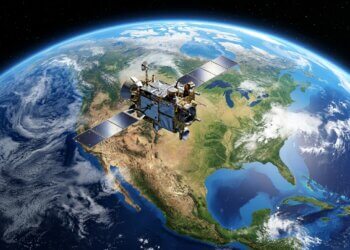
 Amazon’s Project Kuiper proposes up to 3,236 Ka-band satellites in 98 orbital planes with an apogee of 630km. Each satellite would have an estimated life of 7 years. The company says its Kuiper System will deliver satellite broadband communications services to tens of millions of unserved and underserved consumers and businesses in the United States and around the globe. The Kuiper System includes high-performance satellites, terrestrial gateways, internetworking technologies, and a range of customer terminals.
The Kuiper System will be capable of providing continuous coverage to customers within approximately 56˚N and 56˚S latitude serving the continental United States, Hawaii, U.S. territories, and other regions of the world.
Amazon also noted that its proposed Kuiper System would leverage its own secure, high-quality global networking and cloud infrastructure (AWS).
SpaceX launches the first 60 Starlink LEO satellites
 SpaceX successfully launched the first 60 satellites of its Starlink LEO constellation.
SpaceX has disclosed plans to deploy as many as 12,000 satellites in three, low earth orbit (LEO) shells. Cost estimates for full deployment approach $10 billion.
 The launch used a SpaceX Falcon 9 rocket with a first stage that had previously been used on the Telstar 18 VANTAGE mission in September 2018 and the Iridium-8 mission in January 2019. Following the launch, the booster successfully landed on the “Of Course I Still Love You” droneship, which was stationed in the Atlantic Ocean.
The Starlink satellites were deployed at an altitude of 440km. Onboard propulsion was then used to boost each satellite to an operational altitude of 550km.
The Starlink satellites feature a flat-panel design with multiple high-throughput antennas and a single solar array. Each Starlink satellite weighs approximately 227kg.
SpaceX also said the Starlink satellites are able to track and maneuver around orbiting space debris using thrusters powered by Krypton.
In March 2018, the FCC authorized SpaceX to construct, deploy, and operate a proposed non-geostationary orbit (NGSO) satellite system comprising 4,425 satellites for the provision of fixed-satellite service (FSS) around the world.
In July 2016, OneWeb was granted approval to build a similar constellation of MEO satellites.