AMD and Cisco outlined a joint effort to bring enterprise-grade management, security, and observability to local AI deployments built on AMD Ryzen AI Halo systems. The collaboration combines AMD’s local AI computing platform with Cisco’s networking, security, and operations software to help enterprises deploy agentic AI on desktops while maintaining centralized governance and operational control.
The companies said the initiative addresses a growing enterprise challenge as AI inference moves beyond centralized cloud infrastructure toward hybrid deployments closer to employees and enterprise data. Running AI models locally can improve responsiveness, reduce reliance on cloud inference, lower token consumption, and help organizations address data sovereignty requirements. However, enterprises also require mechanisms to monitor AI agents, enforce policy, manage security, and operate thousands of AI-enabled endpoints as part of a unified infrastructure.
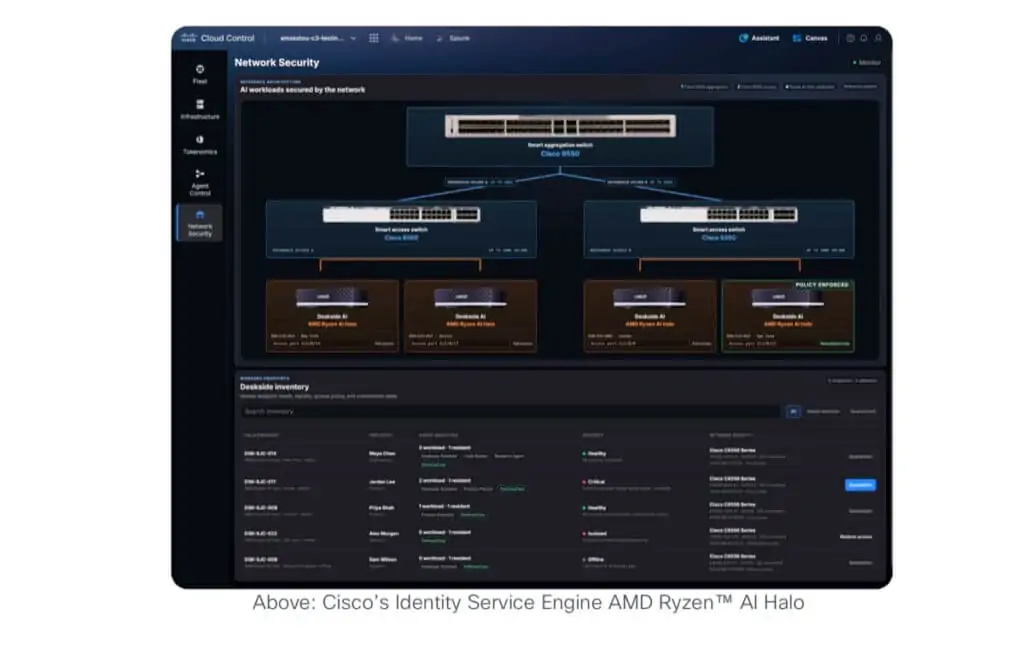
Under the collaboration, AMD contributes Ryzen AI Halo processors together with local AI software capabilities, including Semantic Router for model routing and token management and Lemonade for local inference. Cisco layers enterprise networking and operational software on top of the platform, including Splunk Agent Observability, Splunk Infrastructure Monitoring, AI Defense, DefenseClaw security policy enforcement, Cisco Cloud Control, and Cisco Secure Network technologies. Cisco said the combined architecture gives IT teams centralized visibility into AI workloads, agent behavior, token usage, compute utilization, security posture, and network identity while enabling policy enforcement and device quarantine when necessary.
| AMD + Cisco Enterprise Deskside AI Architecture | |
| AMD Platform | Ryzen AI Halo processors with local AI inference |
| Local AI Software | Semantic Router, Lemonade local inference services |
| Cisco Management | Cisco Cloud Control unified management console |
| Observability | Splunk Agent Observability and Infrastructure Monitoring |
| Security | AI Defense, DefenseClaw policy enforcement, Cisco Secure Network |
| Fleet Controls | Agent governance, device quarantine, policy enforcement |
| Operational Metrics | Token usage, compute utilization, energy consumption, agent behavior |
| Architecture Goal | Scale local agentic AI across enterprise desktops with centralized visibility and governance |
Jack Huynh, senior vice president and general manager of AMD’s Computing and Graphics Group, said:
“AMD is providing the local AI compute foundation enterprises need to bring agentic AI closer to employees, devices and data. By combining AMD Ryzen AI Halo systems and our broader local AI software capabilities with Cisco’s enterprise networking, observability and security technologies, we are helping customers deploy AI in a way that is performant, secure, observable and manageable at scale.”
🌐 Analysis As enterprises deploy persistent AI agents that operate continuously rather than responding only to user prompts, infrastructure requirements will extend well beyond compute performance to include network policy, observability, security, and operational management.
Rather than focusing solely on moving AI traffic, Cisco is positioning the network as the operational control plane for distributed AI endpoints, while AMD continues expanding Ryzen AI beyond client PCs into enterprise-managed AI platforms. Together, the companies are addressing an emerging market for enterprise-managed local AI that complements data center AI infrastructure instead of replacing it.