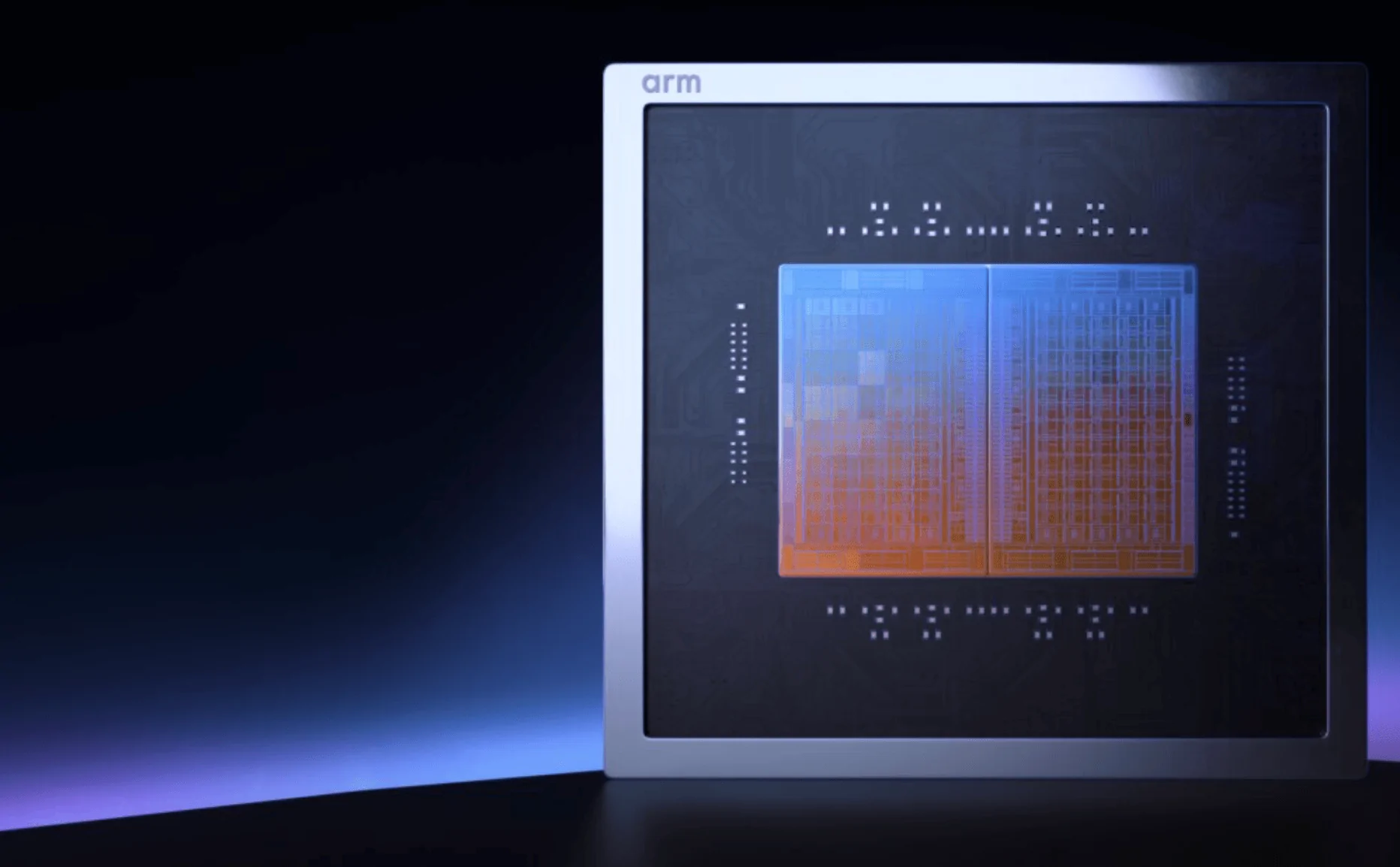
Arm is moving into production silicon for the first time, introducing its own data center processor designed specifically for the emerging class of agentic AI workloads. The new Arm AGI CPU marks a structural shift in Arm’s business model, expanding beyond IP licensing and Compute Subsystems (CSS) into full silicon delivery. The company positions the AGI CPU as a foundational building block for next-generation AI data centers, where CPUs play a central role in orchestrating increasingly autonomous, continuously running AI systems.
The Arm AGI CPU targets a rapidly evolving infrastructure landscape driven by agentic AI—systems where software agents coordinate tasks, execute workflows, and generate sustained token throughput at scale. In this environment, CPUs are no longer peripheral to accelerators but become critical control-plane engines responsible for scheduling, memory management, and interconnect orchestration. Arm estimates that data centers may require more than 4x current CPU capacity per gigawatt as AI agents scale, creating demand for processors optimized for sustained, parallel workloads within strict power envelopes.
Technically, the Arm AGI CPU is built on the Arm Neoverse platform and scales up to 136 Neoverse V3 cores per socket. It delivers up to 6 GB/s of memory bandwidth per core with sub-100 ns latency, targeting high-throughput, latency-sensitive AI orchestration tasks. The design supports a 300W TDP and emphasizes deterministic performance with a dedicated core per thread to avoid contention and throttling under sustained load. Arm’s reference architecture enables dense deployments, including air-cooled racks with up to 8,160 cores and liquid-cooled configurations exceeding 45,000 cores per rack. In these configurations, Arm claims more than 2x performance per rack versus x86-based systems, driven by higher usable thread efficiency and reduced architectural overhead.
The launch also reflects deep hyperscaler alignment. Meta serves as lead partner and co-developer, integrating the AGI CPU alongside its MTIA accelerators to optimize large-scale AI infrastructure. Additional adopters include Cerebras, Cloudflare, F5, OpenAI, Positron, Rebellions, SAP, and SK Telecom, targeting use cases such as accelerator orchestration, control-plane processing, and AI service hosting. Arm is working with ODMs and OEMs including ASRock Rack, Lenovo, Quanta, and Supermicro, with early systems available now and broader deployments expected in the second half of 2026.
Arm’s broader ecosystem—spanning AWS, Google, Microsoft, NVIDIA, Broadcom, Marvell, Samsung, SK hynix, Micron, and TSMC—supports the move into silicon. The AGI CPU is manufactured on advanced 3nm process technology and aligns with existing Arm-based data center deployments such as AWS Graviton, Google Axion, and Microsoft Azure Cobalt, extending the architecture’s footprint into purpose-built AI infrastructure.
- Arm enters production silicon for the first time, expanding beyond IP and CSS into full CPU delivery
- Arm AGI CPU targets agentic AI workloads requiring sustained, parallel compute orchestration
- Up to 136 Neoverse V3 cores per CPU with 6 GB/s memory bandwidth per core and sub-100 ns latency
- 300W TDP with deterministic performance via dedicated cores per thread
- Rack-scale density: up to 8,160 cores (air-cooled) and 45,000+ cores (liquid-cooled)
- Claimed >2x performance per rack versus x86 architectures
- Meta is lead partner; additional adopters include OpenAI, Cloudflare, SAP, SK Telecom, and Cerebras
- Systems available via ASRock Rack, Lenovo, Quanta, and Supermicro; broader rollout expected in 2H 2026
- Built on 3nm process technology with support from major ecosystem players including NVIDIA, Google, AWS, and Microsoft
“AI has fundamentally redefined how computing is built and deployed. Agentic computing is accelerating that change. Today marks the next phase of the Arm compute platform and a defining moment for our company. With the expansion into delivering production silicon with our Arm AGI CPU, we are giving partners more choices all built on Arm’s foundation of high-performance, power-efficient computing, to support agentic AI infrastructure at global scale,” said Rene Haas, CEO of Arm.
🌐 Analysis
Arm’s move into first-party silicon represents a significant shift in competitive dynamics across the data center CPU market. Historically positioned as an IP supplier enabling partners such as AWS (Graviton), Google (Axion), and Microsoft (Cobalt), Arm now introduces a vertically integrated option that could accelerate time-to-market for AI infrastructure deployments. This aligns with broader industry trends where hyperscalers increasingly demand tightly co-optimized hardware stacks spanning CPU, accelerator, memory, and networking.
The AGI CPU also reflects a growing architectural rebalancing in AI systems. While GPUs and custom accelerators dominate training and inference, CPUs are becoming the control-plane backbone for agentic AI—managing distributed workflows, memory hierarchies, and interconnect scheduling at scale. Arm’s emphasis on rack-level efficiency and deterministic multi-core performance positions it directly against x86 incumbents as well as emerging custom silicon strategies from hyperscalers and startups. The degree to which Arm can maintain ecosystem neutrality while competing in silicon will be a key factor shaping adoption over the next several product cycles.