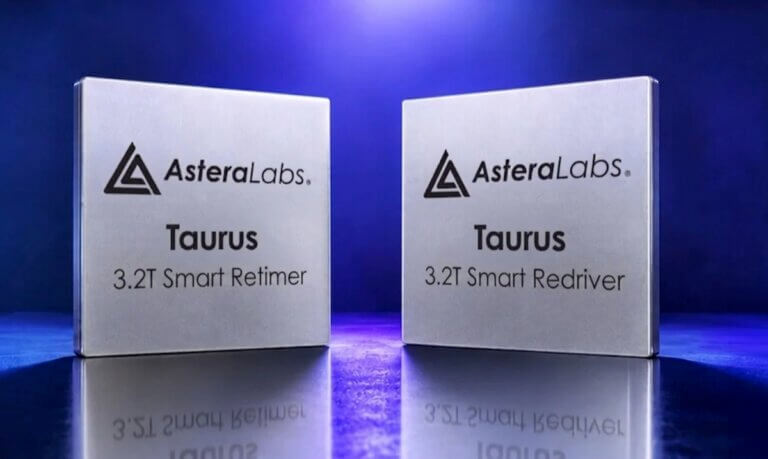
Astera Labs announced an expanded roadmap for its Scorpio X-Series Smart Fabric Switches as hyperscalers push scale-up architectures to support rapidly growing AI clusters. The company said Scorpio X-Series has entered initial production and is shipping in early volumes following close collaboration with hyperscale customers. Astera Labs now estimates the merchant scale-up switching market could reach $20 billion by 2030, reflecting the growing demand for purpose-built fabrics inside large AI domains.
The company said next-generation AI workloads—characterized by larger context windows, multi-turn agentic workflows, and clusters scaling to hundreds of thousands of accelerators—are driving more diverse scale-up connectivity requirements. Rather than a single fabric design, hyperscalers are adopting multiple architectural approaches, each with different needs for radix, protocols, traffic management, and physical connectivity. Astera Labs positioned the expanded Scorpio X-Series portfolio as a response to this fragmentation, targeting flexibility across a wide range of AI platform designs.
To address these requirements, Astera Labs is broadening Scorpio X-Series capabilities across several dimensions, including higher radix options, support for hyperscaler-specific interconnect protocols, in-network computing, enhanced data distribution, and optical connectivity. The company said photonic switch-to-accelerator links will enable multi-rack scale-up domains reaching thousands of GPUs, while in-network compute and Hypercast technology aim to reduce GPU-to-GPU communication overhead and improve overall utilization.
- Scorpio X-Series is now shipping in initial production volumes following hyperscaler collaboration
- Roadmap adds higher radix configurations to support varied AI cluster sizes
- Support planned for hyperscaler-specific and platform-custom interconnect protocols
- In-network computing designed to offload data-intensive operations from GPUs
- Hypercast technology targets more efficient data distribution for AI workloads
- Optical connectivity enables multi-rack, large-scale GPU domains
“As hyperscalers scale to larger cluster sizes and deploy more complex AI workloads, they need flexible connectivity portfolios that can address varied architectural approaches—not one-size-fits-all solutions,” said Thad Omura, Chief Business Officer at Astera Labs.
🌐 Analysis
Astera Labs’ expanded Scorpio X-Series roadmap underscores how scale-up fabrics are becoming a distinct silicon category alongside traditional scale-out Ethernet switching. By focusing on merchant silicon tailored for hyperscaler-specific architectures, Astera Labs is positioning itself against both proprietary in-house fabrics and emerging competitors exploring optical and in-network compute approaches for AI clusters.