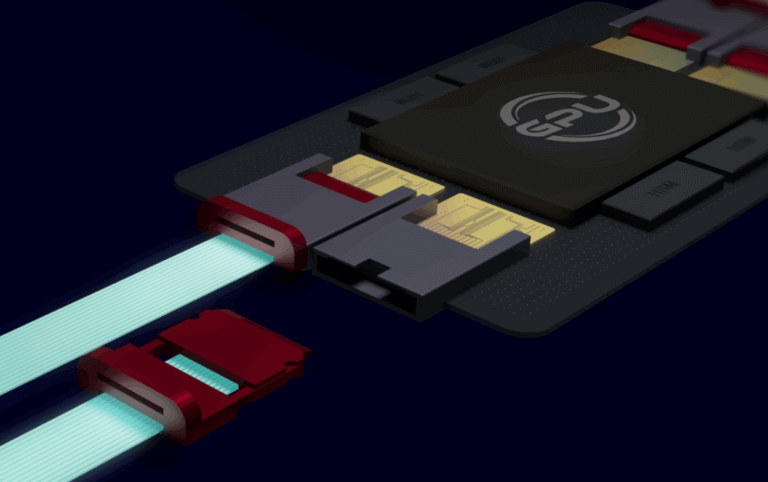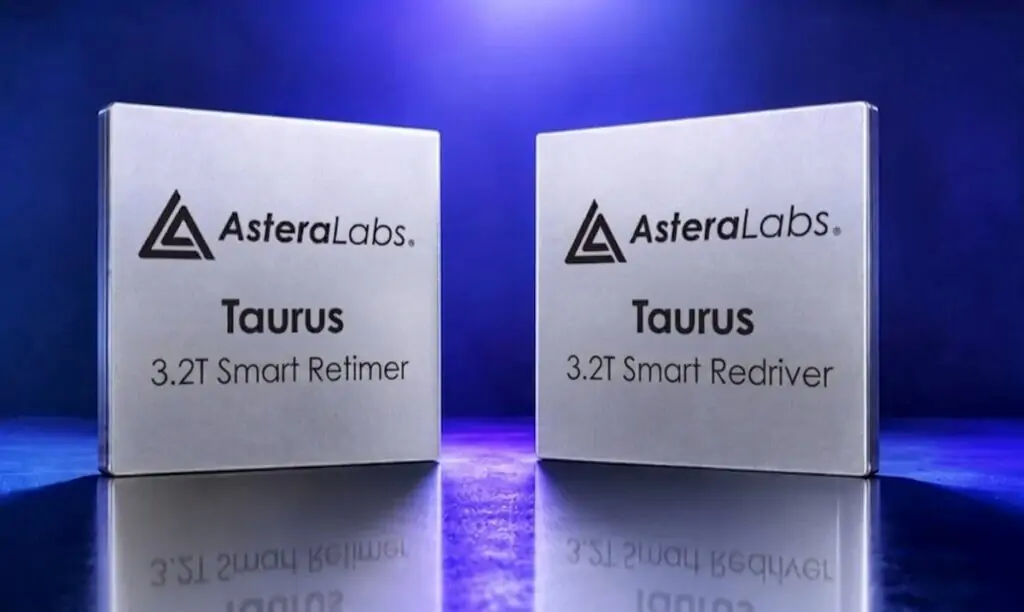
Astera Labs expanded its Taurus connectivity portfolio with new 3.2Tbps Smart Retimers and Smart Redrivers designed for 200G-per-lane Ethernet, UALink, and ESUN interconnects used in next-generation AI infrastructure. The company says the new 16-lane devices are the industry’s first Smart Signal Conditioners built around the Open Compute Project (OCP) Signal Conditioner Standard Footprint, enabling customers to interchange retimers and redrivers without redesigning accelerator or switch boards. The products are sampling now and target hyperscalers, neocloud providers, AI system vendors, and network platform suppliers building increasingly dense rack-scale AI clusters.
The announcement addresses one of the emerging physical-layer challenges of AI infrastructure. As the industry transitions from 112G to 200G PAM4 signaling, passive copper reach becomes increasingly constrained while thermal budgets, channel margins, and deployment complexity tighten. Astera argues that the choice between a retimer—which offers maximum signal recovery but consumes more power—and a redriver—which minimizes latency and power while offering less reach—should not be locked in early during board design. Its new “Smart Swap” capability, enabled through the standardized OCP footprint, allows system designers to make that decision later using measured channel characteristics rather than early design assumptions.
A second differentiator is software. Rather than treating signal conditioners as relatively “dumb” PHY devices, Astera integrates both product families into its COSMOS Intelligent Connectivity Platform. The software provides a common workflow for configuration, telemetry, diagnostics, validation, and field monitoring across retimers and redrivers. Taurus Smart Redrivers add telemetry and intelligent link management capabilities traditionally associated with retimers, including channel estimation, eye monitoring, and temperature-aware equalization. The idea is to provide real-time visibility into link health, rapid bring-up, system tuning, fault isolation, and recovery across AI racks, allowing operators to detect bottlenecks and troubleshoot high-speed links more efficiently.
“AI infrastructure is entering a phase where flexibility becomes a competitive advantage,” said Adit Narasimha, Senior Vice President and General Manager of Astera Labs’ Signal Connectivity Group. “By expanding the Taurus family with footprint-compatible x16 Smart Retimers and Smart Redrivers, we are giving customers a more flexible path to scaling denser AI infrastructure with stronger economics.”
🌐 Analysis: This announcement reflects an important shift in AI infrastructure architecture. Signal conditioners are becoming strategic system components rather than commodity physical-layer devices as hyperscalers migrate to 200G-per-lane electrical interfaces. At these data rates, PCB traces, cable backplanes, connectors, and thermal behavior increasingly determine overall cluster performance. Astera is attempting to differentiate beyond analog signal conditioning by combining hardware, telemetry, software management, and standards-based interoperability into a single platform. The emphasis on observability mirrors broader trends across AI infrastructure, where every layer—from switches to optics to power delivery—is becoming software-managed.
The OCP Signal Conditioner Standard Footprint may prove equally significant. By standardizing the board interface for retimers and redrivers, hyperscalers gain greater supplier flexibility while reducing engineering risk associated with evolving AI architectures. The strategy also aligns with broader industry efforts toward open ecosystems such as UALink, Ultra Ethernet, and OCP hardware specifications. Astera has increasingly positioned itself at the intersection of PCIe, CXL, Ethernet, NVLink Fusion, and UALink connectivity, extending its role from individual semiconductor devices toward a unified rack-scale connectivity platform spanning compute, memory, storage, and networking. The company’s presentation also illustrates how Taurus integrates alongside its Aries PCIe/CXL retimers, Leo memory controllers, and Scorpio fabric switches under the COSMOS software umbrella, reinforcing its broader Intelligent Connectivity Platform strategy.