
• Home
  • About
  • Events Calendar
  • Blueprint Guidelines
  • Privacy Policy
  • Manage Email Delivery
  • NextGenInfra.io
No Result
View All Result
Converge Digest
Thursday, June 4, 2026
  • Home
  • About
  • Events Calendar
  • Blueprint Guidelines
  • Privacy Policy
  • Manage Email Delivery
  • NextGenInfra.io
No Result
View All Result
Converge Digest
No Result
View All Result

Home » AWS pursues Local Zones strategy to cut latency

AWS pursues Local Zones strategy to cut latency

December 1, 2020
in All
A A

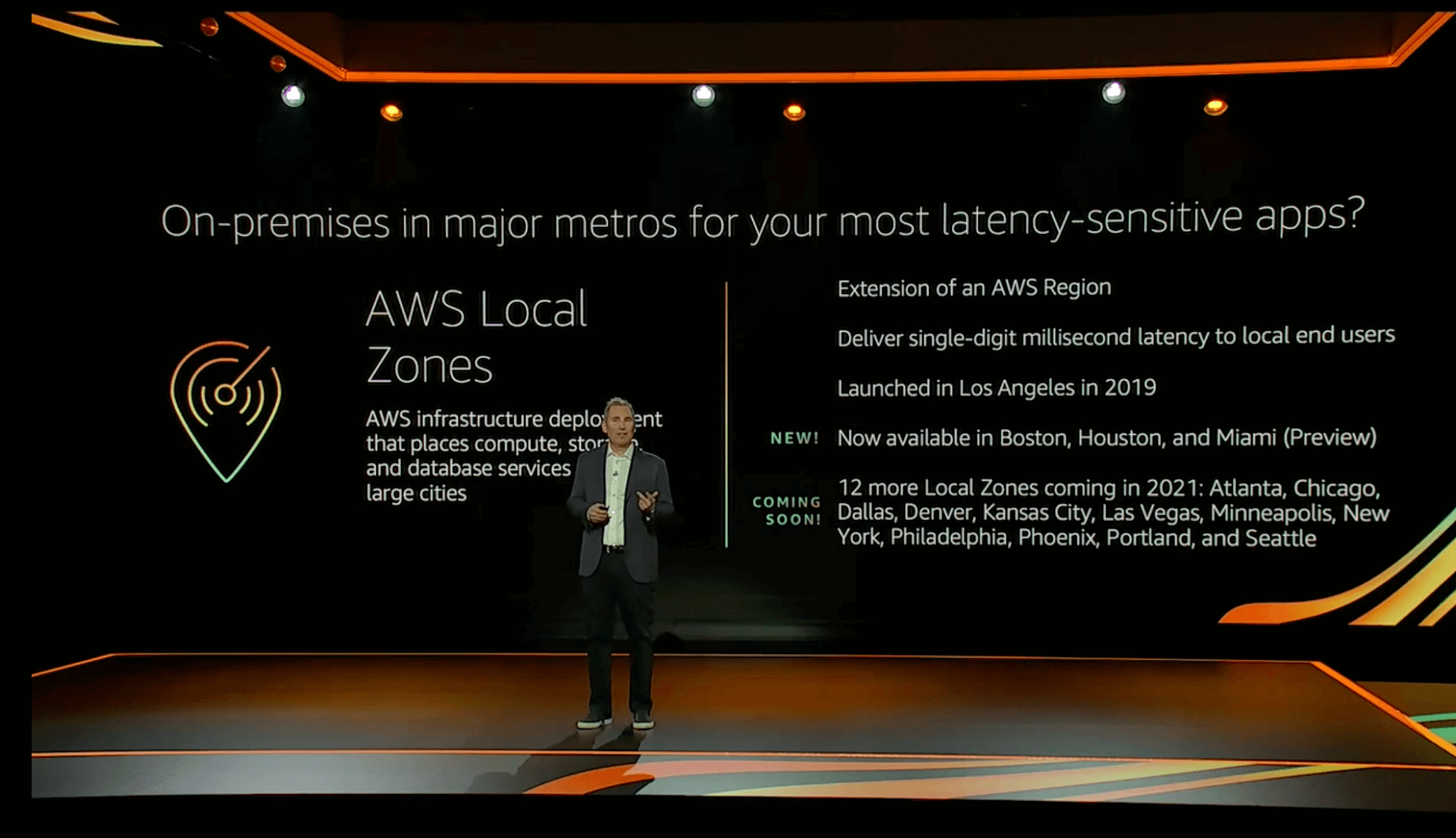
 AWS announced the availability of Local Zones in Boston, Houston, and Miami to serve latency-sensitive and throughput-sensitive workloads. The first AWS Local Zone was previously opened in Los Angeles. AWS has now announced plans to open an additional 12 Local Zones in 2021 in Atlanta, Chicago, Dallas, Denver, Kansas City, Las Vegas, Minneapolis, New York, Philadelphia, Phoenix, Portland, and Seattle.

Currently, AWS spans 77 Availability Zones within 24 geographic regions around the world, with announced plans for 15 more Availability Zones and five more AWS Regions in India, Indonesia, Japan, Spain, and Switzerland. AWS Regions are composed of Availability Zones, which each comprise of one or more data centers and are located in separate and distinct geographic locations with enough distance to significantly reduce the risk of a single event impacting business continuity, yet near enough to provide low latency for high-availability applications. Each Availability Zone has independent power, cooling, and physical security and is connected via redundant, ultra-low-latency networking. 

AWS Local Zones, which are managed and supported by AWS, are designed to support ultra-low latency applications. AWS Local Zones provide customers a high-bandwidth, secure connection between their local workloads and those running in the closest AWS Region. Customers can use the same AWS APIs and tools to run latency-sensitive workloads nearby to end-users, while seamlessly connecting to the full range of services in the AWS Region.

AWS says the vast majority of customers get the necessary performance for their applications in public AWS Regions, however, its Local Zone options will be better for applications such as remote real-time gaming, machine learning inference, and live video streaming. Previously, developers had to build and run these low latency application components with a different set of APIs and tools than the other parts of their applications running in AWS. 

In Southern California, AWS reports single-digit latency to end-users located in the Southern California area.

“Whether your organization has been all-in on the cloud since day one or is just beginning to move workloads to the cloud, all customers want to optimize for price performance,” said Dave Brown, Vice President, EC2, AWS. “As customers bring more and more workloads to the cloud, AWS continues to expand the industry’s leading compute portfolio to meet their increasingly diverse needs. With the new EC2 instance types, AWS Outposts and AWS Local Zones options we’re introducing today, we’re providing customers with an unmatched breadth and depth of capabilities to help them innovate more cost-effectively, with the right compute for the right job.”

https://aws.amazon.com/about-aws/global-infrastructure/localzones

Tags: AWSBlueprint columns
ShareTweetShareSummarizeSummarize
Previous Post

Verizon 5G Edge with AWS Wavelength now available in eight cities

Next Post

Vodafone Business announces AWS Wavelength edge service in London

Staff

Staff

Related Posts

Clouds and Carriers

Vodafone and AWS Expand Sovereign Cloud Services for Germany

May 11, 2026
Financials

Amazon Q1 2026: AWS Surges 28% as Custom AI Chips Top $20B Run Rate

April 29, 2026
Semiconductors

Meta Deploys Tens of Millions of AWS Graviton5 Cores

April 26, 2026
AI Infrastructure

Oracle and AWS Link Clouds with Private Interconnect for AI Workloads

April 16, 2026
AI Infrastructure

Amazon Ties $200 Billion 2026 Capex Plan to AI, AWS, and Custom Silicon

April 9, 2026
AI Infrastructure

Amazon Commits €33.7B to Expand Data Centers in Spain

March 3, 2026
Next Post

Vodafone Business announces AWS Wavelength edge service in London

Please login to join discussion

Categories

  • 5G / 6G / Wi-Fi
  • AI Infrastructure
  • All
  • Automotive Networking
  • Blueprints
  • Clouds and Carriers
  • Data Centers
  • Enterprise
  • Explainer
  • Feature
  • Financials
  • Last Mile / Middle Mile
  • Legal / Regulatory
  • Optical
  • Quantum
  • Research
  • Security
  • Semiconductors
  • Space
  • Start-ups
  • Subsea
  • Sustainability
  • Video
  • Webinars

Archives

Tags

5G All AT&T Australia AWS Blueprint columns BroadbandWireless Broadcom China Ciena Cisco Data Centers Dell'Oro Ericsson FCC Financial Financials Huawei Infinera Intel Japan Juniper Last Mile Last Mille LTE Mergers and Acquisitions Mobile NFV Nokia Optical Packet Systems PacketVoice People Regulatory Satellite SDN Service Providers Silicon Silicon Valley StandardsWatch Storage TTP UK Verizon Wi-Fi
Converge Digest

A private dossier for networking and telecoms

Follow Us

  • Home
  • About
  • Events Calendar
  • Blueprint Guidelines
  • Privacy Policy
  • Manage Email Delivery
  • NextGenInfra.io

© 2026 Converge Digest - A private dossier for networking and telecoms.

No Result
View All Result
  • Home
  • About
  • Events Calendar
  • Blueprint Guidelines
  • Privacy Policy
  • Manage Email Delivery
  • NextGenInfra.io

© 2026 Converge Digest - A private dossier for networking and telecoms.

This website uses cookies. By continuing to use this website you are giving consent to cookies being used. Visit our Privacy and Cookie Policy.
Go to mobile version