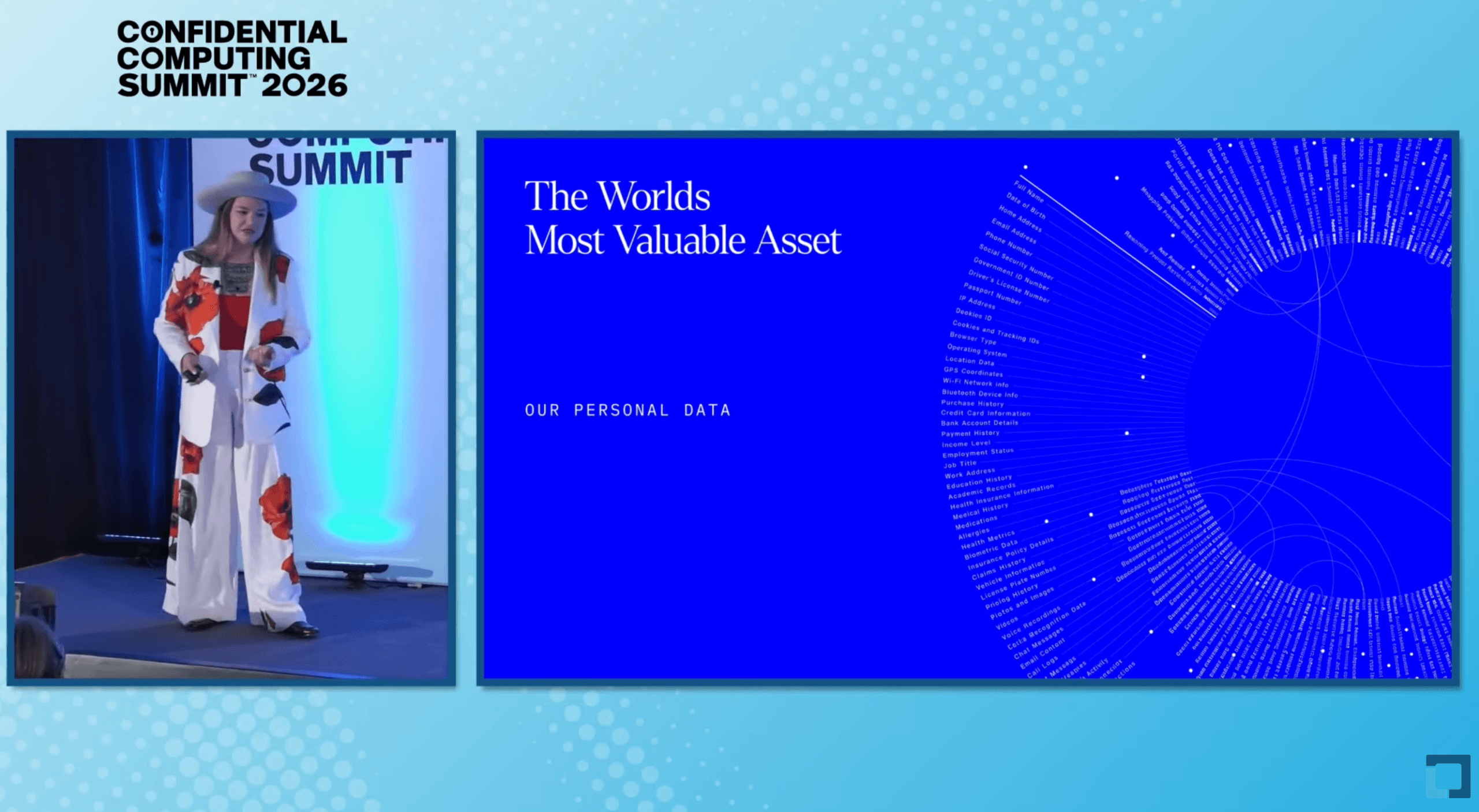
SAN FRANCISCO — Brittany Kaiser, CEO of Alpha Compute and a prominent advocate for digital privacy and data rights, used her keynote at the Confidential Computing Summit 2026 to argue that confidential computing represents a foundational shift in how data ownership, digital sovereignty, and AI infrastructure should be governed. Kaiser, who became widely known as a whistleblower in the Cambridge Analytica controversy and later helped shape data privacy legislation, framed confidential computing as a technical mechanism for enforcing property rights over data rather than relying solely on regulation.
Kaiser argued that the current digital economy remains largely extractive, with individuals, enterprises, and governments routinely surrendering control over valuable data assets. She said confidential computing changes that equation by enabling encrypted workloads and verifiable processing environments that allow users to mathematically verify how data is handled. According to Kaiser, trust in AI systems increasingly depends on transparency, consent, accountability, and ownership, all of which require protections extending down to the hardware layer. She highlighted her work on privacy legislation and legal precedents recognizing data as a form of property, asserting that future AI ecosystems will require enforceable technical controls alongside legal frameworks.
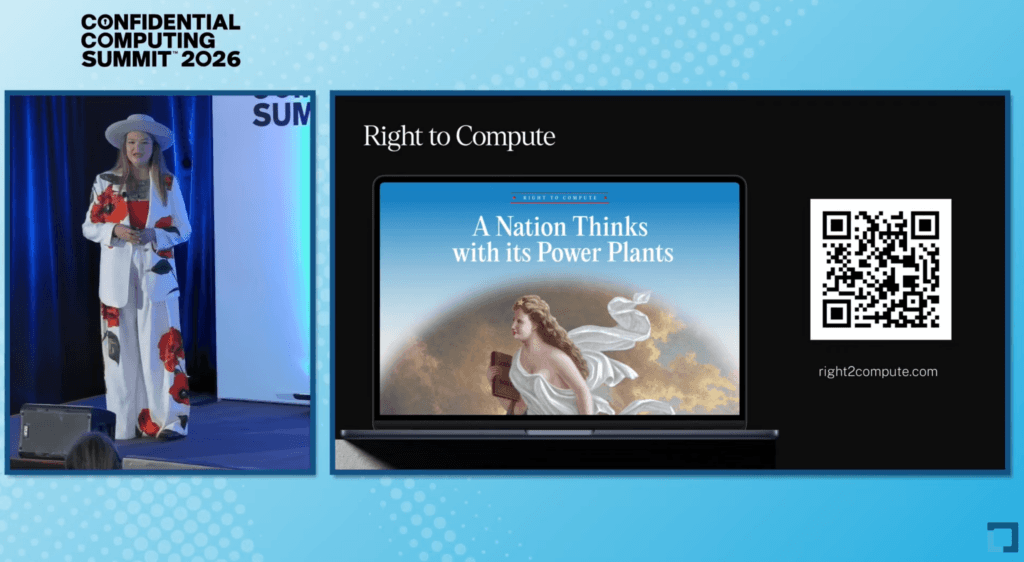
A significant portion of her presentation focused on infrastructure sovereignty. Kaiser announced a new “Right to Compute” initiative aimed at opposing state-level efforts that could restrict new AI data center development in the United States. She argued that domestic compute capacity has become a strategic national asset and that limiting data center construction could force organizations to process data outside U.S. borders. Kaiser positioned Alpha Compute as a vertically integrated AI infrastructure company spanning land, energy, data centers, hardware, and confidential computing deployments, while remaining middleware- and software-agnostic. She said the company intends to work with governments, enterprises, and developers seeking fully encrypted AI workloads and sovereign infrastructure deployments.
• Confidential computing should provide enforceable technical guarantees for data ownership and privacy.
• Data ownership should function similarly to traditional property rights, including consent, usage controls, and economic participation.
• Trustless systems based on cryptographic verification are preferable to systems that rely solely on institutional trust.
• AI-era privacy concerns extend beyond personal information to intellectual property, enterprise data, government information, and AI-generated content.
• Alpha Compute focuses on infrastructure layers including energy, land, semiconductors, storage, networking, data centers, and hardware.
• The company positions itself as software- and middleware-agnostic, partnering across the confidential computing ecosystem.
• Kaiser launched the “Right to Compute” campaign, advocating policies that support domestic AI data center development.
• She argued that data security, compute sovereignty, and national security are becoming increasingly interconnected.
“Trust is the ultimate currency in the age of AI. We are not trying to build trustworthy systems; we are trying to build trustless systems where you can mathematically prove that your data is yours and that it is not being shared non-consensually with other parties.”
🌐 Analysis: While many summit presentations focused on trusted execution environments, encrypted workloads, and attestation technologies, Kaiser broadened the discussion to include legal ownership frameworks, economic rights, and public policy surrounding AI infrastructure deployment. Her emphasis on domestic compute capacity pushes back against recent social and legislative campaigns against data center siting and energy consumption.
Confidential Computing Summit 2026 Converge Digest coverage on trusted AI, encrypted workloads, data sovereignty, and secure agent infrastructure | |
| Event Focus | Confidential computing, secure AI infrastructure, verifiable workloads, trusted execution environments, privacy-preserving cloud services, and data ownership. |
| Hosted By | Linux Foundation ecosystem, with participation from cloud, AI, security, enterprise infrastructure, and open source leaders. |
| Core Themes | Trusted AI, secure agents, private cloud infrastructure, data sovereignty, encrypted workloads, and verifiable execution. |
| Why It Matters | The summit highlighted how confidential computing is moving from a specialized security architecture into a core building block for AI trust, sovereign data processing, secure agents, and enterprise adoption of frontier models. |
Converge Digest Coverage Read the full series from the Confidential Computing Summit 2026 | |
| Inside the Confidential Computing Summit: Trusted AI Main event report on trusted AI, confidential infrastructure, and the summit’s core technical themes. | |
| Apple Extends Private Cloud Compute Beyond Apple Data Centers Coverage of Ivan Krstić’s keynote on Apple’s Private Cloud Compute architecture and trust model. | |
| Anthropic: The Defender Advantage Jason Clinton’s keynote on AI security, defensive leverage, and the changing threat model for software and infrastructure. | |
| Brittany Kaiser Calls for Data Ownership and “Right to Compute” Alpha Compute CEO Brittany Kaiser connects confidential computing with data ownership, digital sovereignty, and domestic AI infrastructure. | |
| OPAQUE Launches Open Framework for Verifiable AI Agents and Secure MCP OPAQUE’s framework targets verifiable AI agents, secure MCP workflows, and confidential AI execution. | |
| Linux Foundation Proposes DNS-Based Identity Framework for AI Agents Linux Foundation proposal explores DNS-based identity infrastructure for AI agents and secure agent-to-agent interactions. | |
🌐 Converge Digest is tracking confidential computing for AI infrastructure. Follow our ongoing coverage of trusted execution environments, secure agents, sovereign AI, and privacy-preserving cloud architectures at ConvergeDigest.com. | |