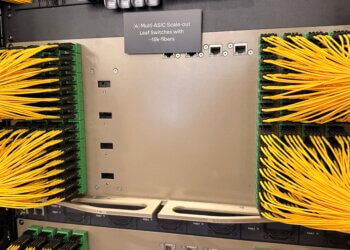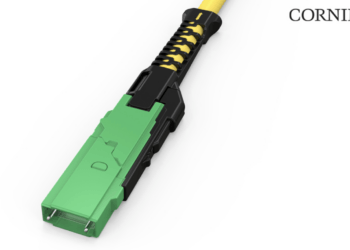
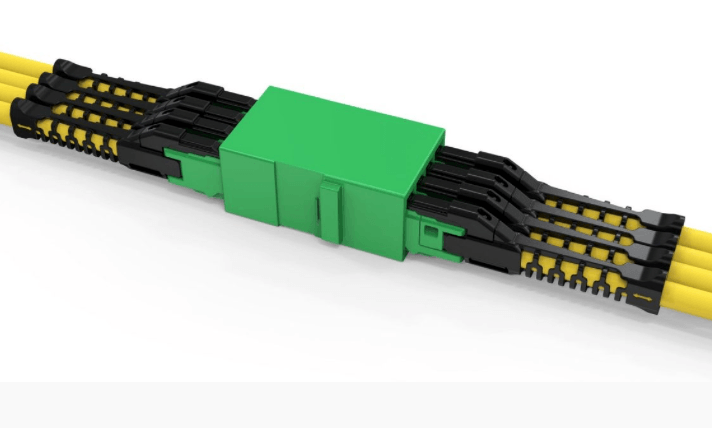
Earlier this month at OFC 2026, Corning introduced PRIZM TMT optical ferrule technology into its connectivity portfolio through a licensing agreement with US Conec, targeting higher-density optical interconnects for AI data centers. The technology uses expanded beam optics with precision-aligned microlenses, enabling higher fiber counts within constrained physical footprints. The move aligns with increasing demand for dense optical connectivity as hyperscale AI clusters scale both within racks (scale-up) and across data center fabrics (scale-out).
The announcement reflects a broader shift toward fiber-rich architectures in AI infrastructure, where thousands of optical connections per rack are becoming standard. As copper links give way to optical interconnects in scale-up domains, connector density, reliability, and ease of installation have emerged as critical constraints. PRIZM TMT addresses these requirements by replacing physical fiber contact with expanded beam coupling, improving tolerance to contamination while simplifying deployment workflows in high-density environments.
- PRIZM® TMT ferrule technology uses expanded beam optics with microlenses instead of direct fiber contact
- Enables higher fiber density within constrained rack and switch environments
- Improves contamination resistance and installation speed in high-density deployments
- Targets both scale-up (intra-rack) and scale-out (fabric) AI network architectures
- Supports transition from copper to optical interconnects in AI infrastructure
- Corning becomes a licensed provider of US Conec’s PRIZM® TMT technology
“By licensing PRIZ TMT, Corning is strengthening its ability to deliver scalable, fiber-rich solutions that help customers build larger, faster, and more efficient AI clusters, while aligning closely with the broader industry ecosystem.” — Mike O’Day, Senior Vice President and General Manager, Corning Optical Communications
| Expanded Beam Optics — Technical Overview | |
|---|---|
| Definition | A fiber optic coupling method that uses microlenses to expand and collimate the light beam before transmission, rather than relying on direct physical contact between fiber cores. |
| How It Works | Light exiting a fiber is expanded through a lens, travels across a small air gap, and is then refocused into the receiving fiber via another lens. This reduces sensitivity to alignment and surface contamination. |
| Key Components | Optical fibers, precision-aligned microlenses, ferrule housing, alignment features, and protective interfaces to maintain optical path integrity. |
| Contrast with Physical Contact (PC) Connectors | Traditional connectors align fiber cores directly in physical contact, requiring extremely clean surfaces and precise alignment. Expanded beam systems tolerate larger misalignment and eliminate direct fiber contact. |
| Contamination Tolerance | Significantly higher tolerance to dust and debris due to the enlarged beam diameter, reducing insertion loss caused by microscopic contaminants. |
| Alignment Sensitivity | Lower sensitivity to lateral and angular misalignment compared to single-mode physical contact interfaces, enabling easier and faster installation. |
| Insertion Loss Characteristics | Typically higher baseline insertion loss than physical contact connectors due to lensing and air gaps, but more stable over time in real-world environments. |
| Return Loss | Generally strong performance due to reduced back reflections from non-contact interfaces, especially when anti-reflective coatings are used. |
| Scalability | Well-suited for high-density multi-fiber connectors (e.g., 16, 32, 64+ fibers) where maintaining perfect physical contact becomes increasingly difficult. |
| Operational Advantages | Faster deployment, reduced cleaning requirements, improved durability, and better performance consistency in harsh or high-touch environments. |
| Typical Use Cases | AI data centers, high-density patch panels, optical backplanes, military/aerospace systems, and environments with frequent connect/disconnect cycles. |