
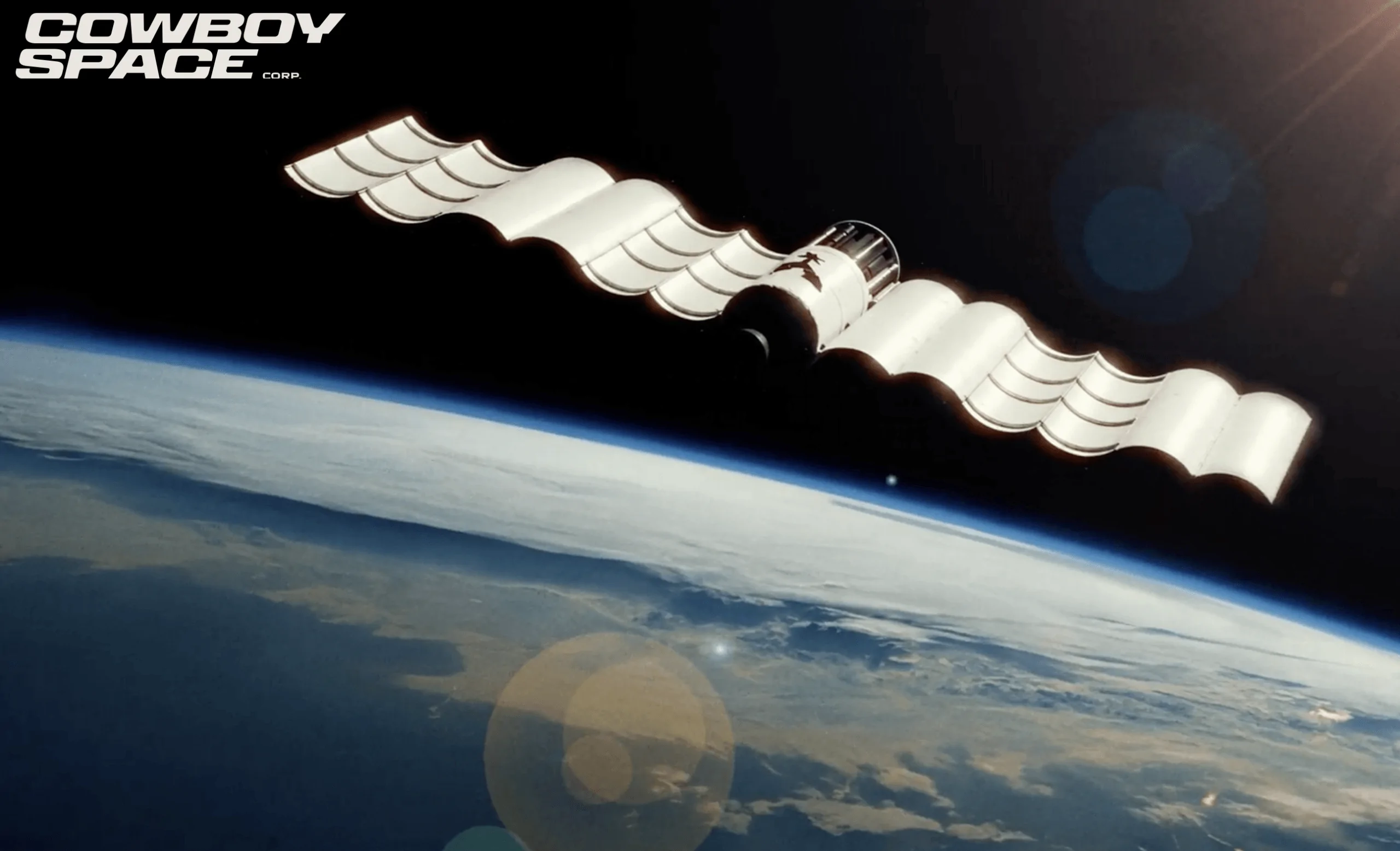
Cowboy Space Corporation, the space infrastructure startup founded by Robinhood co-founder Baiju Bhatt, raised $275 million in Series B financing at a $2 billion valuation to accelerate development of vertically integrated orbital data centers and launch systems designed for AI compute workloads in space. The company, formerly known as Aetherflux, said the funding round was led by Index Ventures with participation from IVP, Blossom Capital, and SAIC, alongside existing investors including Andreessen Horowitz, NEA, and Breakthrough Energy Ventures.
The Cowboy Space Corporation strategy centers on deploying Low Earth Orbit (LEO) satellites powered by solar energy to host AI compute infrastructure directly in orbit. The company is also designing a dedicated launch vehicle whose upper stage doubles as a 1-megawatt orbital data center after reaching space. Rather than separating launch and payload systems, Cowboy said it is co-designing rockets and compute infrastructure as a unified platform to reduce mass overhead and maximize delivered compute capacity. The company said it is collaborating with NVIDIA to deploy NVIDIA Space-1 Vera Rubin Modules optimized for AI processing in space environments.
Cowboy plans to launch its first demonstration satellite later this year to validate space-to-Earth power beaming technology. The company said its engineering team includes veterans from SpaceX, Astranis, NASA, Project Kuiper, and NVIDIA. The broader concept targets mounting constraints in terrestrial AI infrastructure, where hyperscale data center growth increasingly faces power availability, grid expansion delays, land constraints, and cooling challenges.
• $275 million Series B financing round
• $2 billion valuation
• Formerly operated as Aetherflux
• Developing vertically integrated orbital AI infrastructure
• LEO satellites powered by solar energy
• Purpose-built launch vehicle integrated with compute payloads
• Each upper stage designed to become a 1 MW orbital data center
• Collaboration with NVIDIA on Space-1 Vera Rubin Modules
• First satellite launch planned later this year
• Headquarters in San Carlos
“Our approach starts from a blank sheet, where the unique requirements of data centers in orbit drive the form and function of the overall system,” said Baiju Bhatt, founder and CEO of Cowboy Space Corporation. “The rocket and the data center are a single design from day one. It’s a first-principles departure from the traditional constellation model.”
Profile: Cowboy Space
| Category | Details |
|---|---|
| Company Name | Cowboy Space Corporation |
| Former Name | Aetherflux |
| Founded | 2024 |
| Headquarters | San Carlos, California, USA |
| Founder & CEO | Baiju Bhatt (Robinhood co-founder) |
| Latest Funding | $275 million Series B |
| Valuation | $2 billion |
| Lead Investor | Index Ventures |
| Key Investors | IVP, Blossom Capital, SAIC, Andreessen Horowitz, NEA, Breakthrough Energy Ventures, Construct Capital, Interlagos |
| Core Mission | Develop vertically integrated orbital infrastructure for AI compute, power generation, and launch systems |
| Primary Technology Focus | Orbital AI data centers, solar-powered LEO satellites, integrated launch systems, power beaming |
| Orbital Architecture | Rocket upper stages designed to convert into operational orbital data centers after launch |
| Target Compute Capacity | 1 MW compute payload per orbital upper stage |
| AI Infrastructure Partner | NVIDIA (Space-1 Vera Rubin Modules) |
| Near-Term Milestone | First satellite launch planned later this year for space-to-Earth power beaming demonstration |
| Engineering Talent Sources | Former engineers from SpaceX, Astranis, NASA, Kuiper, and NVIDIA |
| Industry Focus | Space-based AI infrastructure and next-generation orbital computing platforms |
🌐 Analysis: Cowboy Space Corporation enters a rapidly emerging category focused on space-based energy and compute infrastructure as AI power demand accelerates beyond terrestrial grid expansion timelines. Multiple startups and government-backed initiatives are now evaluating orbital data centers, solar power beaming, and space-based compute as long-term responses to escalating AI infrastructure requirements. The involvement of NVIDIA signals growing interest from the AI hardware ecosystem in extending compute architectures beyond Earth-based facilities.
🌐 The concept remains highly experimental and capital intensive, with significant technical hurdles involving launch economics, thermal management, radiation hardening, networking latency, orbital servicing, and power transmission. However, the scale of hyperscaler AI infrastructure spending and rising concerns about energy availability are creating conditions where previously speculative orbital infrastructure concepts are attracting substantial venture funding and strategic industry partnerships.


