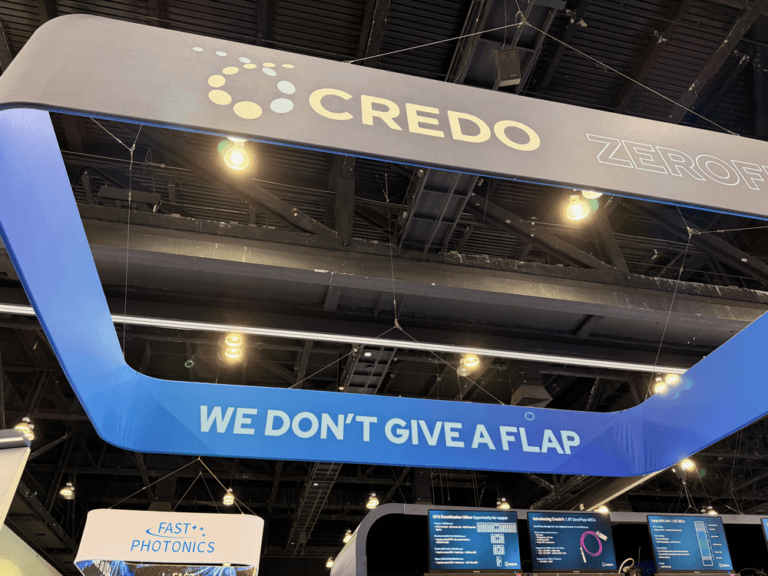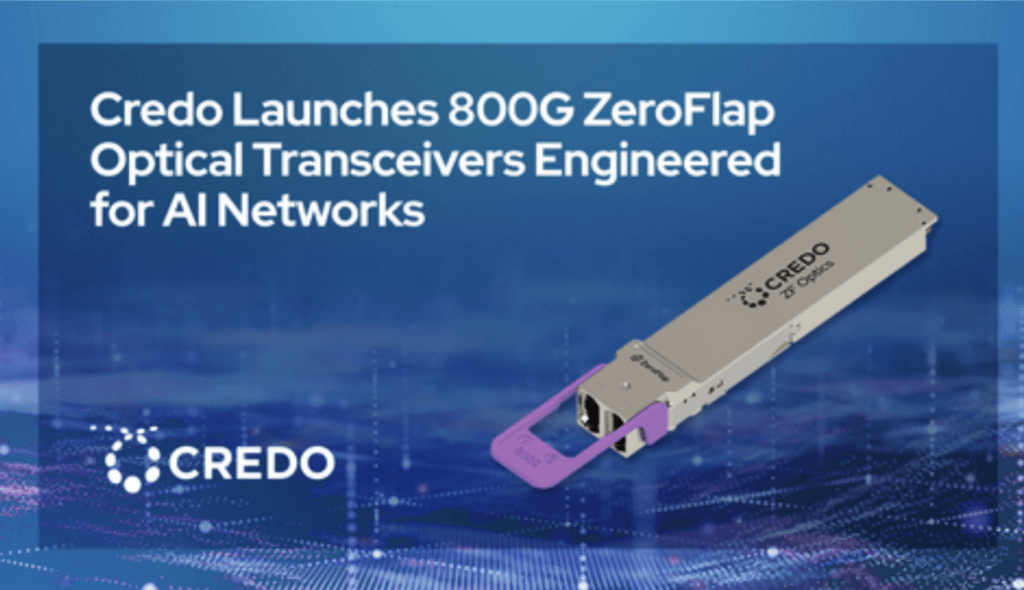
Credo announced general availability for its 800G 2 x DR4 ZeroFlap transceivers, positioning the product as a way to reduce optical link flaps that can disrupt AI cluster performance and slow deployment. The company said the modules aim to improve time to first token and overall cluster productivity by adding telemetry, fault isolation, and automated remediation directly into the transceiver.
The 800G 2 x DR4 ZeroFlap transceivers integrate in-band remote telemetry, automated responses to detect and mitigate link instability, and smart ticketing intended to simplify service requests. Credo said the products use PILOT extensions on network switches to extract optics telemetry and stream it to monitoring agents, with support for SONiC and other switch operating systems. The company is targeting operators that need better visibility into link health across large-scale AI infrastructure.
Credo said the modules also support remote telemetry collection from either endpoint of a link, non-volatile event logging for historical analysis, and compatibility with a range of network architectures including fiber shuffle designs. The products are available in both Integrated Heat Sink and Riding Heat Sink versions for switch-side and server-side deployments. The release focuses on a practical issue in AI networking: reducing link instability that can interrupt training and inference workloads at scale.
- General availability of 800G 2 x DR4 ZeroFlap transceivers
- Focused on reducing optical link flaps in AI clusters
- In-band remote telemetry for real-time link monitoring
- Automated fault localization, remediation, and prevention
- Smart ticketing to speed service and troubleshooting workflows
- Uses PILOT switch extensions for telemetry extraction and streaming
- Supports SONiC and other switch operating systems
- Remote access to telemetry from both sides of a link
- Non-volatile event logging for historical troubleshooting
- Supports multiple architectures, including fiber shuffle
- Offered in Integrated Heat Sink and Riding Heat Sink versions
“By harnessing real-time telemetry inside the transceiver, we’re enabling networks to predict and prevent failures before they impact services,” said Chris Collins, AVP of Sales & Optical Product Marketing at Credo.
🌐 Analysis: Credo is trying to differentiate in 800G optics by addressing operational reliability, not just bandwidth or power efficiency. That aligns with a broader shift in AI infrastructure toward tighter integration of telemetry, automation, and fault management as clusters scale and downtime becomes more expensive. Competitors across the optical interconnect market are also emphasizing manageability and system-level efficiency, but Credo’s message here centers specifically on the persistent problem of link flaps in large AI deployments.