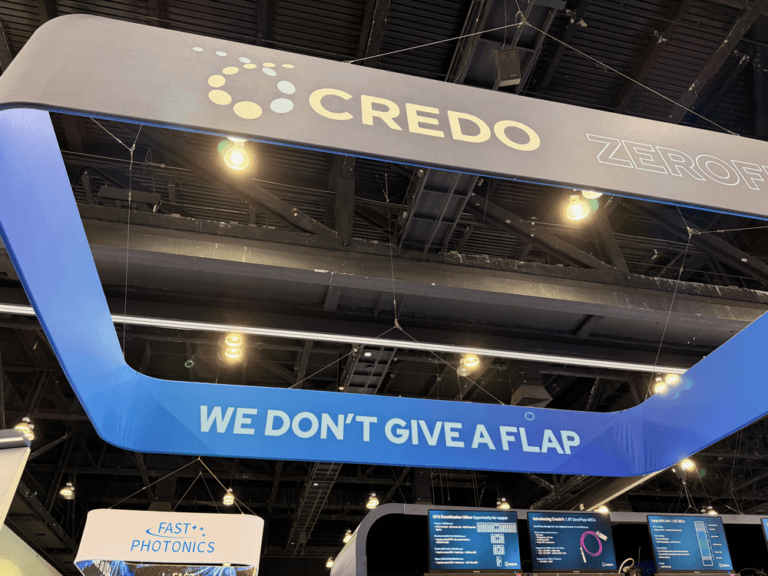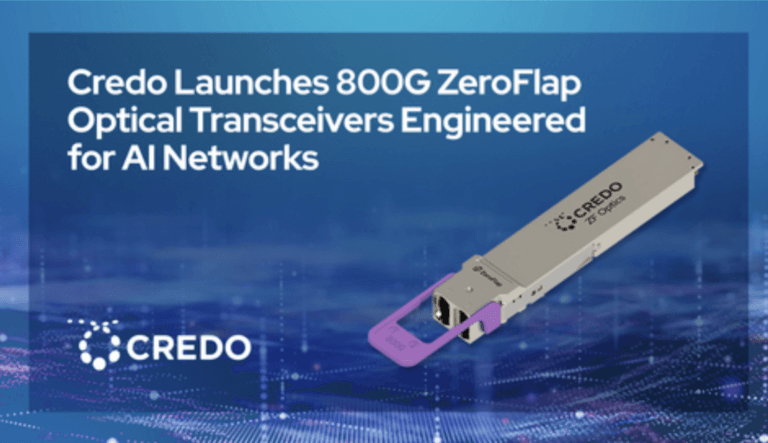
Credo Technology introduced its ZeroFlap (ZF) optical transceiver family at the OCP Global Summit 2025 in San Jose, positioning it as a system-level solution to improve optical reliability in large-scale AI clusters. The new 400G, 800G, and 1.6T transceivers are built on Credo’s PILOT1 diagnostics platform and designed to prevent “link flap” events — repeated link resets that degrade cluster stability — which are increasingly problematic as hyperscale AI networks grow beyond 1 GW.
The ZF optical line integrates advanced telemetry, real-time link diagnostics, and proactive component hardening to enhance reliability in GPU-intensive data centers. Key features include mission-mode optical link monitoring (BER, FEC histograms, MPI), in-band management across bare-metal and heterogeneous environments, non-volatile event logging, and support for telemetry streaming from switch OSes such as SONiC. The transceivers’ self-diagnostics can detect early signs of laser or ESD degradation, helping operators prevent downtime.
Credo and Oracle are jointly leading a new Optics Reliability Workstream within the Open Compute Project Foundation to standardize telemetry-driven reliability for optical interconnects. Credo CEO Bill Brennan and Oracle’s Stephen Manley will outline the initiative in their OCP presentation, “The Path to Zero Flap: Reinventing Optical Reliability for Scalable AI Clusters.”
“Moving our ZeroFlap commitment beyond AECs to optics requires a system approach to collecting, processing, and actioning telemetry before it leads to a link flap,” said Chris Collins, AVP for optical products at Credo. “Credo is committed to the ZeroFlap revolution and is excited to work with the OCP community to standardize this important effort.”
🌐 Analysis: Credo’s new ZeroFlap optics extend its reliability-focused philosophy from AECs into the optical layer, addressing a growing bottleneck in hyperscale AI fabrics where transceiver instability affects GPU uptime. This launch complements OCP’s emphasis on telemetry-rich, open hardware and aligns with other recent OCP initiatives around optical monitoring, co-packaged optics, and switch OS integration. By collaborating with Oracle and embedding system-level diagnostics via PILOT, Credo strengthens its foothold in the AI data center interconnect space.
🌐 We’re tracking the latest developments in networking silicon. Follow our ongoing coverage at: https://convergedigest.com/category/semiconductors/
 | Converge Digest and NextGenInfra.io are bringing together the leaders shaping AI-driven data center networks—from optics and fabrics to silicon and orchestration.
Explore how the industry is re-architecting the network for the AI era through exclusive video interviews,
expert reports, and collaboration opportunities. |