
Eridu, a Saratoga, California–based startup focused on next-generation AI networking infrastructure, emerged from stealth with more than $200 million in funding to develop a new class of high-performance switching architecture for large-scale AI clusters. The financing includes an oversubscribed Series A led by Socratic Partners with participation from John Doerr, Hudson River Trading, Capricorn Investment Group, Matter Venture Partners, Bosch Ventures, Eclipse Capital, Fusion Fund, MediaTek, Osage University Partners, SBVA, TDK Ventures, VentureTech Alliance, Zelda Ventures, and others.
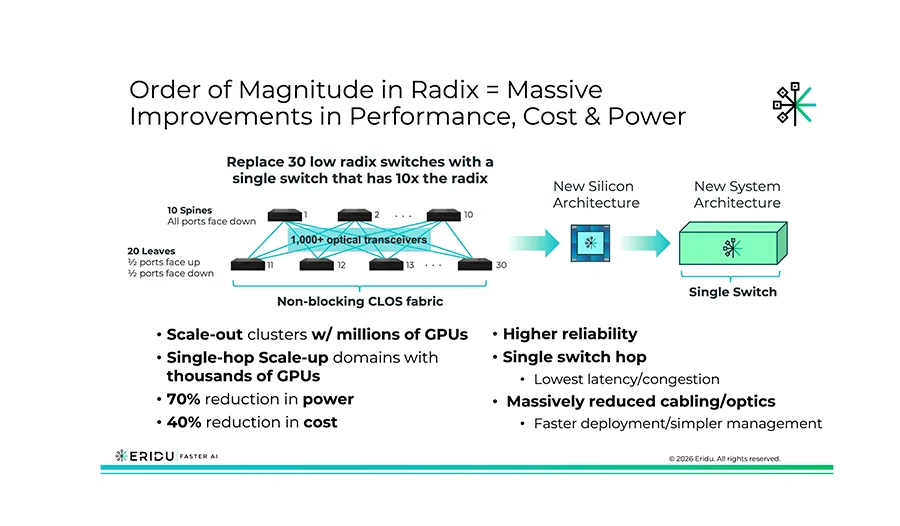
The company is developing a clean-sheet switching architecture designed specifically for AI data centers. According to Eridu, conventional Ethernet or InfiniBand network fabrics struggle to keep pace with the rapid growth of GPU cluster scale, creating what the company describes as a “network wall.” Its design aims to significantly increase switch radix—allowing a single device to connect far more endpoints—and reduce the number of network tiers required in hyperscale AI fabrics. By collapsing multi-tier leaf-spine topologies into higher-radix switching domains, Eridu claims its architecture can enable single-hop communication across thousands of GPUs while scaling clusters to millions of accelerators.
The company said its system architecture combines new silicon design, advanced packaging, optics integration, and system-level networking innovations. The resulting platform is intended to reduce latency and jitter while simplifying deployment of large AI clusters. Eridu claims its design could reduce AI networking power consumption by up to 70% and cut capital costs by up to 40% compared with existing multi-tier network fabrics.
• Clean-sheet AI networking architecture designed for hyperscale AI clusters
• High-radix switching architecture designed to collapse multi-tier network fabrics
• Supports single-hop scale-up domains with thousands of GPUs
• Supports scale-out AI clusters reaching millions of GPUs
• Up to 70% reduction in networking power consumption (company claim)
• Up to 40% reduction in networking CapEx (company claim)
• Funding will support development of Eridu’s switching platform
“Billions of dollars of investment in AI data centers are being wasted because of the network wall,” said Drew Perkins, CEO and founder of Eridu. “The plodding pace of improvement promised by the existing industry vendors is simply inadequate to solve the problem. Eridu has taken on and solved the key challenges across silicon, packaging, systems and optics needed to break through that wall.”
Q&A: Eridu Founders on the Need for a New Networking Architecture for AI
As AI clusters scale to thousands of GPUs, networking infrastructure is emerging as a key constraint inside modern data centers. In this interview, Drew Perkins, Founder and CEO of Eridu, and Omar Hassen, Co-founder and Chief Product Officer, discuss why existing networking architectures may not scale to the demands of AI workloads and how Eridu is approaching the challenge.
Q: What problem did you see in the market that led to the creation of Eridu?
Drew Perkins:
What I saw as AI was starting to emerge was that networking technology was not optimized for AI. Networking had evolved over many years to support applications like voice, video, web browsing running on cloud data centers. AI data centers are a whole new ballgame with 3-4 orders of more east-west bandwidth.
Basically the scale of AI clusters is far greater than data centers designed for cloud, and networking needs to be redesigned from scratch to support that. That means taking a ground-up look at the architecture—from semiconductor processing and chips to packaging, systems, and software—to optimize networking for AI workloads.
Q: What happens when networking cannot keep up with AI infrastructure?
Perkins:
Current networking technology is not scalable to the levels AI needs. When the network is too slow, GPUs do not receive the data they need to process. Their utilization goes down.
Organizations are investing very large amounts in GPUs and AI data centers, but those GPUs may be running at relatively low utilization because the network becomes the bottleneck literally wasting billions of dollars. It’s not good.
Q: Why are existing networking architectures difficult to scale for AI clusters?
Perkins:
Existing systems rely on building networks with multiple layers of switches. To reach large scale you add layers and build large Clos-type networks.
As you add layers, you introduce more power consumption, more latency, and more congestion points. You also increase the number of devices in the network, which affects reliability and deployment complexity. As networks grow larger, those problems compound.
Q: Omar, what gap did you see between compute and networking when looking at AI infrastructure?
Omar Hassen:
When Drew and I first started discussing the AI industry, we noticed there was a lot of innovation happening around compute and memory, but very little innovation on the networking side.
Compute has been growing by orders of magnitude every few years, and memory bandwidth has been increasing quickly. Networking equipment has continued to evolve along the same trajectory it had been on before, and that creates a gap as AI clusters generate much larger volumes of data that must move across the network.
Q: What are the practical impacts of networking bottlenecks in AI data centers?
Hassen:
One of the most visible impacts is GPU utilization. In many environments today GPU utilization may be around 50 percent.
Another issue is power consumption. Networking infrastructure takes power that could otherwise be used for compute. Data center operators would prefer to allocate that power to GPUs, because GPUs generate tokens and revenue.
Q: What is Eridu building to address these challenges?
Hassen:
At Eridu we are building a network switch designed to deliver an order-of-magnitude improvement in throughput and radix.
The switching industry has traditionally advanced through incremental improvements, typically doubling performance every two to three years. Our goal is to introduce a larger step change so that networking can keep pace with the rapid growth of AI infrastructure.
Q: Are you targeting scale-out networking or scale-up networking or both?
Hassen:
The order-of-magnitude increase in radix and throughput of Eridu’s frontier networking switch benefits both. For scale-out we can connect millions of GPUs in two tiers of networking inside and across buildings, improving network performance and GPU utilization while reducing cost and power, speeding deployment and simplifying network management. For scale up we can increase the size of the high bandwidth domain to thousands of GPUs with tens of terabits of bandwidth per GPU – something strongly desired by the frontier labs so they can develop more powerful models.
Q: What technical areas must change to achieve that level of improvement?
Hassen:
There are several technical challenges. One is creating a memory architecture capable of moving far larger amounts of data in and out of the switching silicon. Another is developing the I/O signaling necessary to support that bandwidth.
Packaging is also important because it must support moving that data efficiently into and out of the switching engine.
🌐 Analysis
Eridu’s founding team combines decades of experience building foundational networking and semiconductor technologies. CEO Drew Perkins is a serial entrepreneur and networking pioneer whose career spans more than four decades. He was the lead author of the Point-to-Point Protocol (PPP), a foundational internet protocol widely used in early dial-up and broadband networking, and he also designed one of the first Ethernet switch products. Perkins served as a principal architect at FORE Systems, where he helped develop ATM and Ethernet switching platforms that generated billions of dollars in revenue during the 1990s networking boom.

Perkins later co-founded and served as CTO of several influential networking companies. At Lightera Networks he helped create the CoreDirector optical switch, an early platform for dynamic optical transport. As co-founder and CTO of OnFiber Communications, he helped build a metropolitan fiber-to-the-business network operator. At Infinera, Perkins again served as co-founder and CTO, helping pioneer optical transport systems based on large-scale photonic integrated circuits (PICs), a technology that reshaped the design of long-haul optical networking equipment. More recently he served as CEO of Gainspeed, focused on distributed access architecture for cable broadband networks, and CEO of Mojo Vision, where he oversaw development of an augmented-reality contact lens incorporating a microLED display.
Eridu co-founder and Chief Product Officer Omar Hassen also brings three decades of networking and semiconductor experience across both startups and major silicon vendors. Hassen previously served as SVP of Business Development at Ventana, where he helped drive ecosystem partnerships and market development around RISC-V computing platforms and chaired committees within RISC-V International.

Earlier in his career he held leadership roles at AppliedMicro, where he served as VP and GM of the Connectivity Business Unit and helped guide the company’s transition toward optical communications before its acquisition by MACOM. Hassen’s background also includes senior product and engineering leadership roles at Marvell and Broadcom. At Broadcom he began as a switch architect and later moved into product marketing to help drive development of the company’s first high-density 10G Ethernet switch. Earlier still, he co-founded Entridia, a semiconductor startup focused on WAN network processors, where he helped define the architecture for a high-performance networking processor platform. Across roles at International Rectifier, Marvell, Broadcom, and AppliedMicro, Hassen managed networking and semiconductor product lines generating tens of millions of dollars in annual revenue and helped bring multiple networking silicon platforms to market.