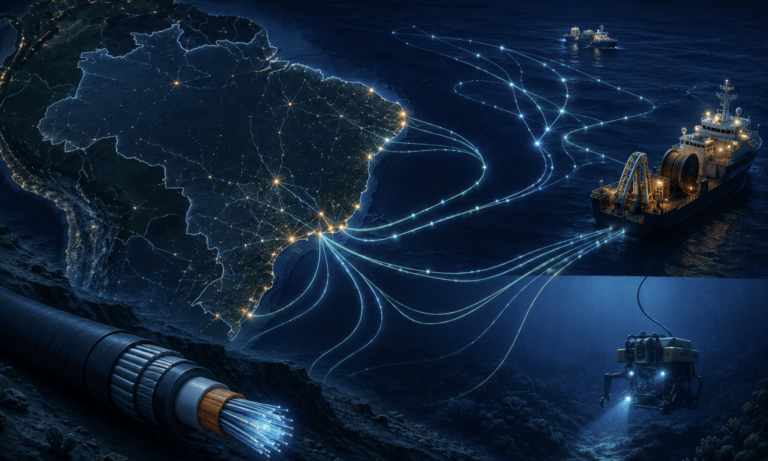
Huawei Marine has been commissioned to construct the Cameroon-Brazil Cable System (CBCS), a 6,000-km undersea network linking Fortaleza (Brazil) and Kribi (Cameroon).
The cable system, which is sponsored by CamTel and China Unicom, will have an initial system capacity of 32 Tbps over 4 fiber pairs. Huawei Marine will deploy its 6fp submarine Repeater 1660, the industry’s first titanium repeater, which boasts a slim-line profile to allow direct lay and plough burial. The cable system is expected to come online in 2017.
Every article published by Converge Digest is researched, curated, fact-checked and editorially reviewed by Jim Carroll, Editor & Publisher. AI-assisted drafting may be used to accelerate production, but all content is reviewed, refined and approved prior to publication.
You just read about Cable. Here is what it replaced:
Open-wire lines served 1880–1980. What ultimately replaced it?
Open-wire lines bare copper conductors bolted to glass insulators on wooden crossarms; wires were periodically transposed (crossed over) to cancel crosstalk and interference. Weather-exposed and very low capacity. Its job passed to Cable — but the problem it solved, and the ideas it proved, live on in what replaced it. The standard rests here in the archive. One of 198 technologies here that opened a door and then held it for the next.

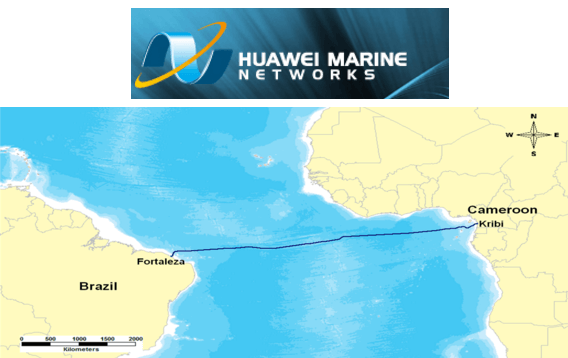
 Huawei Marine has been commissioned to construct the Cameroon-Brazil Cable System (CBCS), a 6,000-km undersea network linking Fortaleza (Brazil) and Kribi (Cameroon).