InPHRED expanded into the data center optical interconnect market, extending its nanoporous semiconductor platform to address ultra-short-reach optical I/O and intra-data-center connectivity for AI infrastructure. The Boston-based company outlined a dual-track strategy spanning chip-level optical interfaces and rack-scale links as hyperscalers push for higher bandwidth density and lower power consumption.
The company’s approach aligns with emerging architectures such as mid-board optics (MBO), near-packaged optics (NPO), and co-packaged optics (CPO), which aim to reduce electrical trace lengths between ASICs and optical engines. InPHRED positions its technology across multiple reach domains, from replacing copper at the shortest distances to enabling single-mode optical links across racks, addressing both signal integrity and thermal constraints in next-generation AI systems.
InPHRED’s roadmap combines GaN-based micro-Resonant Cavity LEDs (μRC-LEDs) for ultra-short-reach optical I/O with 1310 nm InP VCSELs for longer intra-data-center links. The company plans initial demonstrations in Q1 2027 to validate high-density optical engines and scalable architectures that can be integrated closer to compute silicon.
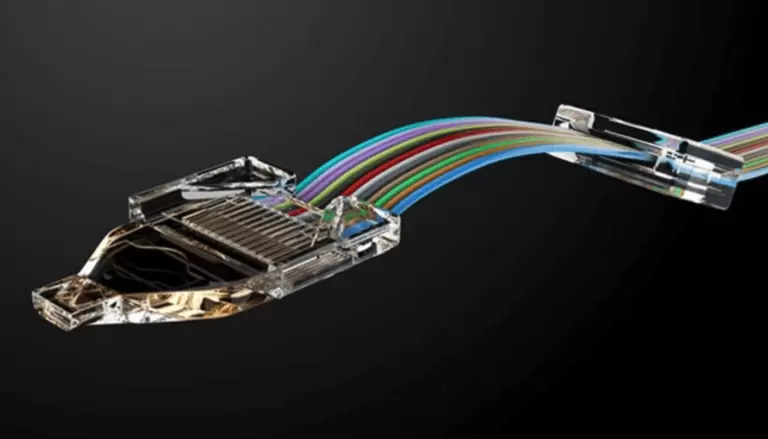
- μRC-LED optical I/O targets chip-to-chip and on-board interconnects, aiming to replace copper with dense optical links positioned near advanced ASIC packages
- Initial μRC-LED demonstration: 200-lane array, 0.3 numerical aperture on sapphire, <3 dB coupling loss, ~4 pJ/bit efficiency
- 1310 nm InP VCSEL roadmap targets single-mode optical engines for MBO/NPO deployments and rack-scale connectivity
- Initial VCSEL demonstration: 32 channels at 50 Gbps per lane (1.6 Tbps aggregate), <2 dB coupling loss per channel
- Thermal targets include operation at 100 °C with a roadmap toward 120–150 °C case temperatures
- Strategy focuses on “wide and slow” architectures to scale channel count while reducing per-lane power and complexity
“As AI systems scale, the challenge is not only how far data must travel optically, but also how far high-speed electrical signals must travel before they become light,” said Professor Jung Han, Chief Scientist and co-founder of InPHRED. “We believe InPHRED is well positioned to address both problems: micro-RC-LEDs for ultra-short-reach optical I/O close to advanced compute packages, and InP VCSELs for efficient single-mode optical engines that can support longer intra-data-center connectivity.”
🌐 Analysis: InPHRED’s entry into data center optics reflects a broader industry shift toward heterogeneous optical interconnect strategies, where no single technology dominates across all reaches. The company’s dual focus on μRC-LEDs and InP VCSELs aligns with parallel efforts from established players and startups exploring CPO, NPO, and alternative light sources to overcome electrical I/O bottlenecks in AI systems.
🌐 Analysis: Recent developments—including aggressive roadmaps for 1.6T optics, external laser source architectures, and co-packaged optics from vendors such as Broadcom, Marvell, and others—highlight the urgency of reducing power per bit and shortening electrical paths. InPHRED’s emphasis on high-temperature operation and simplified coupling could position it as a niche enabler if it meets its 2027 milestones.