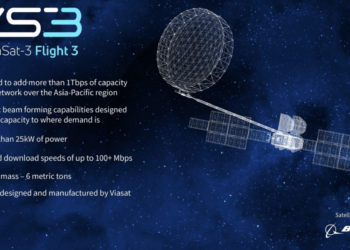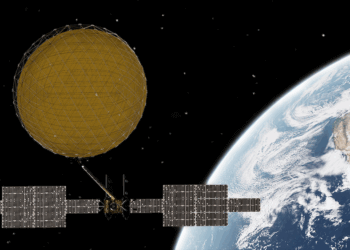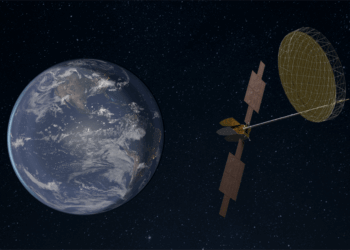
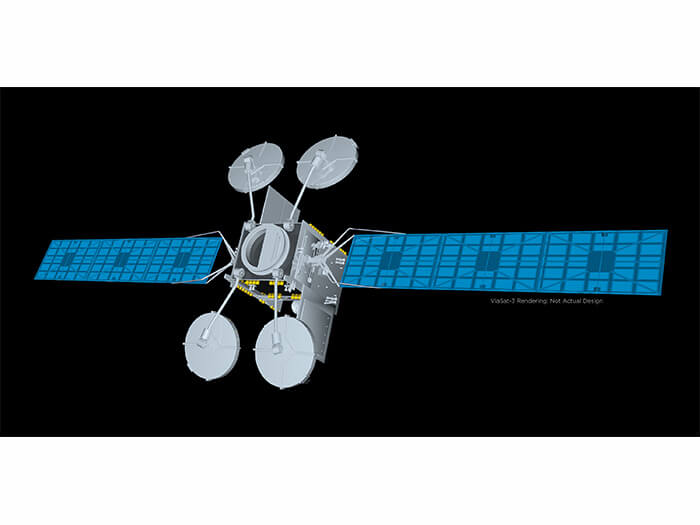
Viasat confirmed plans launch the final satellite in its ViaSat-3 constellation, ViaSat-3 F3, on April 27, 2026, aboard a SpaceX Falcon Heavy from Kennedy Space Center Launch Complex 39A. The satellite targets more than 1 Tbps of capacity over the Asia-Pacific region, completing a global, high-throughput network spanning the Americas, EMEA, and APAC.
The Falcon Heavy launch profile will place ViaSat-3 F3 into a higher-energy transfer orbit, reducing time to geostationary orbit (GEO) where the satellite will use electric propulsion to reach its assigned orbital slot. After several months of orbit-raising and payload validation, Viasat expects the satellite to enter commercial service by late summer 2026. The ViaSat-3 platform is designed to deliver flexible, high-capacity bandwidth across mobility, fixed broadband, and government applications.
ViaSat-3 F3 will finalize the three-satellite constellation, following ViaSat-3 F1, which entered service in 2024, and ViaSat-3 F2, which remains in advanced in-orbit testing. Viasat reported that reflector deployment on F2 has progressed following delays tied to eclipse-season operational constraints, with final deployment steps expected in the coming weeks. The completed constellation introduces enhanced resilience features and supports Viasat’s strategy to evolve toward a lower-mass, multi-orbit, multi-band satellite architecture.
- ViaSat-3 F3 targets >1 Tbps of throughput over Asia-Pacific
- Launch scheduled for April 27, 2026, during an 85-minute window starting at 10:21 a.m. EDT
- Launch vehicle: SpaceX Falcon Heavy from LC-39A, Kennedy Space Center
- GEO insertion via electric propulsion after high-energy transfer orbit
- Commercial service expected by late summer 2026 after in-orbit testing
- Completes global ViaSat-3 constellation (Americas, EMEA, APAC coverage)
- ViaSat-3 F2 reflector deployment nearing completion after eclipse-related delays
- Supports broadband, aviation, maritime, and government communications
“ViaSat-3 F3 will substantially increase capacity that is secure, reliable and highly flexible for customers operating in APAC while delivering greater bandwidth economics,” said Mark Dankberg. “Once ViaSat-3 F3 is in service, the completed ViaSat-3 constellation will become a cornerstone of our unified, global, high-capacity network.”
🌐 Analysis: The completion of the ViaSat-3 constellation marks a critical milestone in the GEO satellite segment, where operators are pushing toward terabit-class throughput to remain competitive with emerging LEO constellations. Viasat’s focus on high-capacity regional satellites contrasts with the distributed architecture of systems such as SpaceXStarlink, reflecting a continued divergence between GEO scale economics and LEO low-latency models.
🌐 Analysis: Viasat’s integration of Inmarsat and its stated move toward multi-orbit, multi-band architectures signal a broader industry shift toward hybrid space networks. Competitors including Eutelsat and SES are similarly blending GEO, MEO, and LEO assets to address enterprise and government demand for resilient, globally managed connectivity.
🌐 We’re tracking the latest developments in satellite and space-based networking. Follow our ongoing coverage at: https://convergedigest.com/category/space/