• Home
  • About
  • Events Calendar
  • Blueprint Guidelines
  • Privacy Policy
  • Manage Email Delivery
  • NextGenInfra.io
No Result
View All Result
Converge Digest
Monday, June 1, 2026
  • Home
  • About
  • Events Calendar
  • Blueprint Guidelines
  • Privacy Policy
  • Manage Email Delivery
  • NextGenInfra.io
No Result
View All Result
Converge Digest
No Result
View All Result

Home » Intel installs ASML’s first High Numerical Aperture EUV system

Intel installs ASML’s first High Numerical Aperture EUV system

April 21, 2024
in Semiconductors
A A

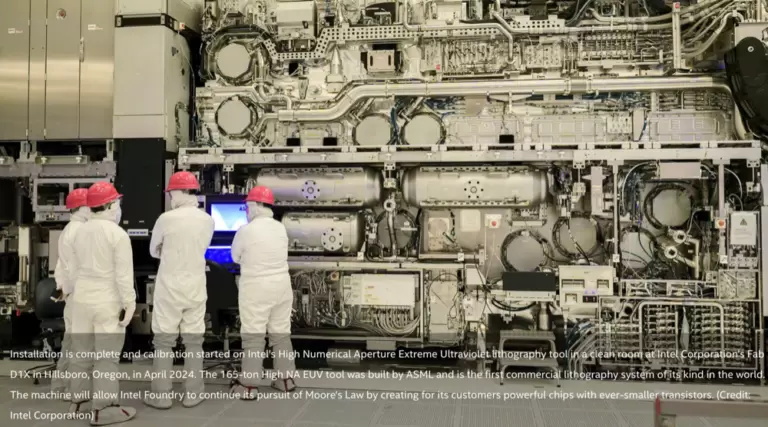
Intel Foundry has received and assembled the industry’s first High Numerical Aperture (High NA) Extreme Ultraviolet (EUV) lithography system, a next-generation lithography system developed by ASML.

The ASML TWINSCAN EXE:5000 High NA EUV tool was installed at the Intel R&D site in Hillsboro, Oregon. It is currently undergoing callibration testing in preparation for production of Intel’s future process roadmap.

Intel says the new tool provides the ability to dramatically improve resolution and feature scaling for the next generation of processors, enabling Intel Foundry to continue process leadership beyond Intel 18A.

ASML recently announced it has printed the first-ever 10 nanometer (nm) dense lines in the High NA lab at the company’s headquarters in Veldhoven, Netherlands. These are the finest lines ever printed, setting a world-record resolution for an EUV lithography scanner. This demonstration validates the innovative High NA EUV optics design from ASML partner Zeiss.

The TWINSCAN EXE:5000 system was transported to Oregon in more than 250 crates inside 43 freight containers. These were loaded onto multiple cargo planes that landed in Seattle. They were then transferred to 20 trucks for the drive to Oregon. The total weight of each new system is more than 150 metric tons.

More About High NA EUV : High NA EUV lithography is an evolutionary step beyond EUV lithography, which uses a wavelength of light (13.5nm) that does not naturally occur on Earth. The light is created by a powerful laser hitting a droplet of tin heated to a temperature of almost 220,000 degrees Celsius — almost 40 times hotter than the average surface temperature of the sun. This light reflects off a mask containing a template of the desired circuit pattern, and then through an optical system built with the most accurate mirrors ever fabricated.

Numerical Aperture (NA) is a measure of the ability to collect and focus light. By changing the design of the optics used to project a pattern onto a wafer, High NA EUV technology enables a significant step forward in resolution and transistor size. The ability to create transistors at these smaller dimensions also requires new transistor structures and improvements in other process steps that Intel is developing in parallel to the integration of the first High NA EUV system.

Source: Intel
Tags: IntelIntel Foundry Services
ShareTweetShareSummarizeSummarize
Previous Post

Oracle plans big cloud infrastructure expansion in Japan

Next Post

Cisco Steps Up in AI Security Battle with Hypershield

Jim Carroll

Jim Carroll

Editor and Publisher, Converge! Network Digest, Optical Networks Daily - Covering the full stack of network convergence from Silicon Valley

Related Posts

Financials

Intel Appoints Client Computing Chief and CTO

May 4, 2026
All

Intel Q1 2026: AI Drives 22% Data Center Growth, Foundry Revenue Up

April 23, 2026
Semiconductors

Intel, Google Expand AI Infrastructure Pact Around Xeon and Custom IPUs

April 9, 2026
AI Infrastructure

SambaNova and Intel Advance Heterogeneous Architecture for Agentic AI Inference

April 8, 2026
Semiconductors

Intel Foundry Demos 19 μm GaN Chiplet with Integrated Logic 

April 8, 2026
All

Intel Confirms Role in Terafab Initiative

April 7, 2026
Next Post

Cignal AI: the 800 GbE optical market is ramping up fast

Categories

  • 5G / 6G / Wi-Fi
  • AI Infrastructure
  • All
  • Automotive Networking
  • Blueprints
  • Clouds and Carriers
  • Data Centers
  • Enterprise
  • Explainer
  • Feature
  • Financials
  • Last Mile / Middle Mile
  • Legal / Regulatory
  • Optical
  • Quantum
  • Research
  • Security
  • Semiconductors
  • Space
  • Start-ups
  • Subsea
  • Sustainability
  • Video
  • Webinars

Archives

Tags

5G All AT&T Australia AWS Blueprint columns BroadbandWireless Broadcom China Ciena Cisco Data Centers Dell'Oro Ericsson FCC Financial Financials Huawei Infinera Intel Japan Juniper Last Mile Last Mille LTE Mergers and Acquisitions Mobile NFV Nokia Optical Packet Systems PacketVoice People Regulatory Satellite SDN Service Providers Silicon Silicon Valley StandardsWatch Storage TTP UK Verizon Wi-Fi
Converge Digest

A private dossier for networking and telecoms

Follow Us

  • Home
  • About
  • Events Calendar
  • Blueprint Guidelines
  • Privacy Policy
  • Manage Email Delivery
  • NextGenInfra.io

© 2026 Converge Digest - A private dossier for networking and telecoms.

No Result
View All Result
  • Home
  • About
  • Events Calendar
  • Blueprint Guidelines
  • Privacy Policy
  • Manage Email Delivery
  • NextGenInfra.io

© 2026 Converge Digest - A private dossier for networking and telecoms.

This website uses cookies. By continuing to use this website you are giving consent to cookies being used. Visit our Privacy and Cookie Policy.
Go to mobile version