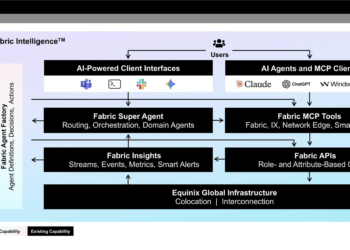

Intel is making a major push into AI infrastructure with a new rack-scale architecture designed specifically for inference and agentic AI workloads. Announced at Computex 2026 in partnership with SambaNova and Foxconn, the platform combines Intel Xeon processors, SambaNova’s SN-50 Reconfigurable Dataflow Units (RDUs), and Foxconn’s system integration capabilities into a production-ready AI rack targeting hyperscalers, enterprises, and emerging AI factories. The announcement signals Intel’s effort to reposition the CPU as a central component of large-scale AI deployments as inference demand begins to outpace model training.
The architecture reflects a growing industry shift: agentic AI places significantly higher demands on CPUs for orchestration, scheduling, memory management, data movement, and the execution of non-matrix workloads. Intel cited an infrastructure evolution moving from a training-centric phase (where approximately one CPU supports four GPUs) toward an inference-centric model approaching a 1:1 ratio of CPUs to accelerators as agentic workloads scale. The new rack design emphasizes performance-per-watt and performance-per-dollar rather than maximizing raw training throughput.
Disaggregated Inference in the Enterprise Cloud
Intel also demonstrated a fully disaggregated inference architecture through Vector Core Compute, a new purpose-built enterprise inference cloud backed by Vista Equity Partners and Cambium Capital.
In a live demonstration executing the MiniMax 2.5 model, the workload was split dynamically across completely different silicon architectures to optimize specific stages of the AI pipeline:
Orchestration & Execution: Handled by Intel Xeon 6 processors.
Decode Processing: Executed by SambaNova SN40 RDUs.
Prefill Operations: Powered by NVIDIA Blackwell GPUs.
This represents one of the first public deployments of a production inference pipeline distributed fluidly across heterogeneous processor types, with Together.ai signed on as the first commercial customer running workloads on the platform.
Announcement Highlights at a Glance
Rack-Scale Infrastructure: Intel, SambaNova, and Foxconn partnered for production-ready, rack-scale AI infrastructure optimized for inference and agentic AI deployments.
Foxconn Integration: Foxconn will provide end-to-end systems integration, manufacturing, and deployment, including a planned CPU-dense variant tailored for cost-optimized inference, data processing, and hybrid AI.
Next-Gen Data Center Silicon: Intel launched the Intel Xeon 6+ processors (formerly code-named Clearwater Forest), marking the architecture’s first deployment of the Intel 18A process node in the data center.
Extreme Density: Built for high parallelism, a single liquid-cooled rack can support up to 36,864 Xeon 6+ cores in a dense compute configuration designed to maximize AI agent concurrency within an approximate 100 kW rack power envelope.
“For more than five decades, Intel, its ecosystem partners, and Taiwan have brought the world the foundational technologies for the PC, Internet, and now AI eras,” said Lip-Bu Tan, CEO of Intel. “Today, with the rise of inference, agentic, and physical AI, Intel is poised to bring the world new innovations from the chip to systems level that promise to transform industry and society for the better.”
🌐 Analysis: The significance of this announcement is not the individual processor launch but Intel’s attempt to define a complete AI rack architecture. NVIDIA has successfully expanded from GPUs into full-stack AI infrastructure through DGX, NVL72, and AI factory designs. Intel is now pursuing a similar strategy by positioning Xeon as the orchestration layer for AI inference while partnering with specialized accelerator vendors rather than relying solely on its own silicon portfolio. The collaboration with SambaNova gives Intel access to a mature inference accelerator architecture without waiting for internally developed alternatives.
🌐 Analysis: The focus on inference is particularly important. Industry spending is increasingly shifting from model training toward production AI deployments, where power consumption, utilization, latency, and total cost of ownership become critical metrics. Intel’s emphasis on CPU density, rack-scale integration, and disaggregated inference suggests the company sees an opportunity to capture infrastructure spending in AI factories that may not require thousands of training GPUs but still need large-scale orchestration and inference capacity. If successful, the strategy could re-establish Xeon as a critical building block of next-generation AI infrastructure even as GPUs continue to dominate training workloads.
| SambaNova Systems Profile | |
|---|---|
| Company | SambaNova Systems |
| Founded | 2017 |
| Headquarters | Palo Alto, California, USA |
| Founders | Rodrigo Liang, Kunle Olukotun, Christopher Ré |
| CEO | Rodrigo Liang |
| Core Technology | Reconfigurable Dataflow Architecture (RDU) for AI training and inference |
| Flagship Products | SN40 and SN50 RDU-based AI platforms; SambaNova Cloud services |
| Primary Focus | Large-scale AI inference, generative AI, agentic workflows, and enterprise AI factories |
| Architecture Approach | Dataflow computing optimized for highly efficient execution of large AI models with minimized memory movement |
| Target Markets | Hyperscalers, cloud providers, Tier-2 AI clouds, enterprises, and sovereign governments |
| Notable Partners | Intel, Foxconn, Together.ai, Oracle, and SoftBank |
| Funding | More than $1.1 billion raised from investors including SoftBank Vision Fund 2, BlackRock, Intel Capital, Google Ventures, and Temasek |
| Market Positioning | High-efficiency alternative to traditional GPU clusters, focused tightly on production inference performance and lower TCO |